


9 Questions to Ask Before Choosing an API Management Platform

Quick Answer: What is an API management platform?
An API management platform helps teams design, secure, publish, govern, monitor, and monetize APIs across their lifecycle and runtime environments.
Core parts of an API management platform:
- API gateway: Routes, secures, and controls API traffic at runtime.
- API lifecycle management: Manages APIs from design and build through versioning, retirement, and reuse.
- Traffic management: Controls routing, throttling, retries, caching, failover, and availability patterns for API traffic.
- API security and policy engine: Applies authentication, authorization, threat protection, quotas, and reusable security policies.
- Developer portal: Provides developers with a self-service platform for finding, testing, subscribing to, and consuming APIs.
- API catalog: Creates a searchable inventory of APIs, owners, versions, policies, and documentation.
- API governance: Enforces standards, security rules, approval flows, and compliance checks across teams.
- API analytics: Tracks usage, performance, errors, adoption, and consumer behavior.
- API monetization: Supports plans, subscriptions, metering, usage reporting, and revenue or chargeback workflows.
- Versioning and change management: Helps teams manage releases, deprecation, breaking changes, and consumer migration.
Below, we look beyond just the feature checklist and show how to ask the right questions before choosing an API management vendor.
Why are feature checklists the wrong starting point?
Choosing an API management platform requires a methodical evaluation process before feature comparisons begin. Start with the operating problem, architecture constraints, governance model, developer workflow, scale assumptions, and migration risk; then compare features against those requirements.
Doing this will clarify what the platform must prove before your procurement team starts comparing vendor claims. The above step is crucial because every stakeholder who is looking for an API management platform in your organization is looking for a solution to solve their own challenges.
Security teams may judge the platform by policy enforcement, architects by deployment flexibility, developers by self-service access, and finance by pricing predictability.
A methodical evaluation turns those competing concerns into a shared buying lens before the team starts comparing feature claims.
The strongest evaluations answer these questions in order before moving on to feature checklists
- What problem should the platform solve first: security, governance, scale, developer experience, monetization, or modernization?
- Is the organization buying runtime traffic control, or a full API management platform with lifecycle governance?
- Can the platform manage APIs where they already run: cloud, multi-cloud, on-prem, partner, and legacy environments?
- How will pricing behave when APIs, consumers, traffic, regions, and agent traffic grow?
- Can governance happen during design and review, before weak APIs reach production?
- Can developers discover, evaluate, request access to, and reuse APIs without relying on internal tickets?
- Can policy be enforced consistently without turning central teams into bottlenecks?
- Can AI agents and MCP-based consumption be governed with identity, scope, policy, and analytics?
- What happens if the organization needs to migrate away later?
Feature checklists are a weak first step because most API management tools now claim the same surface area: gateway, developer portal, analytics, security policy, and API catalog. The real decision is how those parts behave under your architecture, team model, traffic growth, and governance requirements.
An API management platform that looks strong in a demo can still disappoint six months later if:
- Pricing rises with API calls, APIs, regions, or support tiers
- Developer portal workflows stay disconnected from the gateway policy
- OpenAPI standards exist, but policy enforcement happens manually
- Hybrid cloud and legacy modernization require separate tools
- OAuth, JWT, mTLS, and rate limiting are hard to govern consistently
- Migrating away from the platform requires proxy rewrites and policy rework
Use the questions below as a buyer-question checklist before comparing any API management software.
What problem are we solving first?
You need to name the first-order problem before choosing an API management platform: security, governance, scale, developer experience, monetization, or legacy modernization. Each priority changes the best-fit platform.
Problem-first evaluation checklist
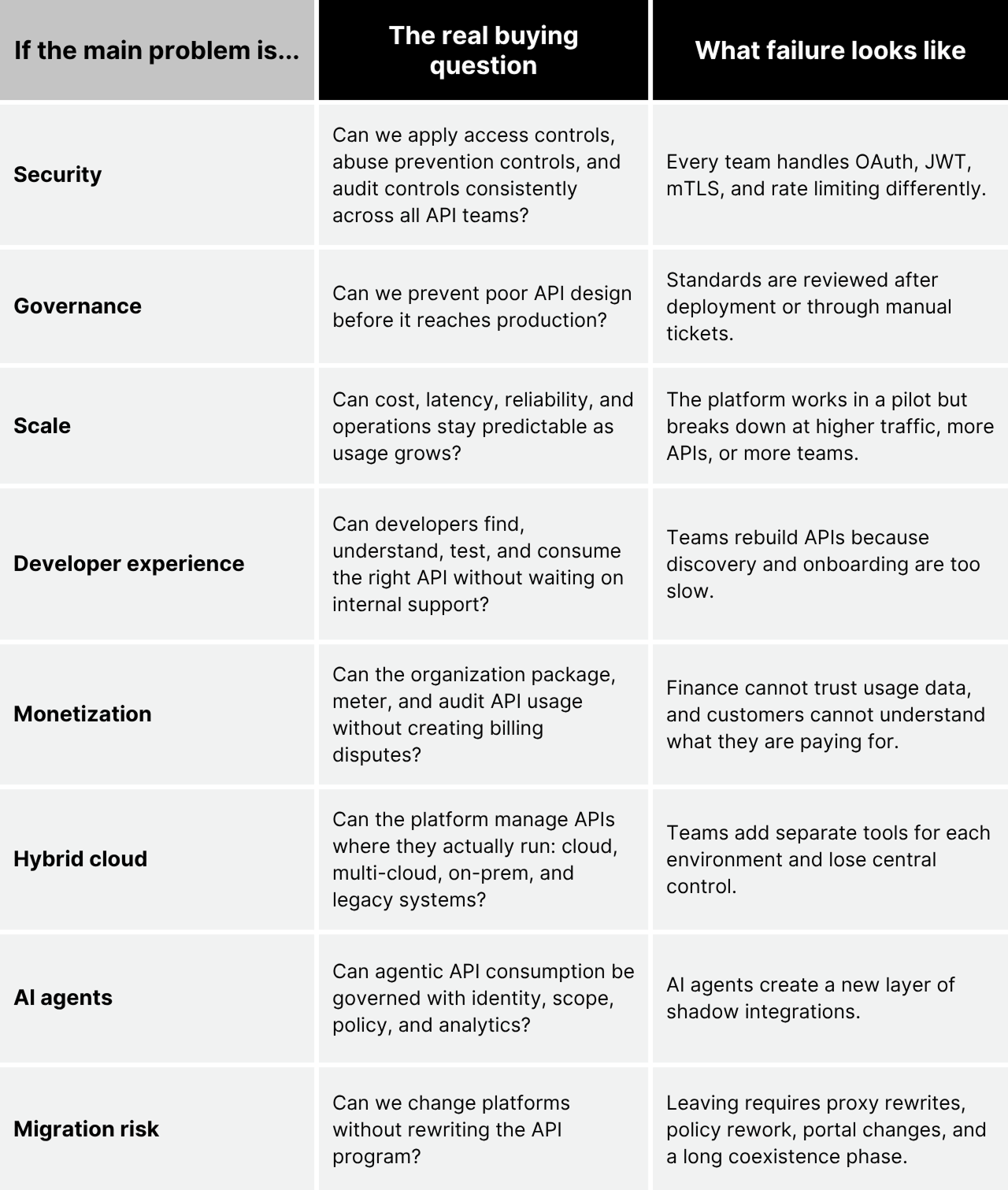
If every stakeholder defines the first problem differently, pause the vendor process. Finance may care about consumption risk; architects may care about hybrid cloud; developers may care about onboarding speed; and security may care about access control and auditability. The platform decision has to reconcile those needs before the feature comparison begins.
Is the API management platform gateway-agnostic?
Many enterprises already have APIs running behind different gateways, cloud services, partner networks, and legacy systems. The buying question is whether the API management platform can manage that reality, or whether it only delivers governance, cataloging, analytics, and developer experience after teams move traffic onto the vendor's own gateway.
Ask vendors to show:
- Can the platform discover and catalog APIs already running on other gateways?
- Can governance rules apply to APIs that remain on existing gateways?
- Can ownership, documentation, and lifecycle status be managed independently of the gateway runtime?
- Can API analytics include APIs that are not routed through the vendor's gateway?
- Can teams keep existing gateways where they make sense?
- What capabilities are unavailable unless traffic moves to the vendor's gateway?
- Gateway standardization can be useful when it is a deliberate architecture choice. It becomes a risk when it is the price of getting visibility, governance, or developer experience.
The practical test: pick an API that already runs behind a different gateway, ask the vendor to catalog it, apply governance metadata, connect documentation, show ownership, and report usage, all without moving traffic to the vendor's gateway. If the platform cannot deliver value until traffic is moved, the evaluation should include migration cost, team disruption, and long-term lock-in.
Can it manage APIs across cloud, hybrid, and legacy environments?
An API management platform has to match where your APIs run: public cloud, private cloud, on-prem systems, partner networks, and older enterprise applications. Hybrid cloud and multi-cloud support is not a checkbox; it is an operating model.
Ask vendors to show:
- Control plane and data plane separation
- Self-hosted or federated gateway support
- Gateway connectors for existing runtimes
- Private, regional, or on-prem traffic paths for regulated APIs
- Support for exposing legacy systems through APIs
- Multi-region failure behavior
The practical test: ask for a demo using one cloud API, one legacy service, one partner-facing API, and one API already sitting behind a different gateway. If the product story weakens outside a clean cloud-native example, the platform may increase operational sprawl instead of reducing it.
How painful will pricing become at scale?
Pricing becomes painful when the billing unit does not match the way your API program grows. API management costs can rise with the number of users, calls, APIs, gateways, environments, regions, premium plugins, support levels, or advanced analytics.
Ask for a pricing model against three real usage scenarios:
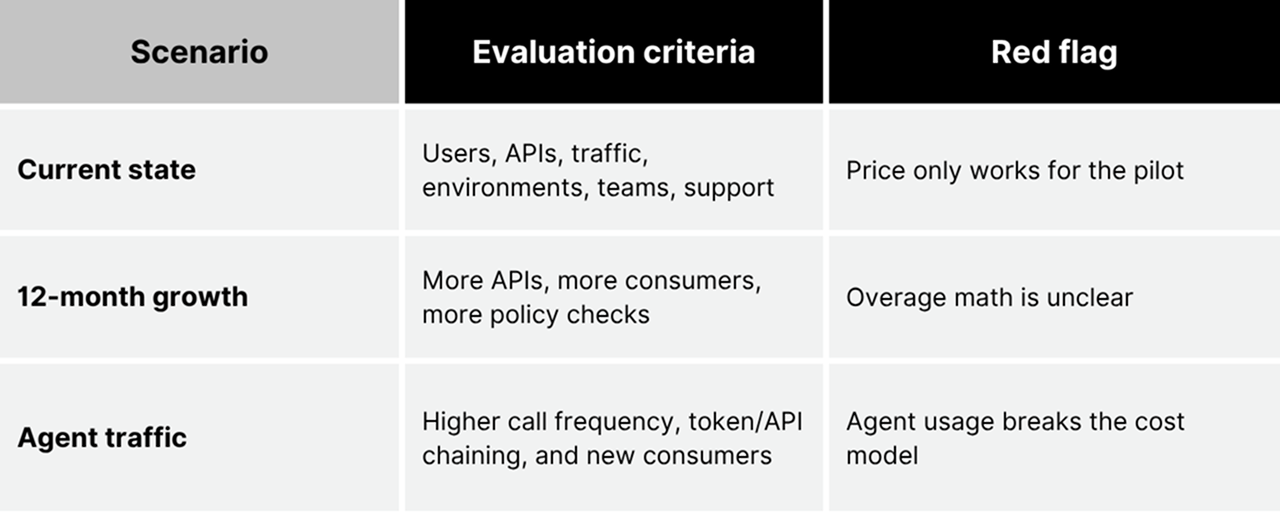
When talking to vendors about pricing, ask questions that expose how the commercial model behaves after the pilot:
- What are the exact pricing tiers, usage limits, and overage triggers?
- What would pricing look like if API traffic grew 10x?
- Which fees are platform fees, and which are support, implementation, hosting, or premium-feature fees?
- Which policies, plugins, analytics, environments, or regions move the account into a higher tier?
- How are agent calls, internal traffic, partner traffic, and test traffic counted?
- What happens commercially during upgrades, migrations, or parallel-run phases?
The goal is not to find the cheapest tool. The goal is to avoid a platform that becomes financially hostile exactly when your API program succeeds.
Does it support lifecycle governance or only runtime traffic?
Lifecycle governance means API standards are applied before production, not only after traffic reaches the gateway. Runtime control is necessary, but it is late in the process.
Strong API lifecycle management covers:
- Design standards
- OpenAPI validation
- API review workflows
- Security and compliance checks
- Versioning rules
- Deprecation policy
- Ownership and metadata
- Deployment approvals
- Runtime policy enforcement
Runtime-only management catches problems at the edge. Lifecycle governance catches them when the API is designed, documented, reviewed, and prepared for reuse. That is the difference between blocking bad traffic and preventing poor API design from becoming production debt.
Ask the vendor to show an API moving from a draft OpenAPI spec to an approved API product, to gateway deployment, to developer portal publication. If governance disappears between those steps, your team will rebuild it with tickets, spreadsheets, and meetings.
Can teams discover and reuse existing APIs?
Teams can reuse APIs only when the platform provides a searchable API catalog that includes ownership, documentation, lifecycle status, policies, and subscription paths. A developer portal that lists only published external APIs is not sufficient for enterprise reuse.
Look for:
- Internal and external API cataloging
- Auto-discovery of documented and undocumented APIs
- OpenAPI, AsyncAPI, and metadata search
- Ownership and domain tagging
- Version and deprecation status
- Consumer usage analytics
- Self-service subscription and access requests
- Sandbox or mock testing
This is where many gateway-led deployments stall. The gateway knows what traffic exists, but developers cannot easily find the right API, compare versions, request access, or understand ownership. API sprawl then continues, because creating a new API feels faster than finding and reusing an existing one.
APIwiz's API marketplace and monetization workflows and API observability layer are built around that discovery and reuse problem: catalog what exists, expose it with usable context, and connect consumption back to analytics.
How well does it enforce policy without slowing teams down?
Good API governance enforces policy through reusable templates, automated checks, and delegated ownership. Bad governance slows teams by turning every API change into a central review queue.
Policy enforcement has to cover:
- OAuth and OIDC patterns
- JWT validation
- mTLS requirements
- Rate limiting and quota rules
- Data exposure controls
- Header and payload standards
- Logging and analytics requirements
- Approval and exception workflows
The buyer test is simple: ask the vendor to create a new API, apply a security baseline, publish documentation, request access from the developer portal, and show the resulting gateway policy. Then ask what changes when one team needs an approved exception.
Strong platforms enable central teams to define policy guardrails while domain teams retain delivery ownership. That balance matters for regulated industries, where security teams need proof without becoming a bottleneck.
APIwiz's API security controls and API documentation workflows support this kind of federated governance: standards, linting, policy templates, and compliance checks across the API lifecycle.
Is it ready for AI agents and agentic API consumption?
An API management platform is agent-ready when agents can discover approved APIs, authenticate with scoped identity, call APIs through policy, and leave an auditable usage trail. Agentic AI changes consumption patterns because a single user intent can trigger many API calls across systems.
AI agents make these questions urgent:
- Which APIs are safe for agent access?
- How does an agent discover approved tools or APIs?
- Can access be scoped by task, user, role, tenant, or data class?
- Can the platform enforce OAuth, JWT, mTLS, and rate limiting for agents?
- Can MCP servers and APIs be published through governed catalogs?
- Can analytics separate human, app, partner, and agent traffic?
- Can teams quickly revoke or rotate agent access?
MCP matters because it gives AI agents a standard way to connect to tools and data sources. But MCP without API governance creates a new shadow integration problem. Buyers need to evaluate whether vendors treat AI agents as a new tab in a portal or as a governed API consumer class with identity, policy, catalog, analytics, and lifecycle controls.
The buying question is not "Does the vendor mention AI?" It is "Can the platform govern agentic API consumption with the same rigor as human and application consumption?"
What does migration or adoption look like?
Migration and adoption risk both matter. A platform should be easy to introduce without requiring a major replacement project, and it should provide teams with a practical way to export or move critical API assets later.
Some API management platforms require heavy setup before they deliver value. But platforms like APIwiz can start by discovering, cataloging, governing, and observing the APIs and tools already in place.
Ask vendors to show:
- Which capabilities work with existing APIs, documentation, policies, and developer workflows
- What has to be imported, rebuilt, or changed before the platform delivers value
- OpenAPI import and export support
- API proxy, route, and policy import/export
- Config-as-code support
- Gateway-independent catalog and ownership data
- Documentation and developer portal content portability
- Analytics, audit log, and subscription history export
- Parallel-run and rollback plan if adoption stalls
- Contract terms for transition, coexistence, and post-exit support
Community threads about API management migrations often point to the same operational risks: coexistence phases, upgrade downtime, pricing pressure, support delays, and policy rework. Treat those stories as test cases. Ask each vendor to walk through a real adoption path and a real exit path, not only a fresh installation.
The strongest answer includes both adoption flexibility and technical portability. If adopting the platform requires a major replacement project, or leaving requires teams to rebuild API proxies, policies, documentation, and access workflows, the platform is not just managing APIs; it is becoming a long-term architecture constraint.
How does APIwiz check the boxes for API management platform selection?
The nine questions above point to a larger requirement: enterprises need API management that works across teams, gateways, clouds, and lifecycle stages. APIwiz checks those boxes by giving platform teams a single place to discover, govern, secure, monitor, and distribute APIs without forcing every API into a single gateway runtime.
Here’s how APIwiz maps to the buyer questions
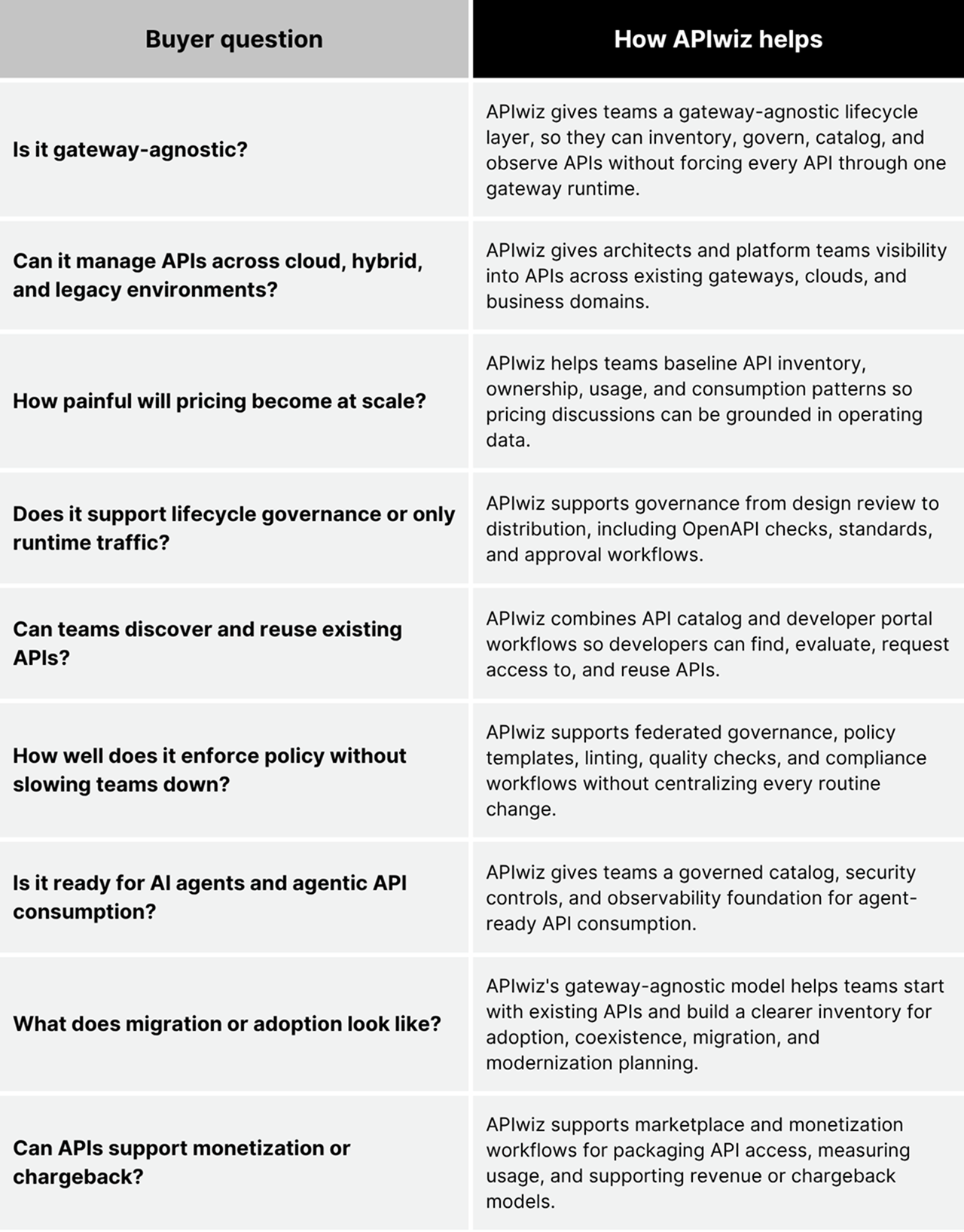
That makes APIwiz a fit for teams whose buying question goes beyond "Which API gateway?" It is meant for organizations that need central control, domain-team autonomy, and a governed path from API design to consumption.
What should the final shortlist look like?
A strong API management platform shortlist should show how many of the nine buyer questions each vendor satisfies, and whether any answer creates an unacceptable risk. Not every question carries the same weight: a weak monetization workflow may be tolerable for an internal API program, but weak security, unclear pricing, or no migration path can break the business case.
Use this scoring model after the demo and proof-of-concept:
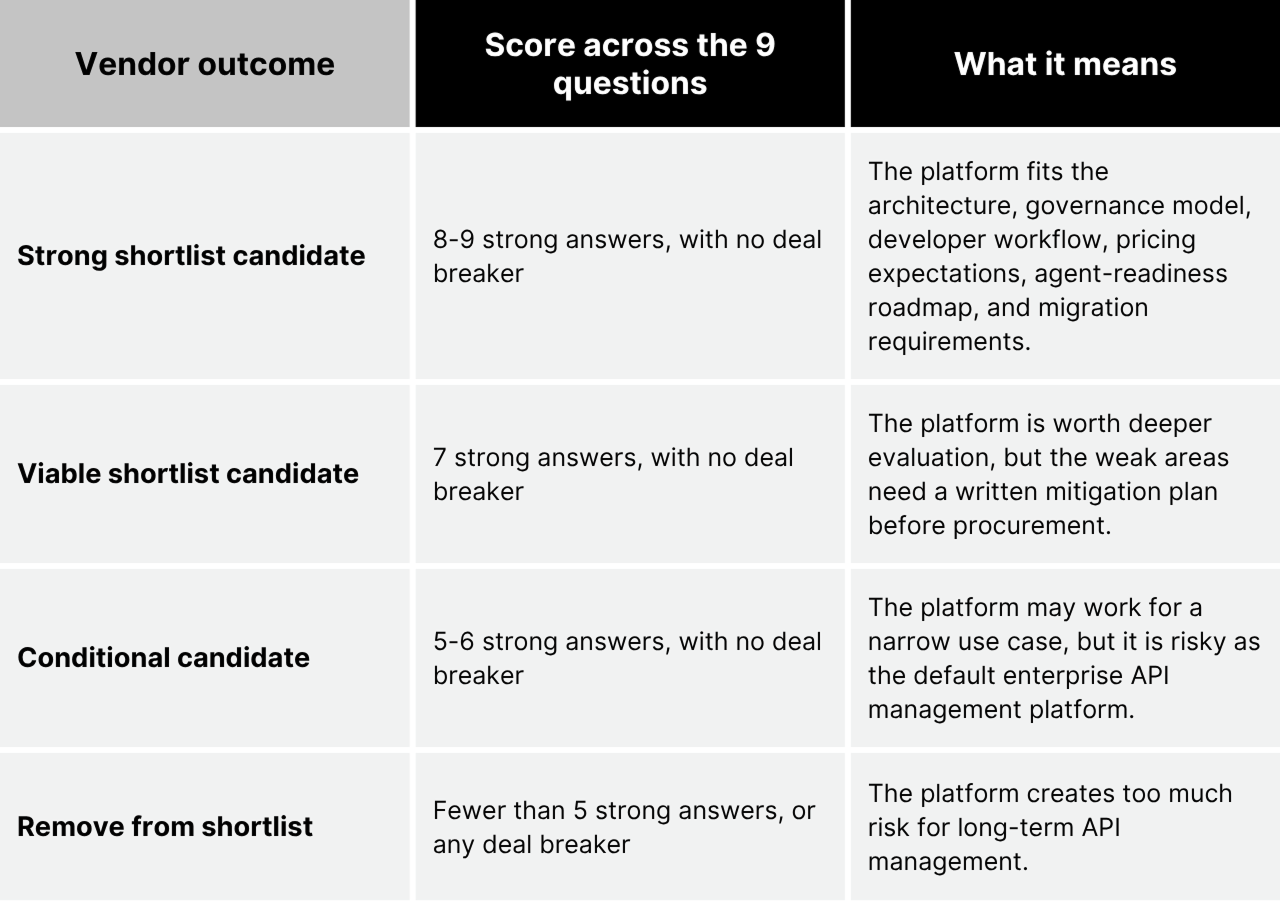
Treat these answers as absolute deal breakers:
- No clear support for OAuth, JWT, mTLS, rate limiting, and policy audit
- No credible hybrid cloud, multi-cloud, or legacy modernization path when those environments matter
- Pricing that cannot be modeled at current usage, 12-month growth, and agent traffic levels
- Runtime-only control with no lifecycle governance, OpenAPI quality checks, or review workflow
- Weak API catalog or developer portal that prevents discovery, reuse, and self-service access
- Policy enforcement that depends on manual central team review for routine changes
- No plan for AI agents, agentic AI consumption, MCP, scoped access, and agent traffic analytics
- No credible migration path, export model, or parallel-run strategy
The right API management platform is the one that answers enough of the nine questions and avoids deal-breakers that would make it expensive, restrictive, or hard to leave.
FAQs
What are API management platforms?
API management platforms are software systems for controlling the full API lifecycle, from design and publication to security, analytics, governance, and monetization. They often include an API gateway, developer portal, API catalog, policy engine, and analytics layer. The best fit depends on architecture, scale, governance needs, and developer workflow.
What is an API platform?
An API platform is the broader operating layer for building, exposing, consuming, and governing APIs. It may include API management, integration, developer experience, testing, observability, and monetization capabilities. An API management platform is usually a core part of an API platform, but not always the whole platform.
What is API management?
API management is the practice of securing, publishing, monitoring, governing, and controlling APIs for internal, partner, and external consumption. It includes gateway controls such as authentication, authorization, rate limiting, and routing.
It also includes lifecycle work such as API design, documentation, cataloging, versioning, analytics, and access management.
How do you choose an API management platform?
Choose an API management platform by starting with your first-order problem, then validating architecture, governance, developer experience, pricing, agent readiness, and migration risk. Run vendors through the same hands-on workflow rather than relying solely on feature matrices.
Use must-have, trade-off, and disqualifier buckets to keep the shortlist honest.
What's the difference between an API gateway and an API platform?
An API gateway controls runtime traffic, while an API platform manages the broader API lifecycle and consumption model. A gateway handles routing, authentication, rate limiting, and traffic policies. A platform adds API design, cataloging, developer portals, governance, analytics, monetization, and lifecycle workflows.
What should you ask before buying API management software?
Ask what problem the platform solves first, whether it is a gateway or full platform, how it handles hybrid cloud, how pricing scales, how governance works, how teams discover APIs, how policy is enforced, whether it supports AI agents and MCP, and how migration works. These questions reveal operating fit better than a generic feature list.
How do you manage APIs for AI agents?
Manage APIs for AI agents by treating agents as governed API consumers with identity, scoped access, approved API discovery, policy enforcement, and analytics. Publish only approved APIs or MCP servers through a governed catalog. Enforce OAuth, JWT, mTLS, rate limits, and audit logging so agentic AI traffic remains traceable and controlled.
Related reads
- API Management Goes Beyond the API Gateway
- Your API Gateway Is Lying To You
- Hidden Cost Of API Sprawl
- How APIwiz Solves API Observability
- What Is API Observability
- API Observability In The Age Of AI
- How Healthy Is Your API Program
- APIwiz Design
Effortless API Management at scale.
Support existing investments & retain context across runtimes.
.webp)
Effortless API Management at scale.
Support existing investments & retain context across runtimes.