

What Is API Observability? Enterprise Guide 2026

What is API observability?
API observability is the practice of collecting, correlating, and analyzing telemetry data — logs, metrics, and traces — to understand the internal state, health, and business impact of APIs in real time across an enterprise ecosystem.
Key aspects of API observability:
- Real-time latency, error, and traffic monitoring
- Distributed tracing across microservices and gateways
- Automated anomaly detection and alerting
- API cost tracking and usage attribution
- Security threat visibility and compliance reporting
Below, we explore why API observability matters for enterprise leaders, how it differs from monitoring, what it looks like from the CIO, CFO, and security leader's perspective, and how APIwiz approaches it.
Why does API observability matter for enterprises?
API observability matters because, without it, enterprises operate blind. They won’t be able to determine which APIs are healthy, which are draining budgets, and which are exposing the organization to security and compliance risk.
The scale of the problem is staggering. Enterprises now manage thousands of APIs, yet less than 50% are actively managed, according to Gartner. API-related security incidents cost enterprises up to $186 billion annually in breaches, compliance failures, and reputational damage (Imperva/Thales). According to a security report by Salt, 80% of organizations lack continuous, real-time API monitoring, and 33% of organizations have suffered an API incident in the past year.
What's at stake without observability:
- Undetected outages cascading across dependent services
- Zombie APIs consuming cloud resources with zero business value
- Shadow APIs bypassing security controls and regulatory requirements
- No ability to attribute API costs to specific teams, products, or revenue streams
The global observability market is projected to grow from 28.5 billion in 2025 to 172.1 billion by 2035 (Research Nester), reflecting the urgency enterprises feel about visibility into their digital infrastructure.
How does API observability differ from API monitoring?
API monitoring tells you what happened — uptime, response codes, error rates. API observability tells you why it happened — root causes, dependencies, behavioral patterns, and business context.
.png)
Enterprises need both. Monitoring catches the symptom. Observability diagnoses the disease. In a landscape where 31% of organizations run multiple API gateways (Postman 2025), monitoring each one separately creates blind spots. Observability unifies the view across every gateway, every cloud, every service mesh.
What are the three pillars of API observability?
The three pillars of API observability are logs, metrics, and traces. Together, they provide the telemetry data needed to understand API behavior, diagnose issues, and optimize performance across distributed systems.
.png)
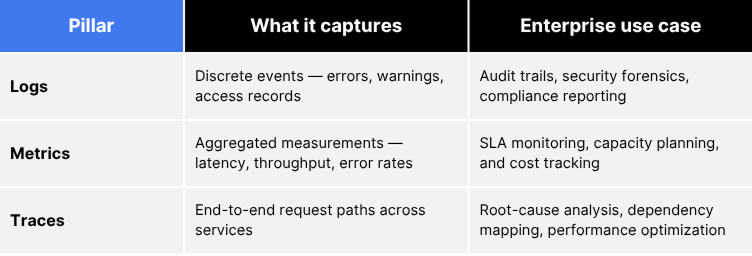
Why all three matter together:
- Logs without traces make root-cause analysis guesswork
- Metrics without logs hide the context behind anomalies
- Traces without metrics can't quantify business impact
What does API observability look like from the CIO's perspective?
For the CIO, API observability is a governance imperative. Without it, there's no way to enforce standards, ensure security, or manage risk across an API ecosystem that grows faster than any team can keep track of manually.
The CIO's blind spots without observability:
- No centralized inventory of APIs across teams, clouds, and gateways
- No visibility into which APIs comply with organizational standards
- No way to detect shadow APIs created outside official security protocols
- No ability to measure developer productivity or API reuse
What observability gives the CIO:
- Single-pane visibility across every API, every gateway, every cloud
- Automated enforcement of design standards and security policies
- Real-time compliance dashboards for regulatory reporting (GDPR, PCI DSS 4.0, EU DORA)
What does the CFO need to know about API observability?
For the CFO, API observability functions as a cost-control tool. Without it, unseen APIs drain budgets, duplicate work increases expenses, and the enterprise can't identify which APIs generate revenue or use the most resources.
The hidden cost problem:
- Zombie APIs — deprecated but still active — consuming cloud compute, storage, and egress with zero business value
- Duplicate APIs built by siloed teams are doubling development and maintenance costs
- The true cost of observability tools is often 3-7x the advertised per-GB rate when compute, egress, and operational overhead are factored in
- 75% of developers lose 6-15 hours weekly to fragmented workflows across an average of 7.4 tools, costing mid-size enterprises nearly $1M/year in lost productivity
The revenue visibility gap:
- No attribution of API traffic to specific revenue streams or customer segments
- No identification of underperforming APIs relative to their infrastructure cost
- No cost-per-call tracking across multi-cloud, multi-gateway environments
What observability gives the CFO:
- Usage-based cost attribution per API, per team, per business unit
- Identification and retirement of zombie APIs draining the budget
- ROI visibility: which APIs drive revenue, which are pure cost
Why is API observability critical for security leaders?
For security leaders, API observability is the difference between reacting to a breach after the damage is done and catching the threat as it unfolds. Without it, incident response becomes a guessing game where teams scramble to reconstruct what happened, which APIs were involved, and how far the blast radius extends, all while the clock ticks.
The threat landscape makes this urgency real. APIs are now the #1 attack vector for enterprise web applications (Gartner), and the OWASP API Security Top 10 (2023) lists Broken Object Level Authorization as the most exploited vulnerability.
High-profile breaches at T-Mobile (37M records) and Optus (10M accounts) didn't result from sophisticated zero-days. They resulted from basic API misconfigurations that went undetected because no one was watching the right signals. And shadow APIs, sitting outside the security team's field of vision, only widen exposure. Gartner reports that unmanaged APIs cause breaches that exceed the magnitude of other breach types.
What this looks like during an incident without observability:
An anomalous spike hits an API endpoint at 2 a.m. Without observability, the security team is pulling logs from multiple gateways, manually cross-referencing timestamps, and trying to trace a request path across microservices without a unified view. By the time they piece together the story, the attacker has moved laterally, exfiltrated data, or disappeared, and the team still isn't sure which other APIs were affected.
What observability changes about incident response:
With full API observability, the same scenario plays out differently.
Distributed tracing shows the exact request path: which endpoint was hit, which downstream services were touched, and where the authorization check failed. Real-time anomaly detection flags the spike before it escalates. Automated discovery has already cataloged every shadow and zombie API in the environment, so the team knows the full attack surface without having to hunt for it.
The incident goes from a multi-day forensic exercise to a contained, traceable event with a clear remediation path. Detection is faster, response is faster, and behavioral baselines reveal credential stuffing, enumeration attacks, and exfiltration attempts that point-in-time monitoring would miss entirely.
What are the business outcomes of API observability?
Organizations with mature observability practices report faster incident resolution, lower infrastructure costs, improved compliance posture, and measurable revenue attribution from their API programs.
The shift is already underway. An Elastic/Dimensional Research survey found that 60% of organizations now characterize their observability practices as mature or expert, up from 41% the prior year. The Dynatrace State of Observability 2025 report confirms the trend: 70% of CIOs and CTOs say observability budgets increased in the past year, and a majority plan to increase them again. This isn't a speculative investment, but a response to measurable returns.
What mature observability enables:
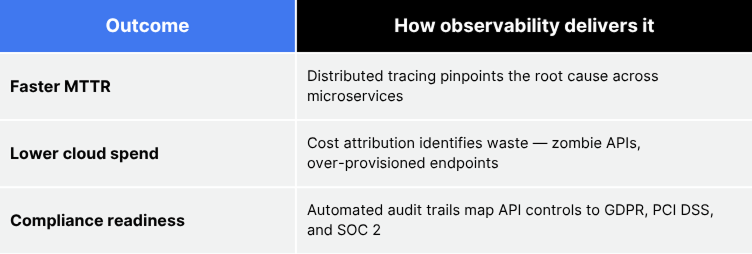
Operational velocity improves across the board. When engineering teams can trace a failing request across microservices in seconds instead of hours, incident resolution stops being the bottleneck. When platform teams can see which APIs are over-provisioned and which are under strain, cloud spend becomes a planning exercise rather than a monthly surprise. Organizations with unified gateway observability report 23% higher throughput and 17% lower latency variance — not because the infrastructure changed, but because teams could finally see where to optimize.
Compliance becomes a byproduct, not a scramble. For enterprises operating under GDPR, PCI DSS 4.0, EU DORA, SOC 2, or HIPAA, regulatory audits are a recurring reality. Without API-level observability, preparing for an audit means manually assembling evidence across fragmented systems to understand which APIs handle personal data, who accessed them, and whether security controls were enforced. With observability, these audit trails are generated automatically.
The financial stakes are significant:
- GDPR fines can reach 4% of annual revenue,
- The EU AI Act introduces penalties of up to 7%, and
- PCI DSS 4.0 now explicitly requires API security controls.
API observability turns compliance readiness into an always-on capability rather than a quarterly fire drill.
The takeaway for enterprise leaders is clear: the value of observability is proven, but the platform you choose matters. A right solution like APIwiz connects telemetry to business outcomes without becoming a cost problem in its own right.
What are common API observability mistakes?
The most common mistakes are treating observability as monitoring, underinvesting in instrumentation, and failing to connect API telemetry to business outcomes.
- Observability as an afterthought: Instrumenting APIs after incidents instead of at design time. Shift-left observability catches issues before production.
- Tool sprawl without unification: Running separate dashboards per gateway or cloud creates the fragmentation problem that observability was meant to solve.
- Ignoring the cost of observability itself: Advertised per-GB pricing hides compute, egress, and operational costs that can inflate bills 3-7x. Budget for the total cost of ownership.
- Sampling too aggressively: Reducing trace sampling to 10% to control costs means missing 90% of anomalies. Intelligent sampling preserves visibility without breaking the budget.
- No business context: Collecting logs, metrics, and traces without mapping them to revenue, cost, or compliance is monitoring with extra steps, not observability.
How does APIwiz approach API observability?
APIwiz Observe provides real-time visibility across every API in your ecosystem, regardless of which gateway or service mesh you use. Built on eBPF technology, it delivers kernel-level tracing with near-zero performance overhead — no agents, no sidecars, no blind spots.
Key capabilities:
- eBPF-powered deep packet inspection without agent overhead
- Unified dashboard across multi-cloud, multi-gateway API deployments
- Configurable security policies and alerts
- End-to-end distributed tracing across microservices
- SLA monitoring with historical trend analysis
- Zero-touch API discovery — finds shadow and zombie APIs automatically
- Cost attribution per API, per team, per business unit
Enterprise customers like Tonik use APIwiz to manage thousands of APIs with full-lifecycle observability — from design-time governance through runtime monitoring to cost optimization.
Key takeaways
API observability is no longer a technical nice-to-have. It's the foundation that determines whether your enterprise can govern, secure, and optimize its API ecosystem. For CIOs, it's governance and control. For CFOs, it's cost visibility and waste elimination. For security leaders, it's threat detection and compliance readiness. Enterprises that invest in observability now will be the ones that scale their API programs without increasing risk.
Interested in seeing how APIwiz delivers full-lifecycle API observability across any gateway, any cloud? Talk to us.
FAQs about API Observability
1. What is API observability, and how is it different from monitoring?
API observability is the ability to understand the internal state of your APIs by analyzing the telemetry data they emit — logs, metrics, and traces. Unlike monitoring, which checks predefined metrics such as uptime and response time, observability provides deep, real-time insight into why APIs behave as they do. This enables root-cause analysis and proactive optimization rather than reactive alerting.
2. Why is API observability important for enterprise decision-makers?
API observability matters to enterprise leaders because it directly impacts governance, cost control, and security posture. Without observability, CIOs can't enforce standards across sprawling API ecosystems, CFOs can't track which APIs generate revenue versus drain budgets, and security leaders can't detect shadow APIs or compliance gaps. It connects technical infrastructure to business outcomes.
3. What are the three pillars of API observability?
The three pillars are logs (discrete event records), metrics (aggregated performance measurements), and traces (end-to-end request paths across services). Together, they provide the complete telemetry needed to diagnose issues, optimize performance, and maintain SLA compliance. OpenTelemetry is the emerging open standard for collecting and correlating all three, providing vendor-neutral instrumentation supported by the Cloud Native Computing Foundation.
4. How does API observability help reduce cloud costs?
API observability enables cost attribution at the API level — tracking which APIs consume the most compute, storage, and egress resources. It identifies zombie APIs (deprecated but still consuming resources), duplicate APIs built by siloed teams, and over-provisioned endpoints. Organizations use this data to retire wasteful APIs, right-size infrastructure, and attribute costs to specific business units or revenue streams.
5. What is the difference between API observability and APM?
Application Performance Monitoring (APM) tracks application-level metrics — response times, error rates, transaction volumes. API observability goes deeper by correlating API-specific telemetry (request/response payloads, authentication patterns, consumer behavior) with infrastructure and business data. APM tells you an application is slow. API observability tells you which API endpoints are slow, who's calling them, and what they're costing.
6. How does API observability support regulatory compliance?
API observability provides the audit trails and real-time reporting that regulators require. For financial services, it maps API security controls to PCI DSS 4.0 and EU DORA requirements. For healthcare, it tracks HIPAA data handling at the API layer. For any organization handling personal data, it provides the GDPR-required visibility into what data flows through which APIs and who accesses it.
Effortless API Management at scale.
Support existing investments & retain context across runtimes.
.webp)
Effortless API Management at scale.
Support existing investments & retain context across runtimes.