

API Cost Optimization: How Zombie APIs Drain Your Budget

The Hidden Cost of API Sprawl: How Poor API Management Is Quietly Draining Your Budget
What is the cost of API sprawl?
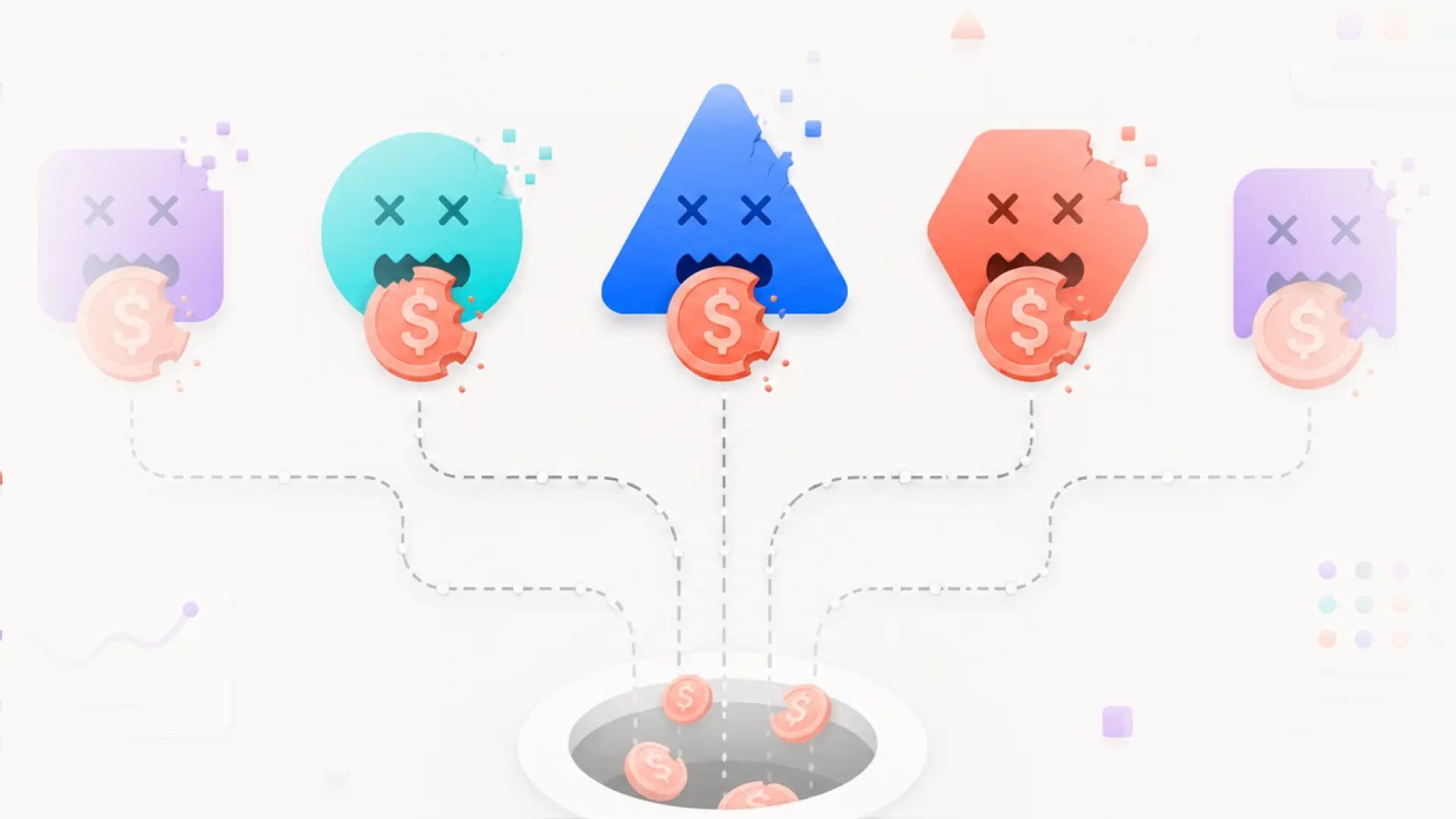
API sprawl is the uncontrolled growth of APIs across teams, API gateways, and cloud environments. It quietly drains enterprise budgets through zombie APIs that waste compute, duplicate APIs that multiply maintenance costs, and shadow endpoints that expand security risk.
Key cost drivers of API sprawl:
● Zombie API compute and infrastructure waste
● Duplicate API maintenance and testing overhead
● Unmonitored AI and LLM API usage amplification
● Shadow API security and compliance exposure
● Developer productivity loss from fragmented toolchains
Below, we explore how to quantify the financial impact of API sprawl, why zombie APIs are the most expensive problem nobody is budgeting for, how AI-era API consumption amplifies unmanaged costs, and what the ROI of full-stack API observability looks like.
Why are API sprawl costs invisible until they compound?
API sprawl costs so much because every unmanaged API silently accumulates compute, maintenance, security, and compliance costs that never appear on a single budget line item. No team owns the total. No dashboard shows the aggregate. You’ll never spot the pattern and uncover the hidden costs until you deliberately look for it.
The scale of budget leaks caused by API sprawl is staggering. Enterprises now manage an average of 15,000+ APIs, with large organizations exceeding 25,000. Yet 78% of organizations do not know exactly how many APIs they currently have. A 2025 Imperva analysis found that organizations have 10-20% more active APIs than they are aware of.
Why the costs compound:
● Each unmanaged API incurs costs across compute, storage, data usage, and logging.
● Without centralized visibility, these costs distribute across team budgets and become invisible to finance
● The problem accelerates as AI-driven API consumption grows. Gartner projects 80% of API traffic will originate from AI agents by 2028
Insecure and poorly managed APIs contribute to up to $87 billion in annual losses globally, according to Imperva and Thales. For enterprise leaders, API sprawl is not a technical nuisance. It is a measurable financial liability that grows with every endpoint nobody is watching.
How do zombie APIs silently drain your compute budget?
Zombie APIs are deprecated or abandoned endpoints that remain active in production, consuming compute, storage, and operational bandwidth despite serving no business purpose. They are the equivalent of paying rent for an apartment nobody lives in.
Over 40% of enterprise API endpoints are classified as shadow or zombie APIs. Only 19% of enterprises feel confident in the accuracy of their API inventories. And, more than 80% of API-related breaches trace back to exposed or forgotten endpoints that existing security tools never knew about.
The financial impact of zombie APIs on an organization:

Every zombie API is a compounding liability. It does not get cheaper with time. It gets riskier, more expensive to remediate, and harder to find without automated API discovery.
How does API duplication multiply costs?
API duplication occurs when teams fail to discover existing APIs and instead build new ones that replicate the same functionality. Every duplicate multiplies maintenance cost, testing overhead, and security surface area across the entire API lifecycle.
When 79% of organizations do not know how many APIs they have, the creation of duplicates is obvious. Teams build new endpoints because finding existing ones takes longer than creating them from scratch. The result is a duplication tax that scales linearly with the number of teams operating in isolation.
The financial impact of duplication:
● Each duplicate API requires its own development, testing, deployment, monitoring, and retirement lifecycle
● 75% of developers lose 6-15 hours per week to fragmented workflows, time partly spent maintaining redundant APIs
● Lost productivity from fragmented API toolchains equates to hundreds of thousands of dollars in costs.
The root cause is straightforward: without a centralized API catalog and discovery mechanism, building new is always faster than finding existing. This is a governance failure, not a developer failure, and it is entirely solvable with the right infrastructure.
How does AI amplify API sprawl costs?
AI amplifies API sprawl costs because LLM API calls are significantly more expensive than traditional API calls. Without observability, unmonitored AI usage can lead to runaway spending that exceeds budgets by 40% or more.
The AI cost multiplier is driven by three factors that compound in environments without centralized API visibility.
First, the per-call cost is higher. A single user request costing $0.10 in a chat interface can cost $0.40 to $1.50 through an agentic workflow that involves retries, verification loops, and multi-step reasoning. Anthropic's research indicates that agentic AI workflows consume 4-15x as many tokens as simple chat interactions.
Second, multi-agent systems multiply volume. Gartner reported a 1,445% surge in multi-agent system inquiries between Q1 2024 and Q2 2025. Early deployments show these systems generate 3-5x higher API call volume than single-agent equivalents due to inter-agent communication and context-sharing processes.
Third, the cost leaks are invisible without observability.
Where AI cost leaks happen:
● Development and testing environments with unrestricted API access and no usage caps
● Reasoning model "thinking tokens" billed as output but invisible in responses, where a 500-token query can consume 3,000+ tokens
● Duplicate AI integrations across teams, each calling the same LLM providers independently
● No cost attribution, making aggregate AI spend invisible when distributed across team budgets
53% of AI teams experience costs exceeding forecasts by 40% or more during scaling. For enterprises already dealing with API sprawl, AI adoption does not just add new costs. It amplifies every existing visibility gap.
How do you calculate the true cost of API sprawl?
Calculating the true cost of API sprawl requires auditing four categories that traditional budgeting ignores: zombie infrastructure waste, duplication overhead, security exposure, and developer productivity loss.
Most organizations budget for API infrastructure as a single line item, aggregated across teams and gateways. This masks the waste. A proper audit disaggregates spend by endpoint and measures each API's actual contribution to the business.
The API sprawl cost formula:

Step-by-step audit process:
- Run automated API discovery across all environments to establish a complete inventory
- Identify zombie APIs: endpoints with zero traffic over 90 days
- Map duplicate APIs: multiple endpoints serving the same function across different teams
- Calculate per-API infrastructure cost: compute + storage + logging + monitoring
- Multiply zombie and duplicate API count by per-API cost to quantify recoverable spend
Organizations that audit their API portfolios typically discover 20-30% redundancy. For an enterprise spending $2M annually on API infrastructure, that represents $400K-$600K in directly recoverable costs, before factoring in reduced security exposure and reclaimed developer time.
What is the ROI of API observability for cost optimization?
The ROI of API observability for API cost optimization is measurable and immediate. Enterprises that gain full visibility into their API portfolios typically recover 20-30% of infrastructure spend by identifying and decommissioning zombie and duplicate APIs.
Observability is not a cost center. It is a cost-recovery mechanism.
How observability recovers budget:
● Automated API discovery eliminates the manual inventory problem that leaves 79% of organizations guessing
● Traffic analysis identifies zombie APIs consuming resources with zero business value
● Dependency mapping reveals duplicates that can be consolidated into shared services
● Usage-based cost attribution gives finance and engineering a shared view of where API spend concentrates
ROI comparison:

For enterprises entering the AI era, where API traffic will grow exponentially, visibility into your entire API ecosystem across gateways and what it costs is no longer optional infrastructure. It is part of your financial hygiene and cost optimization practices.
How does APIwiz help enterprises eliminate API sprawl costs?
APIwiz provides the discovery, observability, and governance infrastructure that turns API portfolios from unaudited cost centers into visible, optimized assets. Because it operates as a federated control plane above any API gateway or service mesh, it gives finance and engineering teams a single view of API spend across the entire organization.
Key cost optimization capabilities:
● Zero-touch API discovery across multi-cloud, multi-gateway environments, finding every API, including zombie APIs and duplicates that are silently consuming your resources
● Traffic analysis and usage metrics identifying zero-traffic endpoints for decommissioning
● Cross-team API catalog with search and discovery, eliminating the "build instead of find" duplication problem
● eBPF-powered observability providing kernel-level cost and performance data with near-zero overhead
● Unified dashboard across all gateways, removing cost blind spots across heterogeneous infrastructure
● AI API cost tracking with per-agent, per-provider, per-use-case attribution
Enterprise customers in banking and fintech, including RCBC, Commercial Bank of Qatar, and digital neobank Tonik, use APIwiz to manage thousands of APIs with full lifecycle governance and cost visibility across their entire stack.
Key takeaways
API sprawl is not a technical inconvenience. It is a measurable financial drain that compounds with every unmanaged endpoint. Zombie APIs consume compute for endpoints nobody uses. Duplicate APIs multiply maintenance costs across teams that cannot see each other's work. Unmonitored AI integrations increase spend by 40% or more beyond forecasts.
Enterprises that invest in automated API discovery, portfolio-wide observability, and centralized cost attribution will recover the 20-30% of infrastructure spend currently hidden in plain sight. The alternative is continuing to pay for APIs that serve no purpose, maintain duplicates nobody asked for, and absorb AI cost overruns that nobody can trace.
Book a demo to see how APIwiz discovers every API in your portfolio and turns hidden costs into recoverable budget.
FAQs about API sprawl costs
What is API sprawl, and why is it expensive?
API sprawl is the uncontrolled proliferation of APIs across an enterprise, typically caused by teams building APIs independently without centralized visibility or governance. It is expensive because every unmanaged API accumulates costs across compute, storage, testing, security scanning, and incident response. Enterprises with over 15,000 APIs often discover that 20-30% of their portfolio is redundant or inactive, representing significant recoverable infrastructure spend.
What is a zombie API, and how does it waste money?
A zombie API is a deprecated or abandoned endpoint that remains active in production despite serving no current business purpose. Zombie APIs waste money by consuming cloud compute, storage, and bandwidth around the clock for endpoints that generate zero business value. They also expand the security attack surface, and the average cost of a data breach is $4.4 million, according to IBM's 2024 report.
How do you find zombie APIs in your infrastructure?
Finding zombie APIs requires automated API discovery tools that scan across all environments, including cloud, on-premises, and multi-gateway, to identify every active endpoint. Traffic analysis then identifies APIs with zero or near-zero traffic over a defined period, typically 90 days. Manual inventory approaches fail because organizations typically have 10-20% more active APIs than they are aware of.
How much can enterprises save by auditing their API portfolio?
Enterprises that conduct a full API portfolio audit typically find 20-30% redundancy in active APIs. For an organization spending $2-5 million annually on API infrastructure, this translates to $400K-$1.5M in directly recoverable costs through decommissioning zombie APIs and consolidating duplicates. Additional savings come from reduced security exposure, lower compliance audit costs, and reclaimed developer productivity.
How does AI increase API sprawl costs?
AI increases API sprawl costs because LLM API calls are significantly more expensive than traditional API calls, and agentic workflows consume 4-15x as many tokens as simple interactions. Multi-agent systems further multiply API call volume by 3-5x. Without observability, 53% of AI teams experience costs exceeding forecasts by 40% or more during scaling.
What is the difference between API monitoring and API cost observability?
API monitoring tracks whether an API is up and responding. API cost observability tracks who is calling each API, how much each call costs, which APIs are redundant or unused, and where spend is concentrated. Monitoring tells you an API is running. Cost observability tells you whether it should be running and what it costs the organization to keep it alive.
Effortless API Management at scale.
Support existing investments & retain context across runtimes.
.webp)
Effortless API Management at scale.
Support existing investments & retain context across runtimes.