

From API Chaos to Clarity: How APIwiz Solves Enterprise API Observability

How does APIwiz solve API observability?
APIwiz delivers unified, real-time API observability across every gateway, cloud, and service in an enterprise ecosystem, using eBPF-powered architecture with near-zero overhead and zero code changes.
What makes APIwiz the right choice for API observability:
- Federated control plane across any API gateway or service mesh
- eBPF-powered deep packet inspection at the kernel level
- Zero-touch shadow and zombie API discovery
- End-to-end distributed tracing from client to backend
- Cost attribution per API, per team, per business unit
Below, we explore why API observability is broken in the AI era, how APIwiz's federated, eBPF-powered architecture solves the core challenges, and what this means for enterprises managing thousands of APIs across fragmented ecosystems.
Why is API observability broken in the age of AI?
API observability is broken because enterprise API ecosystems have outgrown the tools designed to monitor them. The rise of LLMs and agents has skyrocketed API usage, making it hard for current observability tools to manage.
The numbers tell the story.
45% of platform teams now manage five or more observability tools, fragmenting data and escalating costs (DataBahn 2026 State of Observability). 31% of organizations run multiple API gateways, each with its own dashboards and alerting (Postman 2025 State of the API). And Gartner predicts that 80% of API traffic will originate from AI agents by 2028.
What makes AI-era API traffic different:
- Autonomous API usage: AI agents independently discover, call, and chain APIs without any human in the loop.
- Unpredictable API volumes: A single agentic workflow can chain dozens of API calls, consuming several times more than traditional API calls.
- Token-based pricing: LLM costs vary per request and are invisible to legacy rate limiters that count requests rather than tokens.
- Multi-hop complexity: Agentic workflows call multiple gateways, clouds, and services in a single transaction
- Retry amplification: Agents retrying after failed calls create 3–5x traffic spikes during cascade events
Traditional monitoring was built for predictable, human-initiated, single-gateway traffic. It was never designed for this. Enterprises are flying blind across fragmented ecosystems while AI multiplies the traffic, cost, and risk they cannot see.
This is the problem APIwiz was built to solve.
Why does federated architecture matter for multi-gateway observability?
No enterprise runs a single API gateway. AWS API Gateway handles one set of services. Azure API Management runs another. Kong manages internal APIs. On-premises gateways cover legacy systems. This fragmentation isn't a failure of planning. It's the natural result of multi-cloud strategies, acquisitions, and team autonomy.
The problem is that each gateway becomes a silo. Each gateway has its own dashboard, its own alerting rules, and its own data format. When a latency spike hits an API that traverses two gateways, no single tool can trace the full path. When a security incident spans three environments, teams manually stitch together logs to make sense of the incident.
Federated architecture solves this by separating the control plane from the data plane. Instead of forcing all traffic through a single centralized gateway, which creates compliance risks, bottlenecks, and single points of failure. But a federated model places a unified control plane above every gateway without replacing any of them. Telemetry flows up; governance flows down. Raw data stays local where regulations require it.
What this architecture delivers:
- Single unified view: Telemetry from every gateway, every cloud, and every on-premises environment flows into one observability layer
- Unified service registry: Every API across every gateway catalogued with ownership, SLA requirements, compliance classifications, and dependencies
- Cross-gateway tracing: A single request traced from client to backend, across gateways and services, in one dashboard
- Zero vendor lock-in: Enterprises keep their existing gateway investments while gaining total operational clarity
This matters even more in the AI era. AI agents do not respect gateway boundaries. A single agentic workflow may hit APIs managed by AWS, Azure, and an on-premises gateway — all in one chain. Without federated observability, you see three fragments. With APIwiz, you can see the entire transaction in a single view.
What makes eBPF the right foundation for API observability?
eBPF (Extended Berkeley Packet Filter) is the technology that makes deep API observability possible without the overhead that has traditionally made it impractical at scale. APIwiz Observe is built on eBPF for exactly this reason.
Traditional observability requires deploying sidecars alongside every pod or embedding SDK instrumentation into application code. Both approaches consume significant resources and still miss traffic from uninstrumented services.
eBPF takes a fundamentally different approach, running sandboxed programs directly within the kernel to capture every network packet, system call, and API transaction at the infrastructure layer.
Difference between using a Sidecar proxy and an eBPF-base observability tools like APIwiz:
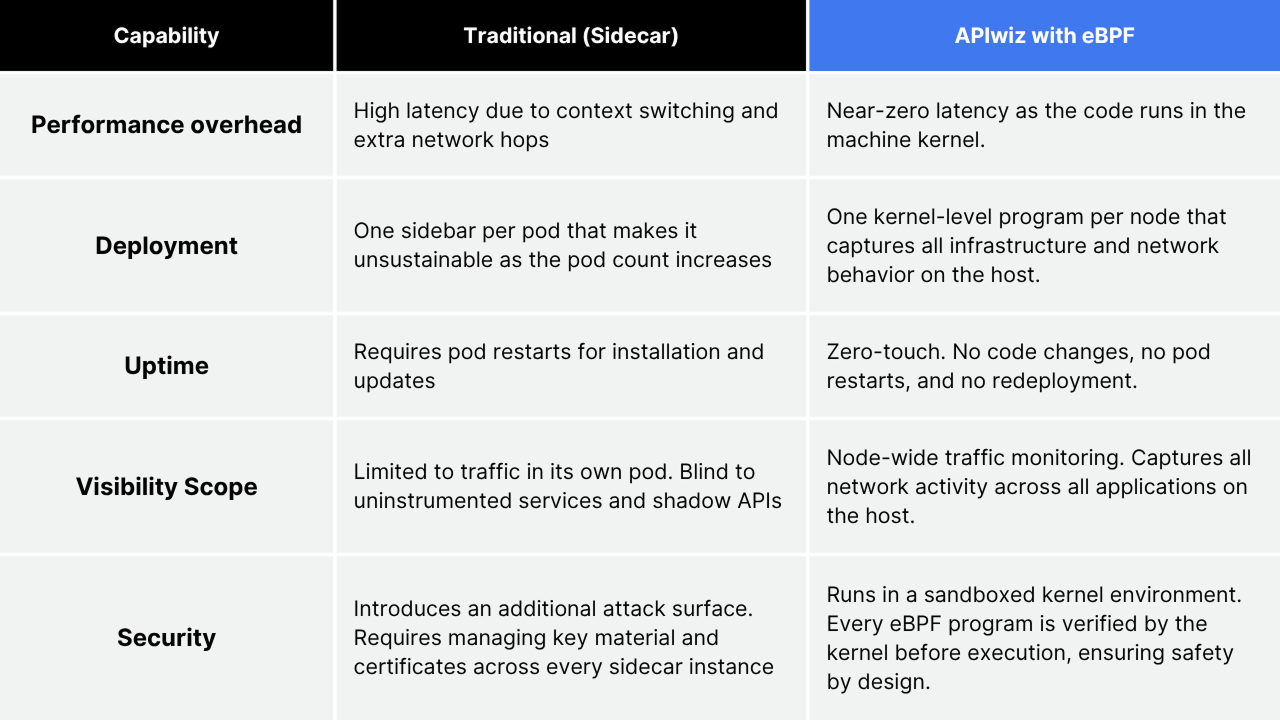
For API-heavy enterprises, eBPF means capturing API traffic at the infrastructure layer rather than relying on each team to instrument their services individually. The adoption curve validates the direction. 31% of teams running Kubernetes at scale have adopted at least one eBPF-based observability tool, according to the CNCF 2026 survey.
Why do shadow and zombie APIs stay invisible? And how do you find them?
Shadow APIs are endpoints created by development teams that were never registered with the API gateway or governance process. They bypass security controls because no one knows they exist.
Zombie APIs are deprecated endpoints that remain active — consuming compute, exposing attack surface, and answering requests with no owner and no business value.
Shadow APIs and zombie APIs stay invisible because they exist outside the registries and inventories that traditional monitoring tools depend on.
Finding them requires looking at what actually happens on the network, and not what is documented. APIwiz's zero-touch discovery does exactly this, using kernel-level network inspection to surface APIs that no one knew existed.
How APIwiz finds what other tools miss:
- eBPF-powered network inspection: Captures all API traffic at the kernel level, including traffic to endpoints not registered in any gateway or service registry
- Continuous scanning: not a one-time audit, so new shadow APIs are caught as they appear, not months later during a manual review
Manual API inventories are snapshots. They are outdated the day they are completed. eBPF-powered continuous discovery is the only approach that keeps pace with how fast modern development teams create new endpoints.
What does API observability need to look like for AI agent traffic?
AI agents create traffic patterns that legacy monitoring was never designed to handle — autonomous, high-volume, multi-hop, and token-priced. Observability for this era needs to match that scale and complexity. APIwiz is built for exactly these patterns.
Consider what a single AI agent workflow looks like from an API perspective. An autonomous agent receives a task, makes a planning call to one LLM, queries three internal APIs for context, calls a second LLM for processing, writes results to a database API, and triggers a notification API. That is seven or more API calls, spanning multiple gateways, multiple providers, and potentially multiple clouds — in a single workflow.
The observability system watching this traffic needs capabilities that did not exist five years ago.
APIwiz 3.0 - Built for the AI era:
Federated control plane traces AI agent requests end-to-end across AWS, Azure, Kong, and on-premises gateways from a single dashboard
eBPF-powered observability captures every API transaction at the kernel level, including traffic from uninstrumented services that AI agents discover and call autonomously
Zero-trust security pipelines enforce governance policies consistently across every gateway, preventing AI-driven API sprawl from creating unmonitored attack surfaces
Zero-touch API discovery automatically surfaces shadow and zombie APIs that AI agents may be calling without anyone's knowledge
The age of AI does not just increase API traffic volume. It changes the nature of that traffic. APIwiz is designed for both.
How do you turn API telemetry into business intelligence?
API observability only matters if it connects to business outcomes. Collecting logs, metrics, and traces without mapping them to cost, revenue, and compliance is just monitoring, not observability. APIwiz turns telemetry into intelligence that enterprise leaders can act on.
Cost attribution and optimization
Most enterprises cannot answer a basic question: what does this API cost us? APIwiz helps you track API costs across multi-cloud, multi-gateway environments — attributing API spend to specific teams, products, or revenue streams. It makes it possible by:
- Identifying zombie APIs draining budget with zero business value
- Surfacing duplicate APIs that double development and maintenance costs
- Tracking consumption across LLM-integrated APIs before costs spiral
- Comparing cost-per-transaction across gateways to help you optimize routing
Compliance and audit readiness
Regulated industries like banking, fintech, and telecom cannot treat compliance as a quarterly exercise. APIwiz delivers compliance-ready audit trails mapping API controls to OWASP API Security Top 10, PCI DSS 4.0, GDPR, and EU DORA
On top of that, APIwiz also helps with:
- Real-time security pipeline enforcement — not post-incident reporting
- Shift-left validation that catches compliance issues at design time, not production
- Continuous compliance monitoring across every API in the ecosystem
Adoption and revenue attribution
- Offers detailed developer productivity metrics, including time-to-first-call, API reuse rate, integration count, and more.
- Provides insights on which APIs drive customer value
APIwiz offers actionable insights across the entire API lifecycle, making it the perfect choice for managing your organization’s API ecosystem.
Why should observability span the full API lifecycle?
Observability that starts in production starts too late. By the time a production dashboard catches an issue, the cost, in terms of downtime, security exposure, or budget overrun, has already been incurred.
APIwiz is a federated API management platform that covers the entire API lifecycle from design through monetization, with observability woven into every stage.
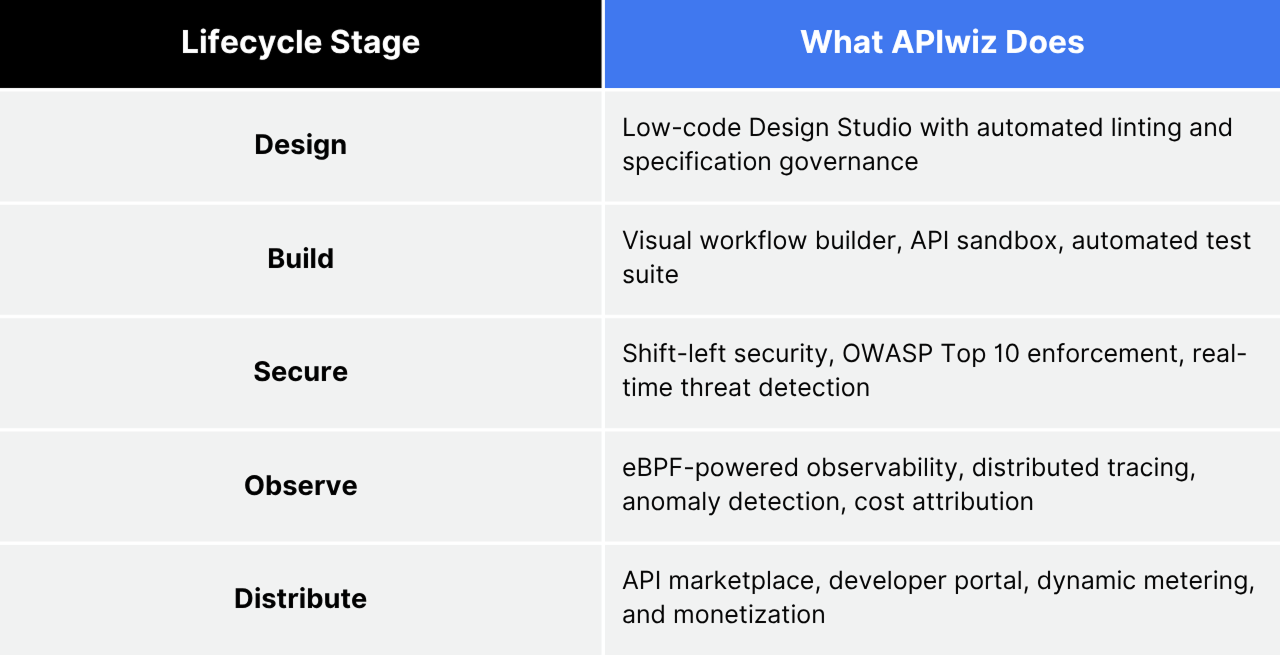
Why full lifecycle integration changes the equation:
- Security findings from Observe feed directly into Secure for automated remediation — no manual handoff, no ticket queue
- Discovery data flows into the centralized service registry, closing the loop between what exists in production and what is governed
- Cost data from Observe informs monetization strategy in Distribute — pricing APIs based on actual cost-to-serve, not estimates
- Design-time linting catches issues that would otherwise surface as production anomalies
Standalone observability tools see production. APIwiz sees the whole picture — from the specification that defines an API to the marketplace where it generates revenue. That continuity is what turns reactive incident response into proactive API program management.
What does API observability look like in practice?
Enterprise customers across banking, fintech, and telecom use APIwiz to manage thousands of APIs with full lifecycle observability. Here is what that looks like in practice.
Commercial Bank of Qatar (CBQ) had 15+ domain teams operating in silos, each using different tools —Insomnia, Kong Enterprise, and AppDynamics—with no unified view of its API landscape. APIwiz delivered a complete API inventory within two weeks, surfacing shadow and zombie APIs that had been invisible to existing tools.
CBQ also created a centralized data dictionary, migrated from Kong Enterprise to Kong open-source to eliminate licensing costs, and rolled out centralized security policies that progressed from alerting to active enforcement — all within 12 months.
Tonik (Digital Neobank) built its entire digital banking platform on an API-first architecture managed by APIwiz, scaling to 230,000 customers within 15 months of launch — with full observability across every API powering the platform.
Key takeaways
The age of AI has turned API observability from a technical checkbox into a business-critical capability. AI agents are multiplying traffic 15–20x, introducing token-based costs that legacy tools cannot track, and creating multi-hop workflows that span every gateway in your ecosystem. Fragmented, gateway-by-gateway monitoring cannot keep pace.
APIwiz delivers what enterprises need now: a federated, eBPF-powered platform that provides unified observability across every gateway, every cloud, and every API — from design to production to monetization. One platform. One view. Complete visibility.
The chaos is real. The solution exists. The question is how long your enterprise keeps debugging in the dark.
Book a demo to see how APIwiz delivers unified API observability across any gateway, any cloud.
Effortless API Management at scale.
Support existing investments & retain context across runtimes.
.webp)
Effortless API Management at scale.
Support existing investments & retain context across runtimes.