

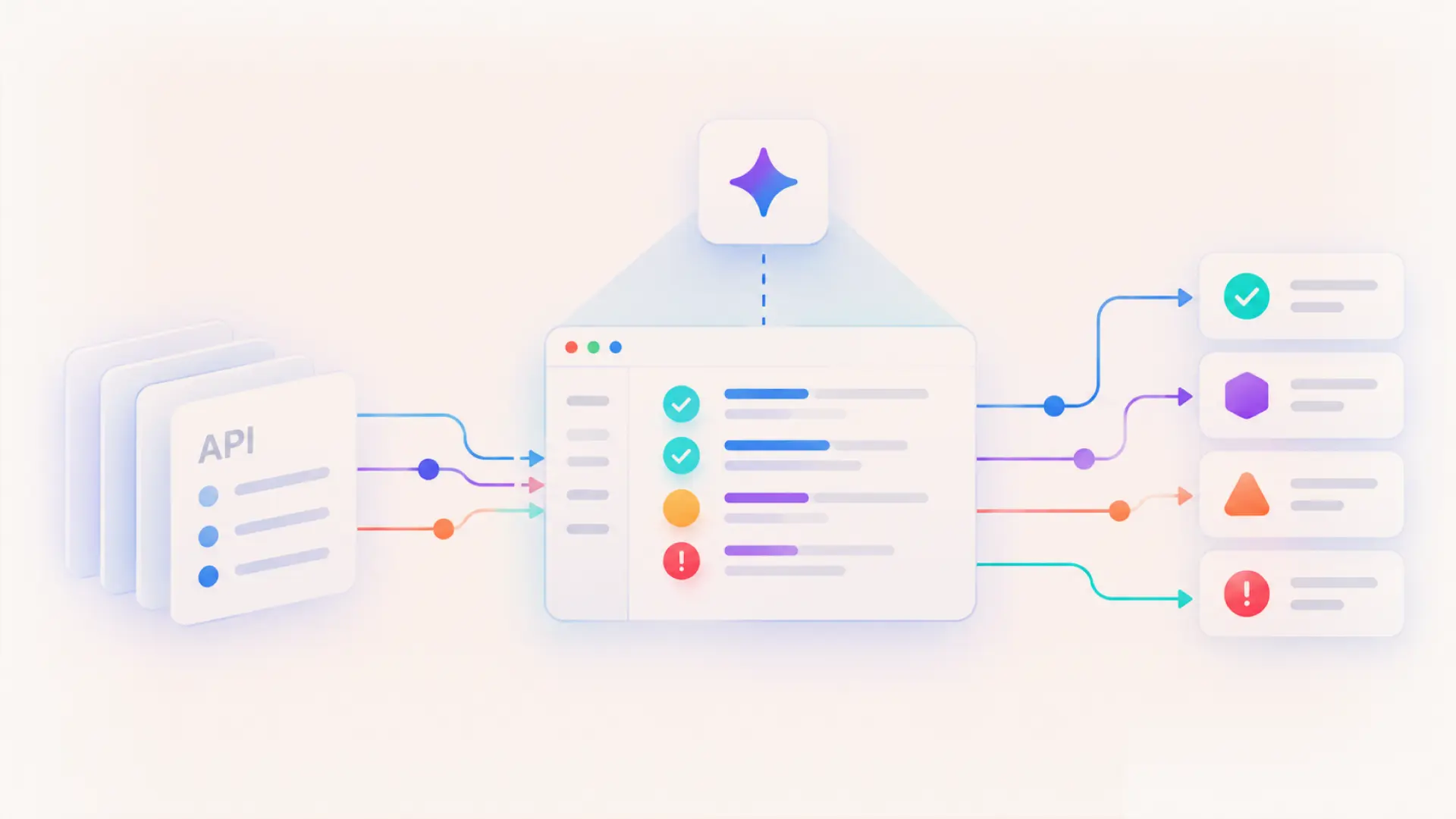
AI Readiness Assessment: Are Your APIs Ready for AI Agents?

Quick answer: How do you assess whether an API is ready for AI agents?
Assess whether an API enables an agent to discover the correct operation, understand its contract, authenticate with limited permissions, handle failures safely, recognize lifecycle changes, and produce a traceable operational record.
To make that assessment, examine the following areas of the API:
- Discovery and ownership: Verify that approved operations, environments, owners, and agent-access rules are documented.
- Machine-readable contracts: Check whether the deployed API matches a contract covering operations, schemas, security requirements, examples, errors, and lifecycle status.
- Controlled execution: Test how the API enforces authentication, authorization, rate limits, idempotency, safe retries, and safeguards for sensitive operations.
- Behavioral consistency: Use repeatable tests to confirm that the API behaves as its contract describes.
- Operational accountability: Verify that API calls can be traced to the agent workflow, consumer, operation, policy decision, and outcome.
Below, we explain how to evaluate these areas, identify gaps that should block agent access, prioritize remediation, and maintain API readiness for AI agents over time.
How do AI agents use APIs?
AI agents usually access APIs through the software running the agent, such as an agent platform, workflow engine, or custom backend. This software exposes approved tools to the model and maps each tool to a specific API operation. When the agent selects a tool and supplies the required arguments, the software validates the request, calls the API, and returns the response to the agent.
Because a developer may not review every request before execution, the API must provide clear contracts, enforce access controls, reject invalid input, return useful errors, apply operational limits, and record what happened.
An API is ready for AI agents when it can support this workflow safely and predictably.
What makes an API ready for AI agents?
An API is ready for AI agents when an approved agent workflow can find the right operation, send a valid request with limited permissions, interpret the response, recover from failure, and leave an auditable record. Readiness depends on both the published contract and the behavior of the deployed API.
Evaluate the evidence behind these requirements:
A complete contract can describe how an API should work, but it does not prove that the deployed API behaves the same way. For this assessment, readiness requires design-time evidence from the contract and controls, as well as runtime evidence from tests and telemetry.
How should you assess readiness across an API landscape?
Start with the agent use case, not the entire API estate. Identify the operations the agent may call, the environments and data involved, the actions that require human approval, and the consequences of an incorrect or repeated request. An API may be suitable for a read-only workflow while remaining unsafe for payments, account changes, or other sensitive actions.
For each approved operation, compare three kinds of evidence:
- Design-time evidence: Contracts, ownership records, access policies, lifecycle metadata, and documented limits describe how the API should work.
- Test evidence: Contract, authorization, failure, replay, throttling, and dependency tests show how the API behaves under expected and adverse conditions.
- Runtime evidence: Logs, traces, metrics, audit records, and consumer activity show what happens in deployed environments.
Record the evidence reviewed, unresolved gaps, responsible owner, permitted agent use, and conditions that should trigger reassessment. Missing ownership, unsafe authorization, uncontrolled side effects, or failures that cannot be recovered safely should block the use of connected agents. Partial evidence may support an isolated test or restricted pilot, but not broader access.
How do you assess discovery and ownership?
Discovery readiness starts with an inventory that an agent integration team can verify. It needs the production host, environment, protocol, current version, lifecycle state, owning team, support route, data classification, allowed consumers, and source contract.
Treat a registry or spreadsheet as a starting point, then reconcile it with deployed routes and runtime traffic. Look for active endpoints missing from the inventory, deprecated operations that still receive calls, and records without a current owner. Unknown ownership or lifecycle state should block agent access until the gap is resolved.
This area matters because OWASP lists improper inventory management as an API security risk. Do not approve agent access to an endpoint whose owner or lifecycle state is unknown.
How do you assess API specifications?
Specification readiness depends on a valid, retrievable description for every operation approved for agent use. Check paths, methods, parameters, request and response schemas, status codes, security requirements, servers, and content types.
Use CI to check contract syntax, required organizational rules, schema-valid examples, and breaking changes against the approved baseline. Separately, use integration and deployment checks to verify that the implemented API matches the contract and enforces its documented security requirements. Approve only operations that are covered by the current contract and verified against the target environment.
Validate the adapter that converts an OpenAPI operation into an agent tool, as tool runtimes may support different schema subsets.
How do you assess operation descriptions and examples?
An operation is ready only when an agent can determine when to call it and what the call will do. Define its purpose, preconditions, side effects, required roles or scopes, parameter meaning, units, accepted ranges, and representative success and failure examples.
Examples must validate against the same schemas used in testing. Mark destructive, irreversible, billable, or externally visible actions explicitly. For multi-step work, document prerequisites and the stable identifier passed to the next operation.
Reject descriptions that merely restate the method and path. Readiness evidence should include schema-valid examples, explicit constraints, and tests showing that the agent workflow selects the intended operation and constructs valid arguments. Use observed selection and argument failures to improve descriptions and test cases.
How do you assess authentication and authorization?
Authentication readiness covers the complete machine identity path, not merely the presence of an API key field. Record the supported client flow, token endpoint discovery, credential rotation, the API each token is valid for, permitted scopes, tenant boundaries, object-level authorization, and the revocation process.
OAuth 2.0 Security Best Current Practice recommends limiting token privileges, restricting tokens to their intended services, publishing authorization-server metadata, and using stronger client authentication where feasible. Tests must cover expired and malformed tokens, tokens issued for a different API, missing scopes, cross-tenant identifiers, and restricted objects.
Block agent use when it depends on shared credentials, broad administrator access, or untested tenant and object boundaries. Before expanding access, give the agent workflow a dedicated machine identity and only the permissions it needs. Confirm that unauthorized requests are rejected, credential rotation works as expected, revoked credentials can no longer be used, and previous calls remain attributable to the correct machine identity.
How do you assess errors, retries, timeouts, and idempotency?
An agent workflow needs sufficient error information to decide whether to correct the request, stop, retry, or request human approval. For HTTP APIs, use consistent status codes and structured RFC 9457 problem details. Define stable error types, useful descriptions, and correlation identifiers. Document which failures are terminal, which are retryable, how long requests may run, and what backoff and retry limits apply.
HTTP semantics define safe methods, PUT, and DELETE as idempotent, but tests should confirm that the deployed API follows those semantics. Do not automatically retry an operation that changes data or triggers an action unless repeating it is known to be safe. For POST requests that create, update, or trigger an action, document any idempotency mechanism, including key scope, retention period, duplicate-response behavior, and conflict handling.
Test the uncertain case where the server completes an action but the client times out before receiving the response. An API that can duplicate a payment, message, or order under that condition is not ready for an agent to perform that action.
How do you assess rate limits and consumption guardrails?
Rate limits protect API capacity. Consumption guardrails limit the cost and impact of actions that an authorized agent can perform. Define and enforce quotas, concurrency limits, and payload limits for each relevant consumer, operation, and environment. Document the throttling response so the agent workflow knows when to stop or retry.
RFC 6585 defines HTTP 429 for cases where a requester sends too many requests within a given period. The response may include Retry-After to indicate how long to wait before trying again. As part of the readiness assessment, test burst traffic, sustained traffic, concurrent requests, and quota exhaustion.
Rate limits count requests, but they do not measure the cumulative effect of a business workflow. An agent could create many accounts, send repeated messages, export data in batches, or place duplicate orders without exceeding a per-second request limit. The result could be high cost, spam, unintended data exposure, duplicate transactions, or other business harm even though each request was valid and remained within the limit. Test these end-to-end patterns and set controls based on their business impact, not only their request volume. OWASP treats unrestricted resource consumption and unrestricted access to sensitive business flows as separate risks.
Verify that limits are enforced and that monitoring can identify abnormal activity by consumer and workflow. Restrict agent access when costly or sensitive operations lack appropriate limits, approvals, or other workflow-specific controls.
How do you assess versioning and lifecycle status?
Lifecycle readiness means an agent can distinguish active, deprecated, and retired operations before execution. Evidence includes version identifiers, compatibility rules, status, deprecation date, replacement operation, migration guide, owner, and observed consumer traffic.
RFC 9745 defines the Deprecation response header and a link relation for deprecation information. RFC 8594 defines Sunset for the expected time a resource becomes unavailable.
Release notes alone are insufficient for automated consumers. Verify that lifecycle status is available with the operation, that the replacement path works, and that usage evidence identifies affected consumers. Removal checks should prevent retired routes from remaining callable through an agent tool.
How do you assess testing and behavioral consistency?
API readiness requires evidence that the implementation matches the published contract and expected business behavior. Test valid and invalid input, authentication failures, role and scope boundaries, replayed requests, throttling, timeouts, and dependency failures. Verify response schemas, status codes, error details, side effects, idempotency, limits, and version compatibility.
Automate critical contract and behavior checks, then run each test at the appropriate stage of the delivery pipeline or in the target environment. Record approved exceptions and convert production defects into regression tests so coverage reflects observed failures as well as the original design.
Treat API testing and agent evaluation as separate but complementary activities. API tests determine whether an operation behaves as documented under the scenarios tested. Agent evaluations determine whether the agent selects the correct operation, supplies valid arguments, sequences calls correctly, and stops or requests help when it cannot proceed safely.
How do you assess runtime observability and auditability?
Runtime observability helps operators detect and diagnose API behavior. Auditability provides a durable record of agent-triggered actions. Together, they should show which agent workflow requested an operation, which machine identity called the API, what the API did, and whether the action succeeded.
For each call, capture the API operation and version, machine identity, agent workflow identifier, timestamp, outcome, latency, retry count, and correlation or trace identifier. Record relevant authorization, policy, and human-approval decisions in the associated audit trail. Do not record access tokens, credentials, or sensitive payload fields.
OpenTelemetry provides semantic conventions for HTTP spans, including the method, route, response status, error type, and resend count. Use these attributes as a technical baseline, then correlate the trace with the agent workflow and any related audit record.
Verify that operators can follow an action from the agent request through the API and its dependencies, distinguish initial calls from retries, identify the policy or approval that permitted the action, and determine its side effects. Test alerts and incident-reconstruction procedures, and apply appropriate access and retention controls to audit records.
How should you prioritize API-readiness gaps?
Prioritize each gap based on the risk it poses to the specific API operation and agent workflow. Consider the potential impact, how easily the failure could be triggered, the agent's level of access, the sensitivity of the data or action, reversibility, and whether monitoring would detect the problem.
Use the result to decide what access, if any, should remain available:
Apply these decisions to each operation and use case. Risk depends on what an operation can do. Incomplete audit records should prevent an agent from initiating payment operations, as every financial action must be attributable and available for investigation. The same gap may be tolerable during a restricted pilot that only retrieves public data and cannot change system state.
Verify each fix using the test or runtime evidence that exposed the gap. Keep the original finding, remediation owner, verification record, permitted agent use, and approval decision together.
How does APIwiz support continuous API readiness?
APIwiz can help teams maintain the inventory, contracts, controls, tests, and runtime evidence used to assess API readiness for AI agents.
- Maintain inventory and evidence of ownership: APIwiz Build includes a Service Registry that tracks API metadata, versions, ownership, and dependencies. APIwiz Secure provides API discovery across cloud and on-premises environments. Teams can use this information to identify unmanaged APIs, missing owners, and lifecycle gaps.
- Keep contracts and changes visible: APIwiz Design provides a collaborative design studio, structured data modeling, automated linting, version management, changelogs, and automated API documentation. These capabilities help teams maintain and review the design-time evidence behind approved operations.
- Test APIs and apply controls before deployment: Build provides an API Sandbox for mocking behavior and testing integrations, as well as a scenario-driven API Test Suite. Secure adds a security pipeline, compliance controls, threat protection, and incident alerts.
- Collect runtime evidence: APIwiz Observe provides API Insights, logging, tracing, monitoring, Consumer Insights, and Workflow Insights. Teams can use this evidence to examine API performance, consumption, workflow execution, and runtime failures.
APIwiz supports the API lifecycle evidence used in the assessment. The team deploying the agent still defines the required controls, selects the operations the agent may use, implements the tool integration, and approves the use case.
Key takeaways
An AI readiness assessment starts with executable evidence. Inventory, contracts, identity, failure behavior, limits, lifecycle status, tests, and telemetry must agree on the operations an agent will call.
Assess readiness for each approved operation and use case. Missing authorization controls, unsafe retries, duplicate side effects, or unknown ownership should block agent access, regardless of how strong the documentation elsewhere is.
Treat readiness as a maintained state. Reassess after contract, policy, dependency, version, or traffic changes, and feed production failures back into specifications and tests.
Book a demo with APIwiz to discuss how its inventory, design governance, testing, security, and observability capabilities can support your API-readiness program.
FAQs about AI-ready APIs
What is an AI-ready API?
An AI-ready API lets a permitted machine client discover, understand, call, and monitor approved operations with bounded risk. It combines a machine-readable contract with bounded permissions, predictable failures, tested side effects, consumption guardrails, lifecycle metadata, and traceable behavior. Readiness applies to defined operations and use cases, not automatically to every endpoint.
How do you assess whether an API is ready for AI agents?
Assess the approved operations across the areas above using current contracts, controls, tests, and runtime evidence. Verify critical write paths through negative and replay tests. Restrict access when authorization, failure handling, consumption controls, or traceability is incomplete.
Do AI agents require different API documentation?
Agents need the same accurate semantics as developers, but more of the information must be structured and available at execution time. Clear descriptions, schemas, examples, scopes, error types, limits, side effects, and lifecycle status reduce guesswork. Human guides remain useful, but they do not replace a validated machine-readable contract.
Can an existing REST API be used by an AI agent?
Yes. An existing REST API can support an agent when the integration exposes approved operations as tools and supplies the required authentication and control path. Test it for ambiguous descriptions, overbroad permissions, retries, duplicate mutations, limits, and traceability.
How does API governance support AI readiness?
API governance makes readiness criteria repeatable across teams and lifecycle stages. It can define contract fields, security schemes, version rules, error patterns, test gates, ownership metadata, and runtime evidence. Governance does not prove safety by itself; enforcement and observed behavior provide that proof.
Related reads
- The AI-ready organization: A blueprint for scaling beyond pilots
- API observability in the age of AI
- The hidden cost of API sprawl
- How to evolve APIs without losing developer trust
- What is API observability?
- Why API management goes beyond the API gateway
Effortless API Management at scale.
Support existing investments & retain context across runtimes.

Effortless API Management at scale.
Support existing investments & retain context across runtimes.