

The AI-Ready Organization: A Blueprint for Scaling Beyond Pilots

Walk into any boardroom in 2025 and you’ll hear the same story: “We’re all-in on AI.”
The numbers seem to validate the enthusiasm, Deloitte’s 2025 Tech Trends report shows that 94% of global enterprises increased their AI investments this year, and McKinsey notes that 88% of organizations report using AI in at least one function. On paper, the adoption curve looks unstoppable.
But dig beneath the surface and a very different picture emerges.
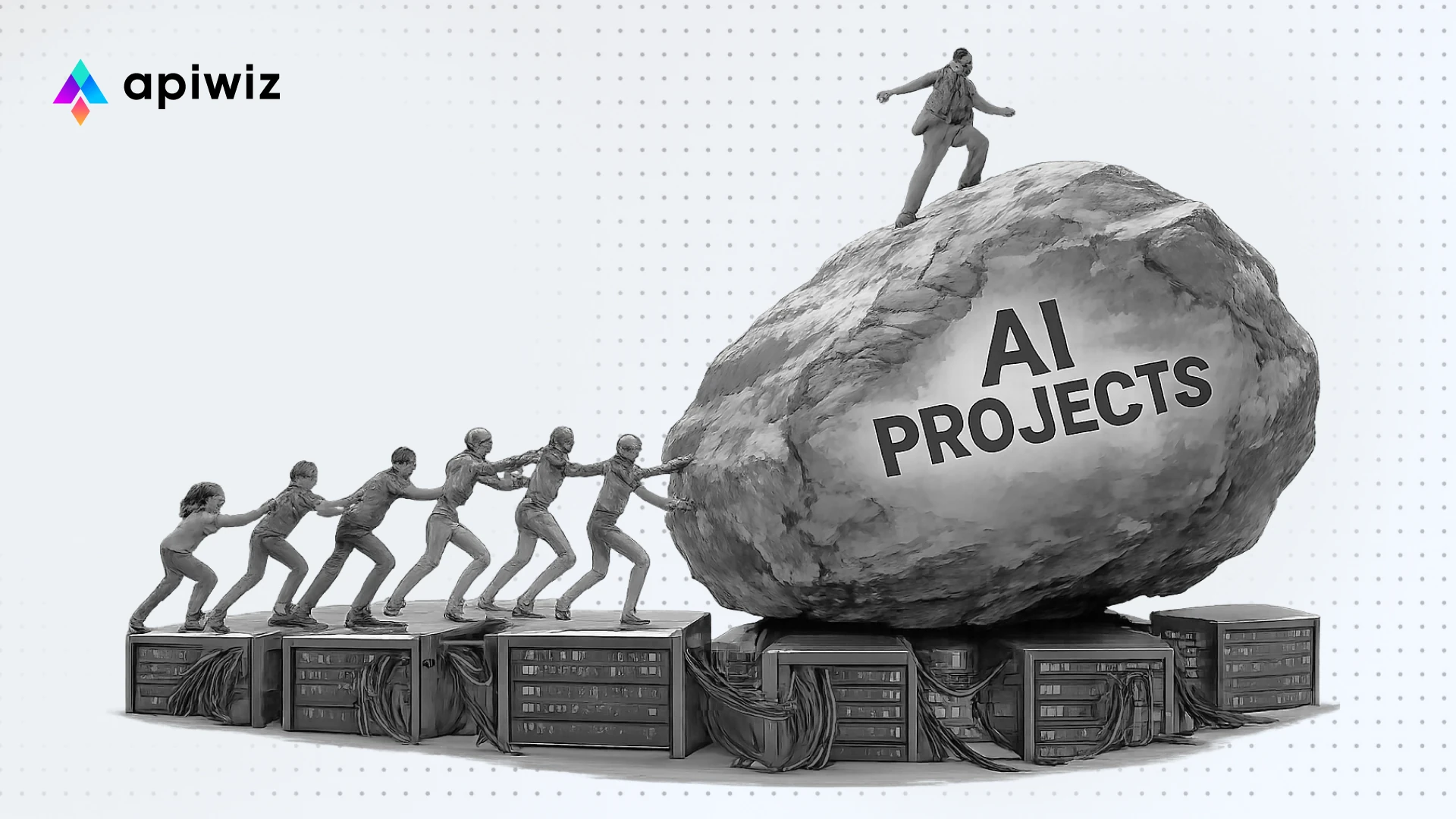
MIT’s 2025 State of AI in Business report states 95% of GenAI pilots fail to scale, and only 5% deliver measurable revenue acceleration.
The gap between AI enthusiasm and AI execution has nothing to do with the capability of AI models. The technology is ready. The real gap is organizational readiness and in most enterprises, the digital foundation simply isn’t ready for AI.
This article breaks down why companies are getting stuck in AI pilots and what it truly takes to turn AI from scattered experiments into a production-grade enterprise capability.
Understanding Why Pilots Fail to Scale
Before diving into the blueprint, let’s understand what separates the 5% who successfully scale from everyone else. The barriers fall into five critical categories:
1. The Business Alignment Gap
Many AI pilots begin as technology experiments rather than business-driven initiatives. A data science team gets excited about a new model, builds a proof of concept, demonstrates impressive accuracy, and then… nothing happens. When objectives disconnect from measurable KPIs, projects struggle to gain executive sponsorship or budget for scaling.
The ownership vacuum: Gartner’s research highlights leadership gaps: while many boards prioritize AI, ownership remains unclear, with CEOs often leading but distributed across C-suite roles. The confusion cascades down through organizations—data science teams assume business units own the use case, business units assume IT owns the implementation, and IT assumes data science owns the outcomes. The result is impressive demos never translate to business value because no one defines what value looks like.
2. The Integration Complexity Wall
78% of enterprises struggle with AI integration. AI agents break when they encounter inconsistent APIs, outdated documentation, and fragmented systems. As organizations leverage AI models from different providers, consuming models directly from applications creates point-to-point integration complexity that makes scaling nearly impossible.
The reality: every department built APIs with different standards, documentation contradicts actual behavior, authentication patterns differ across systems, and legacy systems require 6-9 months of middleware development just to connect.
3. The Workflow and Tooling Chaos
A typical enterprise business process doesn’t happen in a single system. It spans 10-15 different tools, with data and context passing through email, Slack messages, spreadsheet attachments, and manual handoffs between teams. There’s no single workflow engine orchestrating this—it’s held together by human memory and informal processes.
Often there are brittle integrations held together by manual workarounds and AI agents amplify these brittleness problems because they generate more API calls, need faster response times, and lack the human ability to work around problems when integrations fail.
4. The Data Foundation Problem
AI thrives on quality data, but most organizations operate in silos where data is inconsistent, incomplete, or inaccessible. Customer data lives in multiple different systems with multiple different schemas. There’s no single source of truth.
5. The Lack of AI Operational Controls
Few companies have established machine learning operations (MLOps) pipelines to handle version control, testing, deployment, and monitoring of models. Moving from prototype to production demands scalable infrastructure and automation. Many organizations can train models, but deploying them reliably, monitoring performance, and ensuring governance at scale requires different skill sets and tools.
Without proper operational controls, your most promising models can silently decay in production.
6. The Governance, Culture, and Risk Challenges
Gartner predicts 60% of AI initiatives will fail by 2027 due to staff resistance, higher than typical executive citations. Data privacy concerns top GenAI risks at 42%, with hallucinations noted as key reliability issues impacting trust. What tends to happen is that generative AI efforts end up in ‘limbo’ between proof of concept and production because the governance required for approval isn’t in place.
Teams are under pressure to move fast, but without the proper guardrails, risk and compliance teams can’t sign off keeping even high-value AI pilots stuck on the sidelines.
The good news: These are solvable problems with proven solutions. The organizations scaling AI successfully today built the foundations that make these challenges manageable.
The Enterprise AI Scaling Blueprint
Success in scaling AI requires a holistic transformation across strategy, systems, people, and governance.
Step 1: Start With High-Value, Well-Defined Use Cases
Scaling AI begins with clear business problems where AI offers both leverage and longevity, rather than brainstorming sessions or “let’s try this model.”
Here are few things to consider:
- Strategic importance: Does this use case move a hard business metric—revenue, cost, risk, or customer satisfaction? If you can’t tie it to a KPI, it will be the first thing cut when budgets tighten.
- Operational repeatability: Does the task happen hundreds or thousands of times per week?
- Manageable risk : Can you start with advisory or assistive AI before full automation? Internal operations and low-stakes decisions are better starting points
Step 2: Build Cross-Functional AI Delivery Teams
Build AI fusion teams rather than isolated labs as scaling AI requires integration, which requires collaboration.
A fusion team includes:
- product lead (defines value + success)
- process owner (owns workflow)
- engineering lead (integrations + infra)
- data/ML lead (models + evaluation)
- risk/compliance representative
- change-management lead
This collapses months of back-and-forth into co-owned delivery. Otherwise AI becomes a relay race between misaligned stakeholders, one of the biggest causes of pilot failure.
Step 3: Build the Enterprise Readiness Foundation
This is the most important part and the part most organizations underestimate.
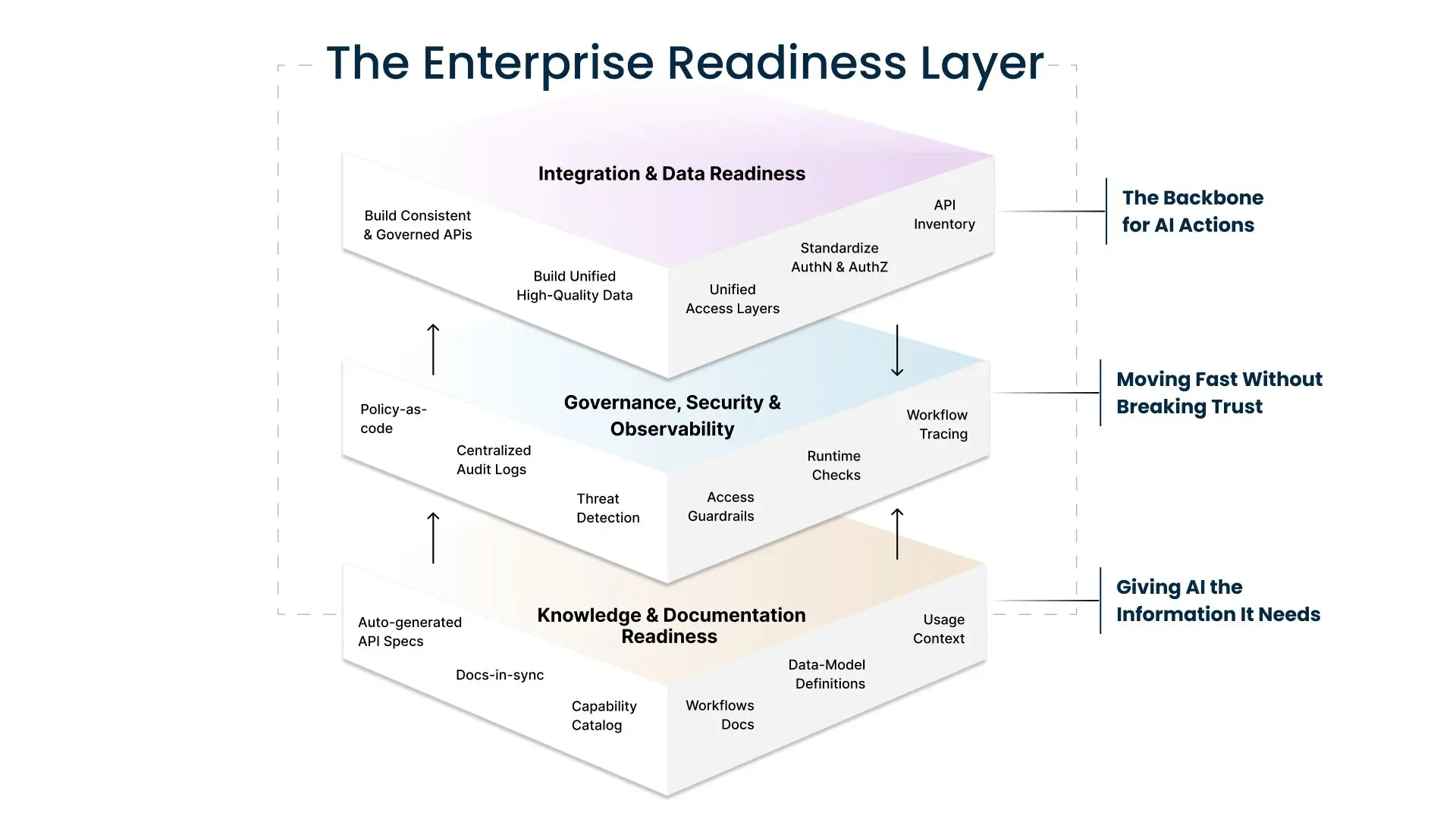
The organizations that scale AI at speed have built what we can call an Enterprise Readiness Layer: the infrastructure that makes your enterprise accessible, navigable, and trustworthy to AI systems.
The foundation has three essential layers that work together: We’ll go deeper into these layers in the next section.
Step 4: Implement AI Operations (MLOps)
Operating AI in production is where most organizations struggle. Treat AI like any other critical system: with proper operations.
- Model and prompt versioning – clear tracking of what’s running where.
- Automated evaluations – regular tests for accuracy, bias, and safety, not one-off checks at launch.
- Monitoring and drift detection – alerts when behavior or input data shifts.
- Guardrails and policies – encoded rules on what AI can and cannot do.
- Human-in-the-loop for high-stakes actions – structured escalation and override paths.
- Safe rollout patterns – blue/green deployments, canary releases, and fast rollback.
The Enterprise Readiness Layer- Deep Dive
These foundational layers form what can be described as the Enterprise Readiness Layer — the critical infrastructure that allows AI to move from isolated experiments to system-level automation. Think of this as your technical foundation.
Layer 1: Integration & Data Readiness ( Making the Enterprise Accessible)
AI systems need to call APIs, pull data, trigger workflows, and move across systems that were never designed to talk to each other. The first layer is about making the enterprise coherent, so AI can actually navigate it.
1.1 Build Consistent, Governed APIs (The Backbone for AI Actions)
If your APIs are inconsistent, undocumented, or behave differently across teams, your AI will break the moment it tries to integrate.
Your organization needs to:
- Enforce consistent API contracts
- Standardize authentication and authorization
- Adopt versioning and error-handling patterns
- Map and inventory all existing APIs
- Document purpose, inputs, outputs, and ownership
When you do this, AI interacts through a single predictable, governed API layer. This removes the integration complexity barrier—the #1 blocker reported by CIOs
1.2 Build Unified, High-Quality Data (The Backbone for AI Understanding)
AI will fail or worse, make wrong decisions if your data is fragmented, duplicated, or contradictory.
Leaders need to invest in:
- canonical data models for core entities
- unified data access layers
- governance for sensitive data
- automated quality checks
- entity consistency across systems
Clean data leads to operational reliability.
It’s the difference between an agent making a correct decision and making a costly one.
1.3 Workflow Standardization (Backbone of AI Context)
When APIs are not orchestrated into end-to-end workflows, AI agents are forced to guess the sequence, stitch context manually, or call systems in the wrong order.
Your organization must:
- Design use-case–based API workflows, not standalone endpoints
- Define the orchestration logic connecting APIs into a full business flow
- Model events and triggers so downstream systems update automatically
- Establish retry, timeout, and dependency rules at the workflow level
- Centralize orchestration instead of stitching point-to-point integrations
This transforms scattered APIs into coherent, machine-navigable workflows —giving AI the context it needs to act reliably and autonomously.
Layer 2 — Governance, Security & Observability: (Moving Fast Without Breaking Trust)
Once the enterprise becomes legible to AI, the next challenge is ensuring it operates safely, predictably, and within guardrails.Build governance as an operating system
2.1 Implement Security & Guardrails by Default
AI interacts with sensitive systems at machine speed. Your security posture must be prepared for that.
- Enforce policy-as-code for data access
- Adopt consistent authentication across systems
- Centralize audit logs for every API triggered
- Detect anomalies in access patterns
- Protect against prompt injection and unsafe outputs
- Implement rate limits to protect legacy systems
- Tag and Track Sensitive data point exposure to prevent compliance issues
These controls ensure AI can act but only within approved boundaries.
2.2 Build AI Governance
AI governance must accelerate, not block.
- Automate compliance checks at runtime
- Encode privacy, bias, and safety rules into pipelines
- Build approval workflows for high-stakes outputs
- Require human review only where impact demands it
- Monitor AI for errors, hallucinations, and drift
- Enforce consistent review processes across teams
The result is speed with safety—not speed versus safety.
2.3 Build Observability Across All AI Workflows
You must implement:
- End-to-End tracing for every API Workflow
- Production Monitoring for accuracy, latency, and anomalies
- Drift detection for both data and behaviour
- Alerting for unexpected access or deviations
- Logs for auditing and debugging
This level of visibility ensures AI becomes predictable and predictable systems scale.
Layer 3 — Knowledge & Documentation Readiness(Giving AI the Information It Needs)
AI agents rely on documentation the same way developers do — except they cannot “figure it out” when documentation is wrong.If your knowledge is scattered or outdated, AI will fail.
3.1 Auto-Generate Documentation That Never Drifts
Manual API documentation always becomes outdated. AI cannot work with mismatches between reality and documentation.
Your org must:
- auto-generate OpenAPI/AsyncAPI specs from source
- validate examples as part of CI/CD
- block deployments where documentation fails
- maintain a single registry for all specs
This keeps your docs precise, current, and machine-readable.
3.2 Build a Unified Enterprise Capability Catalog
AI agents need to know:
- what APIs exist
- what workflows they can trigger
- what data they can access
- who owns each capability
You must create a central, searchable, machine-readable catalog of:
- APIs: Individual capabilities the AI can call representing specific “tools” it can use to fulfil user requests.
- API Workflows: Pre-orchestrated sequences of APIs mapped to real business use cases, enabling AI to handle complex, multi-step tasks reliably.
- Data Models: Clear definitions of the business entities (customers, orders, products, accounts) so AI knows what data exists, how it is structured, and how it can be used.
- Documentation: Context about when and how to call each API or workflow, what each capability does, expected inputs/outputs, and guardrails to follow.
This becomes the “map” of your enterprise for AI.
Closing the Readiness Gap with APIwiz
As you evaluate your organization's AI Readiness, the gap between early pilot success and true enterprise scale can feel overwhelming. This is where APIwiz becomes a catalyst for AI transformation. By automating and governing the technical foundation outlined in this blueprint, APIwiz turns fragmented systems into a machine-navigable ecosystem.
- For Integration Readiness: APIwiz provides the API Catalog and Design-First Governance needed to enforce consistent contracts and standardized auth/versioning. It ensures your "Backbone for AI Actions" is predictable and governed from day one.
- For Workflow Standardization: The API Workflow Builder lets you pre-orchestrate scattered APIs into end-to-end business flows. Instead of AI agents guessing your sequences, they follow the machine-readable "map" you’ve built in APIwiz.
- For Security & Governance: By treating Policy-as-Code, APIwiz automates compliance checks and sensitive data masking at runtime. You move at machine speed without breaking trust, ensuring that risk teams are "enablers" rather than "blockers."
- For Knowledge Readiness: With Always-in-Sync Documentation and a Unified Enterprise Capability Catalog, your AI agents have access to the exact context they need, eliminating the hallucinations caused by outdated or fragmented metadata.
AI transformation is about building durable organizational and technical foundations that allow intelligence to scale. When this foundation is in place, every new AI capability becomes faster, cheaper, and more reliable to deploy, creating compounding returns over time.
Click here to a Demo with APIwiz
Effortless API Management at scale.
Support existing investments & retain context across runtimes.
.webp)
Effortless API Management at scale.
Support existing investments & retain context across runtimes.