

API Virtualization: Build Reliable Partner Sandboxes Before the Backend Is Ready

What is API virtualization?
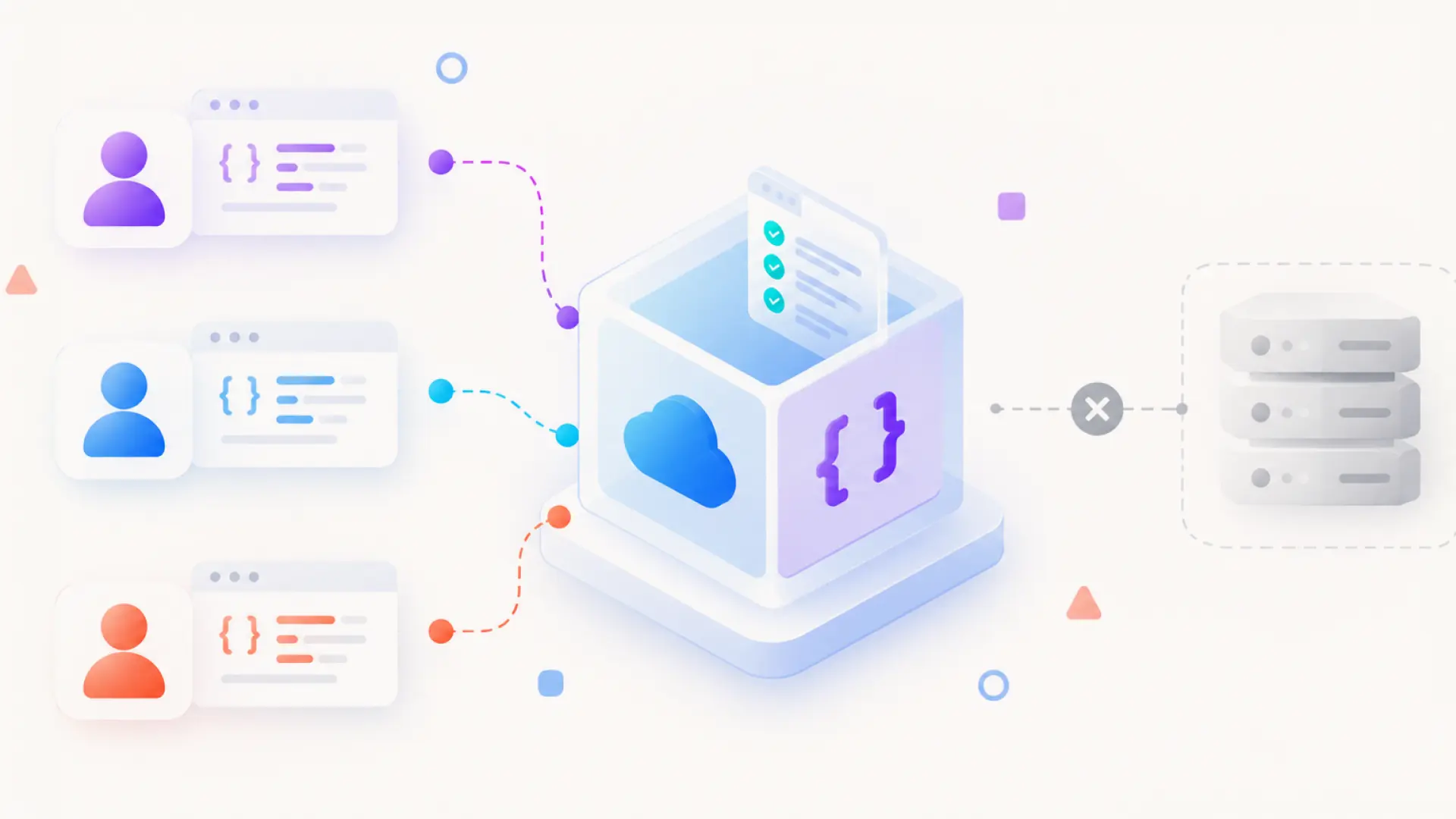
API virtualization creates a simulated API that reproduces a real service's contract and selected behavior, including responses, state changes, latency, and failures. Teams use it when the actual API is unavailable, unfinished, unstable, restricted, or costly to access.
The core capabilities of API virtualization include:
- Versioned API contracts: Define the operations, schemas, security schemes, and error formats the simulation must follow.
- Dynamic responses: Return different outputs based on request headers, parameters, payloads, and scenario rules.
- Stateful workflows: Preserve state changes across related calls using isolated synthetic data.
- Latency and failure simulation: Reproduce timeouts, rate limits, delayed processing, and specific error responses.
- Reconciliation with the real API: Compare simulated behavior against the released API and resolve any differences.
Below, we examine why backend dependencies slow API delivery, how shared environments and manual mocks create friction, how API virtualization processes requests, and what a unified four-phase framework looks like. We also cover how platforms like APIwiz support the workflow, how to measure its impact, and how to assess sandbox readiness.
Why do backend dependencies slow API delivery?
API delivery slows when one team cannot continue until another service, environment, or data source is ready. Frontend, mobile, QA, integration, and partner teams often depend on backend systems owned by different teams or vendors. Those dependencies may be incomplete, unavailable, restricted, or moving on a different release schedule.
Without stable behavior to test against, consumers can implement only part of an integration. They cannot reliably validate authentication, state changes, retries, rate limits, error handling, or other multi-step workflows. Work that could proceed in parallel becomes sequential.
The dependency bottleneck usually appears in five ways:
- A shared test environment that is unavailable, being used by another team, or changing during a release.
- An external service that is restricted, rate-limited, costly to call, or unreliable.
- Production data that cannot be placed in a developer or partner environment without equivalent security controls, as advised by OWASP's guidance for non-production API deployments.
- Failure conditions such as timeouts, rejected transactions, and delayed responses that cannot be triggered predictably in the live system.
- A dependent service that is delivered on a different schedule from the applications consuming it.
A manufacturer is launching an ordering portal for distributors. The portal and partner teams are ready, but the ERP adapter and shared test environment are not. They can build against the API contract, but cannot validate inventory, pricing, or duplicate-order behavior until late integration.
The result is more than a delayed test cycle. Each dependent team incurs different operational costs, ranging from blocked development and unstable automation to environment overhead and late consumer feedback.
How do backend delays create friction across API teams?
Backend delays leave teams without a shared, testable view of how the API should behave. Work may continue, but the engineering, QA, platform, operations, and product teams begin making decisions based on different assumptions, data, and API versions. The longer these differences remain unresolved, the more coordination and rework integration requires.
The friction compounds across handoffs. An engineer may implement one interpretation of an error response, QA may prepare tests for another, and a partner may integrate against a different contract version. When the backend becomes available, these mismatches emerge together and are difficult to trace to their source.
Shared staging environments and manual mocks can reduce some of this friction by giving teams something to build and test against before the backend is ready. However, they may not cover stateful workflows, repeatable failure conditions, isolated test data, or the correct contract version.
These gaps often surface during final integration, when teams have the least time to resolve them. Understanding why requires a closer look at where these common workarounds fall short.
Why do shared staging environments and manual mocks fail?
Shared staging environments and manual mocks are useful starting points, but they solve different parts of the dependency problem. Staging provides access to a real implementation but offers limited control and isolation.
Manual mocks provide greater availability and control, but they reproduce only the behaviors teams explicitly build and maintain. Both approaches become harder to rely on as consumers, scenarios, and API versions multiply.
Shared staging environments make test results harder to reproduce. When teams use the same service versions, credentials, and test data, one team's deployment, data change, or environment reset can affect another team's tests. A failure may reflect the condition of the environment rather than a defect in the client, which is why AWS DevOps Guidance recommends isolating integration tests from shared environments where possible.
Static responses validate only known interactions. A fixed payload can show that a client sends a request and handles a predefined response. By itself, it cannot validate request-dependent outputs, state transitions, post-transaction data, or a workflow that moves from ACCEPTED to PROCESSING to COMPLETED.
Manually maintained mocks can diverge from the real API. When the service contract or behavior changes without a corresponding mock update, consumers may pass tests against responses the released API no longer provides. Versioning and contract testing help teams detect this divergence.
Late integration leaves important behavior untested. Authentication, idempotency, rate limits, timeouts, and downstream failures may remain unverified until the real backend becomes available. Teams then have less time to determine whether a failure originates in the client, the test setup, or the service.
These limitations are where API virtualization becomes useful. However, API mocking and API virtualization are not separated by a universal capability boundary. Modern mocking tools may also support dynamic responses, stateful scenarios, latency, and fault injection.
The practical distinction lies in the levels of behavioral fidelity, repeatability, versioning, and governance required to validate real integration scenarios. A static success response may support early client development, but validating a multi-step integration requires a more complete simulation of the API's behavior. The next section explains how that simulation processes a request.
How does API virtualization work?
At runtime, an application sends a request to a virtual endpoint in place of the dependent service. The virtualization layer matches the request to an API operation and active scenario using details such as the HTTP method, path, parameters, headers, and body.
It then selects or generates the configured status code, headers, response body, and response timing. If the scenario maintains state, the request can update stored synthetic data or move the workflow to its next state, which determines how later requests are handled.
When matching rules, starting data, state transitions, and nondeterministic inputs such as timestamps or generated IDs are controlled, teams can reproduce the same outcome from the same starting state. This makes integration scenarios easier to automate and diagnose without requiring the real backend for every test.
These request-level mechanics explain how a virtual endpoint behaves. A unified framework defines how teams create, operate, validate, and reconcile virtual APIs across environments and releases.
What does a unified API virtualization framework look like?
A practical API virtualization framework connects four phases: define what the API promises, provide a controlled environment, simulate the behaviors clients must handle, and continuously validate the result. Together, these phases turn a temporary mock endpoint into a repeatable testing workflow.
Phase 1: Create the virtual API from an approved contract
Start with the contract version that teams and partners are expected to implement. An OpenAPI Description can define operations, parameters, schemas, security schemes, and responses.
The contract should be accompanied by a concise scope covering supported workflows, known exclusions, ownership, and acceptance criteria. This establishes exactly what the virtual API represents without implying that it reproduces every production behavior.
Phase 2: Provide isolated, reusable environments
Give each team or partner an isolated environment or tenant that starts from a known state. Use synthetic data, resettable scenarios, pinned contract versions, revocable credentials, and a clearly identified owner.
A small set of seeded records can represent conditions such as available inventory, customer-specific pricing, a backordered item, or an existing order. This allows teams to repeat the same tests without affecting one another or using real customer data.
Phase 3: Simulate relevant behavior and failures
Model the behaviors that can change how a client responds, including request-dependent outputs, state transitions, timeouts, rate limits, authentication failures, duplicate requests, and downstream errors.
Make these conditions deterministic so the same trigger produces the expected result on every run. Focus on scenarios that affect consumer acceptance or application resilience; unnecessary realism increases maintenance without improving confidence.
Phase 4: Automate validation and reconciliation
Run the agreed scenarios during development and in CI/CD, recording the contract, scenario, and client-build versions for each result. Passing these tests shows that the client handles the behavior represented by the virtual API, not that every production condition has been validated.
When the real backend becomes available, replay the same scenarios against it. Compare responses, errors, and state transitions, then classify differences as simulation defects, service defects, or approved contract changes. This reconciliation keeps the virtual API aligned as the service evolves.
How do you stop the virtual API from drifting?
Reconciliation catches divergence after the backend ships. The more valuable control catches it at commit time.
The failure mode described earlier — consumers passing tests against responses the released API no longer provides — happens when the simulation is maintained separately from the contract. Two practices prevent it structurally rather than detecting it later.
Generate the simulation from the contract rather than authoring it alongside. When responses, schemas and error formats are derived from the published API description, a contract change propagates automatically instead of waiting for someone to update a mock. What remains hand-authored is the part a contract cannot express: state transitions, scenario triggers, and seeded data.
Fail the pipeline when the contract and the simulation disagree. Validate the virtual API's responses against the current contract on every build, and treat a mismatch as a build failure rather than a warning. Consumer-driven contract testing extends this to the other side of the integration, with each consumer publishing the subset of behavior it actually depends on, so the provider learns at build time when a change would break a specific client.
This also changes what "scenario maintenance effort" measures. If that number is rising while contract changes are frequent, the simulation is probably being maintained by hand when it could be generated.
What changes when AI agents consume your sandbox?
Partner integrations increasingly include autonomous agents, either because the partner has built one or because the partner's own product embeds one. That changes several assumptions in a sandbox designed for human developers.
Documentation is no longer the onboarding path. A developer reads a getting-started guide and infers intent from an incomplete description. An agent does neither. Whatever the sandbox expects — authentication sequence, required headers, state preconditions — has to be expressed in the contract and machine-readable metadata rather than in prose around it.
Failure handling needs testing, not assuming. Agents retry more aggressively than human-written clients and may treat a rate-limit response as transient rather than instructive. The sandbox is the right place to find out: simulate the rate limit, the timeout and the duplicate submission, then observe whether the agent honors Retry-After and whether its retry creates a second order.
The sandbox may need to exist at the tool layer too. Where a partner reaches your API through an MCP server or similar tool interface, the behavior that needs simulating is the tool invocation, not only the underlying HTTP call. Teams exposing APIs to agents this way should decide whether the virtual environment covers that layer or stops below it, and document which.
Scenario authoring is also becoming less manual. Generating candidate scenarios and synthetic data from a contract is now practical, which lowers the maintenance cost this guide treats as a real constraint. The judgement that remains human is deciding which behaviors matter enough to simulate.
How do platforms like APIwiz support API virtualization?
The four-phase framework depends on keeping the API contract, simulated behavior, test scenarios, ownership, and partner documentation aligned. An API platform adds value by connecting these artifacts rather than allowing the virtual API to become another separately maintained test asset.
APIwiz provides four connected capabilities that support the API virtualization framework:
- Establish a governed baseline: APIwiz Design supports collaborative specification design, version management, changelogs, and design-stage linting. These capabilities help teams identify the contract version and governance rules the virtual API must follow.
- Simulate and test before the backend is ready: API Sandbox and API Test Suite support mocked API behavior, simulated workflows, integration testing without backend dependencies, and automated scenario-driven tests across environments.
- Preserve ownership and version context: Service Registry records API metadata, versions, owners, and dependencies. This helps teams connect the virtual environment to the API and service it represents.
- Give partners usable access: APIwiz Distribute provides controlled-access API guides, API references with interactive tryouts and changelogs, and an API Marketplace for internal, partner, and public APIs.
These capabilities connect the virtualization workflow, but teams still determine what the simulation must reproduce. Contract owners define supported workflows and exclusions; scenario owners maintain test data and expected behavior; and delivery teams compare the virtual API with the released service. The platform helps teams operationalize these responsibilities through a shared, repeatable workflow.
How should teams measure the impact of API virtualization?
Measure both the delivery improvements created by virtualization and the effort required to keep the virtual API accurate. Establish a baseline for the same APIs and workflows before adoption, then compare results by team, partner, and release rather than relying on generic percentage claims.
Treat the following as program-specific indicators rather than a formal industry benchmark. DORA's software delivery metrics measure overall delivery throughput and instability, while AWS guidance on continuous integration includes build success and pipeline failures due to infrastructure or configuration issues. The measures below isolate the bottlenecks virtualization is intended to change.
Interpret these metrics together. If blocked time and dependency-related failures decrease while escaped mismatches remain stable or decline, virtualization is improving delivery without sacrificing accuracy. If delivery becomes faster but escaped mismatches increase, scenario coverage or behavioral fidelity may be too low.
Rising maintenance effort without a corresponding reduction in blocked time or integration time suggests that the simulation covers more detail than teams need, or that scenarios are not being reused effectively. Continue to track broader DORA metrics separately because virtualization is only one factor affecting overall software delivery performance.
API virtualization readiness checklist
Use this checklist to determine whether a virtual API is ready for internal teams or partners to develop and test against.
Key takeaways
API virtualization allows development and testing to proceed before dependent backends are ready. Its value depends on how accurately and consistently the virtual API represents the behavior teams need to validate.
- Start from an approved contract: Tie each virtual API to a specific contract version, supported scope, acceptance criteria, and owner.
- Enable parallel delivery: Give internal teams and partners isolated, reusable environments before backend implementation is complete.
- Simulate relevant behavior: Cover request-dependent responses, state transitions, timeouts, rate limits, authentication failures, and other conditions that affect client behavior.
- Prevent drift structurally: Generate the simulation from the contract where possible, and fail the build when the two disagree, rather than relying on reconciliation alone.
- Automate scenario validation: Run agreed scenarios during development and in CI/CD, recording the contract, scenario, and client-build versions used.
- Reconcile with the real API: Replay the same scenarios once the backend becomes available, and assign each meaningful difference to an owner.
- Measure delivery and accuracy: Track dependency-blocked time, time to first validated integration, dependency-related pipeline failures, escaped mismatches, and maintenance effort.
Book a demo with APIwiz to see how contract design, API Sandbox, test automation, and service ownership can support parallel API delivery.
FAQs about API virtualization
What is API virtualization?
API virtualization simulates an API's contract and selected behavior so teams can develop and test without depending on the real service. A virtual API can reproduce dynamic responses, state changes, latency, errors, and multi-step workflows.
How is API virtualization different from API mocking?
API mocking typically returns predefined responses that conform to an API contract. API virtualization typically reproduces broader behavior, including conditional responses, state changes, latency, failures, and multi-step workflows. The capabilities can overlap, so the choice depends on the required behavior and test fidelity.
When should teams use API virtualization?
Use API virtualization when a backend is incomplete, unavailable, unstable, restricted, expensive to call, or unable to provide the required test conditions. It is particularly useful when internal teams and partners need to develop and test in parallel against the same contract.
Can virtual API tests replace testing against the real API?
No. Virtual API tests show that a client handles the contract and scenarios represented by the simulation, but they do not validate production performance, deployment configuration, downstream-system behavior, or unmodeled edge cases. Testing against the real API is still required.
How do teams keep virtual APIs aligned with the real API?
Replay the same acceptance scenarios against each relevant release of the real API. Compare responses, errors, and state changes, classify meaningful differences, assign owners, and update the contract, scenarios, test data, and documentation together.
Can a sandbox serve AI agents as well as developers?
It can, but the requirements differ. An agent cannot infer intent from a getting-started guide, so authentication sequences, required headers, and state preconditions need to be expressed in the contract and machine-readable metadata rather than in surrounding prose. Agents also retry more aggressively than human-written clients, which makes the sandbox the right place to verify whether a partner's agent honors rate-limit responses and whether its retries create duplicate transactions.
What should a partner API sandbox simulate?
A partner sandbox needs to simulate the operations, state transitions, and success and failure conditions of the agreed-upon partner workflows. It also needs to document exclusions, isolate each partner's synthetic test data, support environment resets, and record the contract and scenario versions used for acceptance.
Related reads
- How to Evolve APIs Without Losing Developer Trust
- 8 Signs Your API Developer Portal Is Not Helping Developers
- 7 API Lifecycle Mistakes That Put Revenue, Security, and Customer Trust at Risk
- API Security Checklist 2026
- Policy as Code: How to Automate API Governance from Design to Production
- Top 3 Tips for Developers to Enhance API Testing
- Federated API Management
Effortless API Management at scale.
Support existing investments & retain context across runtimes.

Effortless API Management at scale.
Support existing investments & retain context across runtimes.