


7 API Lifecycle Mistakes That Put Revenue, Security, and Customer Trust at Risk

What is API lifecycle management?
API lifecycle management is the practice of governing APIs from design and build through publishing, monitoring, versioning, deprecation, and retirement.
Core parts of API lifecycle management:
- API discovery: finding and cataloging every active, inactive, shadow, and undocumented API.
- API ownership: assigning accountable owners for product, engineering, security, and operations.
- API governance: applying standards for design, security, documentation, versioning, and policy.
- Developer portal: making APIs discoverable, understandable, testable, and consumable through self-service workflows.
- API observability: tracking traffic, latency, errors, consumers, adoption, and lifecycle health.
- API retirement: deprecating, migrating, disabling, and removing APIs when they no longer serve a business need.
Below, we look at seven API lifecycle mistakes that turn ordinary engineering debt into CXO-level exposure across revenue, security, compliance, modernization, and customer trust.
Why do API lifecycle mistakes become business risk?
API lifecycle mistakes become business risk when leaders cannot answer four basic questions: which APIs exist, who owns them, who uses them, and what data they expose.
That visibility gap affects the business in several ways:
- Revenue leakage: valuable APIs are not packaged, metered, priced, or promoted through a developer portal.
- Security exposure: forgotten endpoints continue to accept traffic after the team has moved on, creating potential entry points for attackers.
- Compliance gaps: undocumented APIs and data flows can lead to compliance violations under frameworks such as GDPR, HIPAA, and PCI DSS.
- Customer disruption: breaking changes can disrupt integrations, cause failed transactions, and force customers or partners to rebuild with insufficient notice.
- Duplicated engineering work: teams rebuild APIs that already exist.
- Failed modernization: cloud migration and legacy system replacement leave old endpoints alive.
These risks build when APIs move through design, launch, versioning, and retirement without a single operating model. That is why API lifecycle management needs to be defined in business terms, not only engineering terms.
What does API lifecycle management mean in business terms?
API lifecycle management turns APIs into governed, discoverable, measurable, and retireable digital assets. In business terms, it gives leadership control over the API estate, much like asset management provides control over applications and infrastructure.
A mature API lifecycle program helps leaders see and control six things:
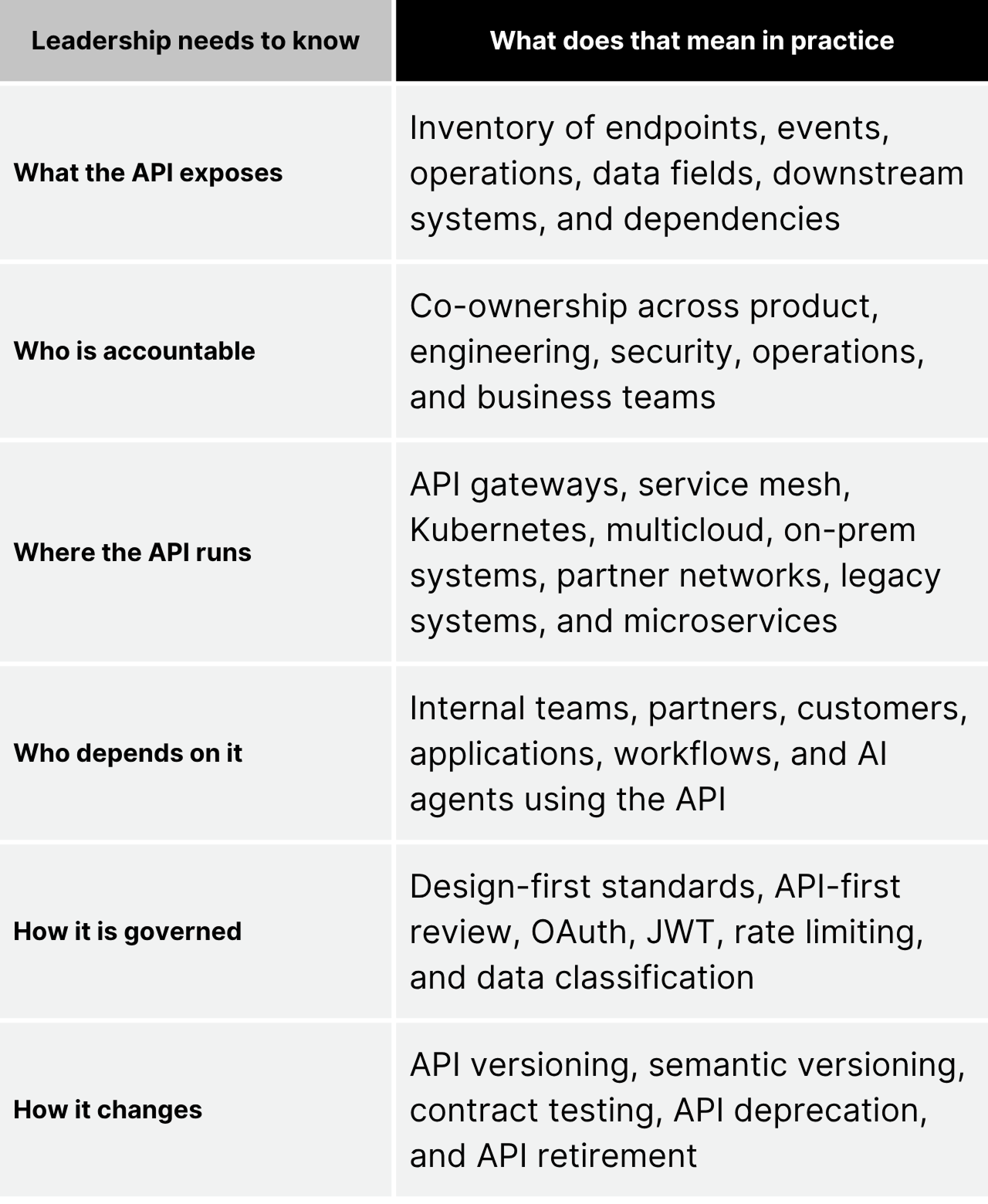
This is why an API catalog or API registry matters. It is not just a directory of endpoints. It is the operating surface where ownership, lifecycle status, documentation quality, policy posture, usage analytics, and retirement plans become visible enough to manage.
What are the seven API lifecycle mistakes leaders should fix?
The seven most damaging API lifecycle mistakes are ownership gaps, skipped governance, stale documentation, unmanaged versions, zombie APIs, narrow technical metrics, and disconnected enforcement. Each mistake looks technical at first. Each one creates a business outcome that the executive team eventually feels.
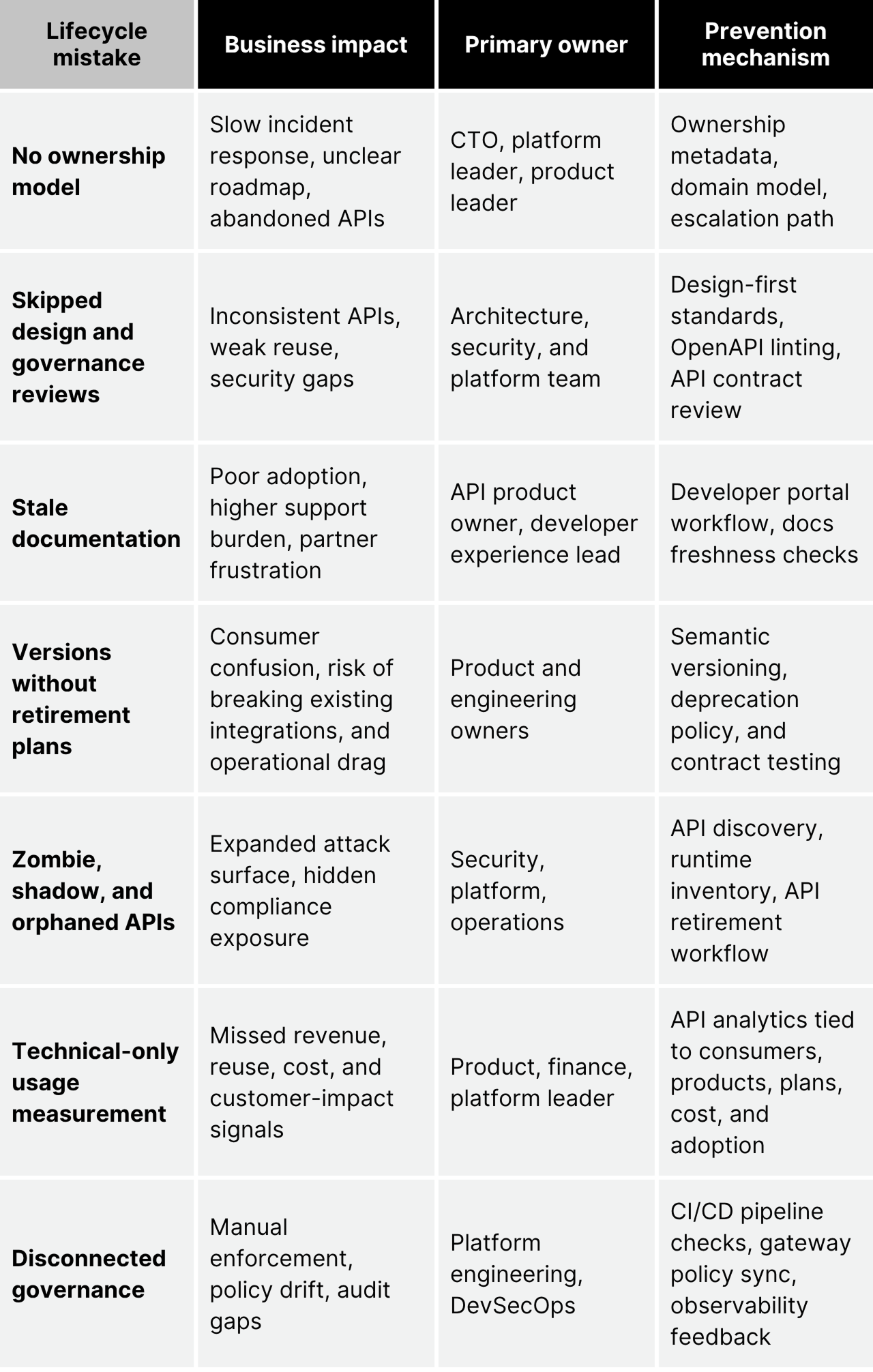
Mistake 1: What happens when APIs have no clear owner?
APIs without accountable owners become business risk because no one is responsible for quality, security, adoption, cost, or retirement. Ownership cannot stop at "the team that built it"; APIs often outlive the team, the project, and the original system.
Ownership gaps create predictable problems:
- No decision-maker for breaking changes
- No accountable approver for OAuth scopes, JWT claims, or rate limiting
- No product owner for packaging, pricing, or developer experience
- No operational owner during incidents
- No security owner when OWASP API Security Top 10 risks are found
- No retirement owner when traffic drops or a legacy system is replaced
A practical starting point is to define the minimum ownership metadata every API needs before it is published or kept active. Here is an example template platform teams can adapt:
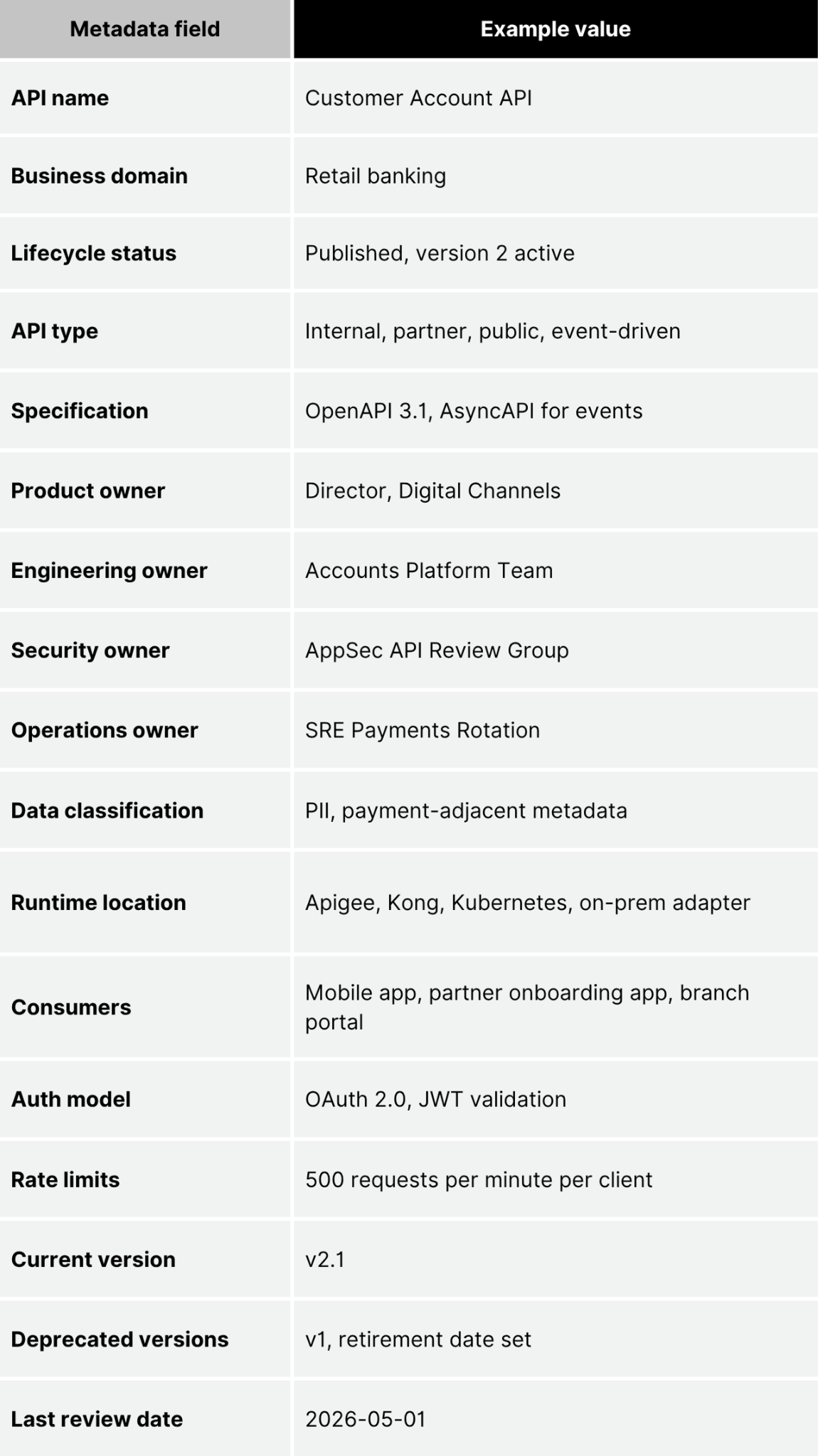
If an API cannot meet this minimum metadata bar, it is not ready to be treated as a governed enterprise asset.
Mistake 2: Why is skipping design and governance review risky?
Skipping design and governance review creates inconsistent APIs that are harder to secure, reuse, monetize, and support. The cost appears later, when every API has a different naming pattern, payload structure, error model, authentication approach, and versioning scheme.
Strong API governance starts before code is merged. Before an API is released, it should pass checks for:
- API-first planning
- Design-first review
- OpenAPI Specification or Swagger definition for REST APIs
- AsyncAPI definition for event-driven APIs
- API contract approval
- Naming, pagination, error, schema, and security standards
- OAuth, JWT, rate limiting, and logging requirements
- Contract testing before release
This is where lifecycle governance differs from gateway-only control. An API gateway, such as Kong or Apigee, can enforce a runtime traffic policy, but it cannot repair a poor API contract after consumers build against it. Gateway controls matter; design governance prevents a large share of avoidable downstream friction.
For executives, the business question is simple: are teams discovering and reusing high-quality APIs, or are they creating local integrations because the approved path feels slow, inconsistent, or unclear?
Mistake 3: Why does stale API documentation hurt adoption?
Stale API documentation hinders adoption because developers lose trust in the developer portal. Once the docs are unreliable, consumers create support tickets, inspect network calls, ask for private Slack help, or avoid the API entirely.
Documentation decay usually starts after launch:
- OpenAPI files do not match production behavior.
- Error codes change without examples.
- Deprecated fields remain in guides.
- Rate limits are enforced but not documented.
- OAuth scopes and JWT claims are unclear.
- Sandbox behavior differs from production.
- Event schemas documented in AsyncAPI no longer match the messages sent in production.
The business costs are measurable: longer onboarding cycles, higher support load, lower API reuse, slower partner activation, and a weaker developer experience. For monetized APIs, documentation gaps also become revenue leakage because customers cannot adopt what they cannot understand.
A healthy API lifecycle program treats documentation as a governed asset. API reference pages, tutorials, examples, SDKs, changelogs, and access workflows should be published through a developer portal and updated as part of the release process, not after someone complains.
APIwiz's API documentation workflows help teams connect design artifacts, standards, and documentation quality before APIs move into broader distribution.
Mistake 4: What goes wrong when versions have no retirement plan?
API versions without retirement plans increase consumer confusion, operational drag, and the risk of breaking existing integrations. Versioning is not the same as lifecycle management; a new version solves only part of the problem.
Without a retirement plan, teams end up with:
- v1, v2, and v3 endpoints running indefinitely
- Consumers are unsure which API version is safe
- Security patches applied across multiple versions
- API analytics fragmented by endpoint and gateway
- Product teams unable to see migration progress
- Infrastructure cost for low-value traffic
- Higher risk of accidental breaking changes
Use semantic versioning where it fits the API contract, and define a deprecation policy that customers and internal teams can trust.
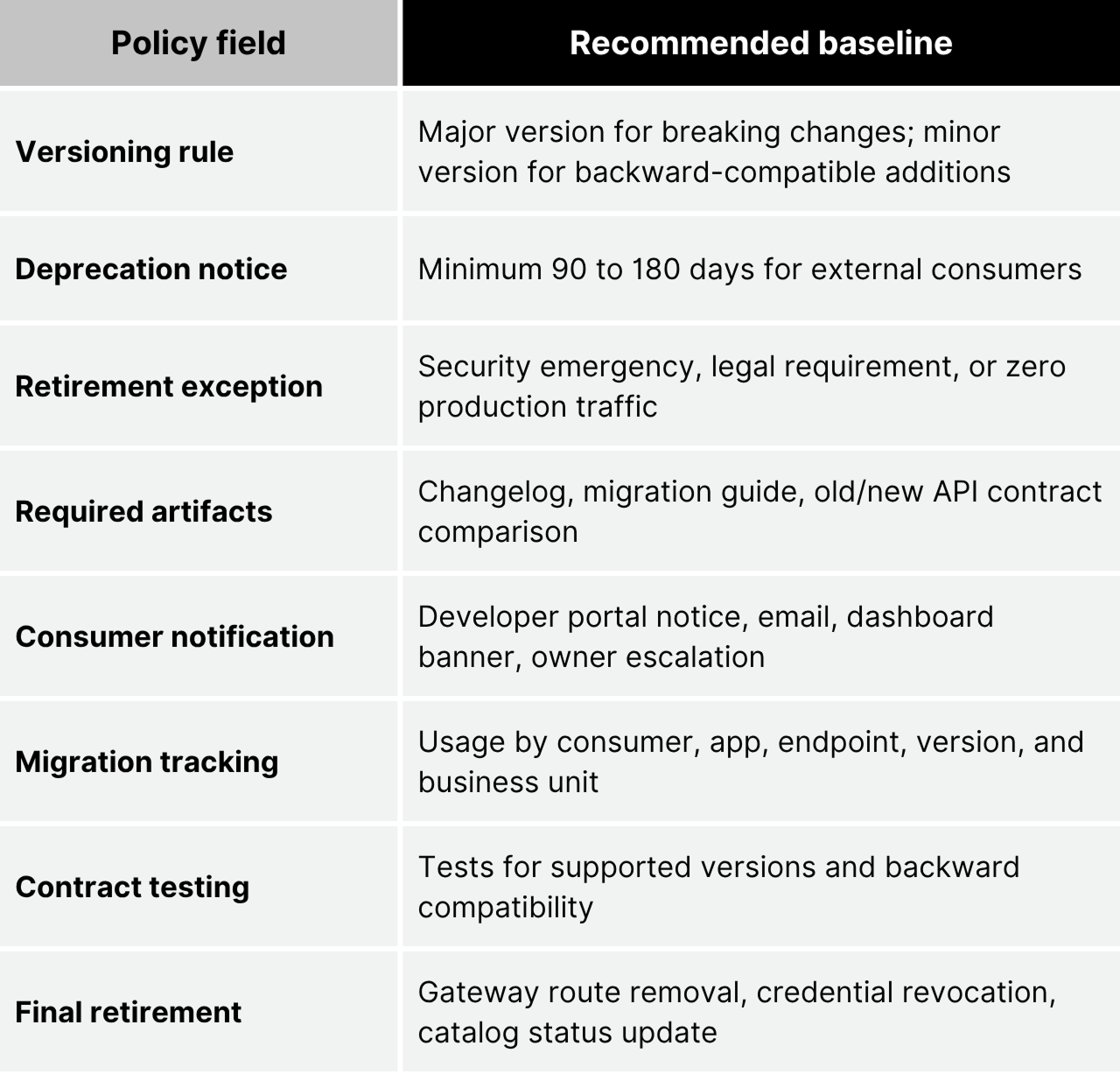
Public API providers handle this carefully because customer integrations depend on it. For example, Slack's developer changelog for the retirement of the files.upload API includes a named sunset date, developer reminders, replacement methods, migration documentation, and a clear warning that apps may break if they do nothing.
For executives, the useful metric is not how many API versions exist. It is how much traffic still depends on deprecated APIs, which consumers are affected, and whether keeping those versions alive is still worth the cost and risk.
Mistake 5: How do zombie, shadow, deprecated, and orphaned APIs expand risk?
Zombie, shadow, deprecated, and orphaned APIs expand risk by keeping unknown or weakly governed endpoints reachable after ownership, documentation, or business need has disappeared.
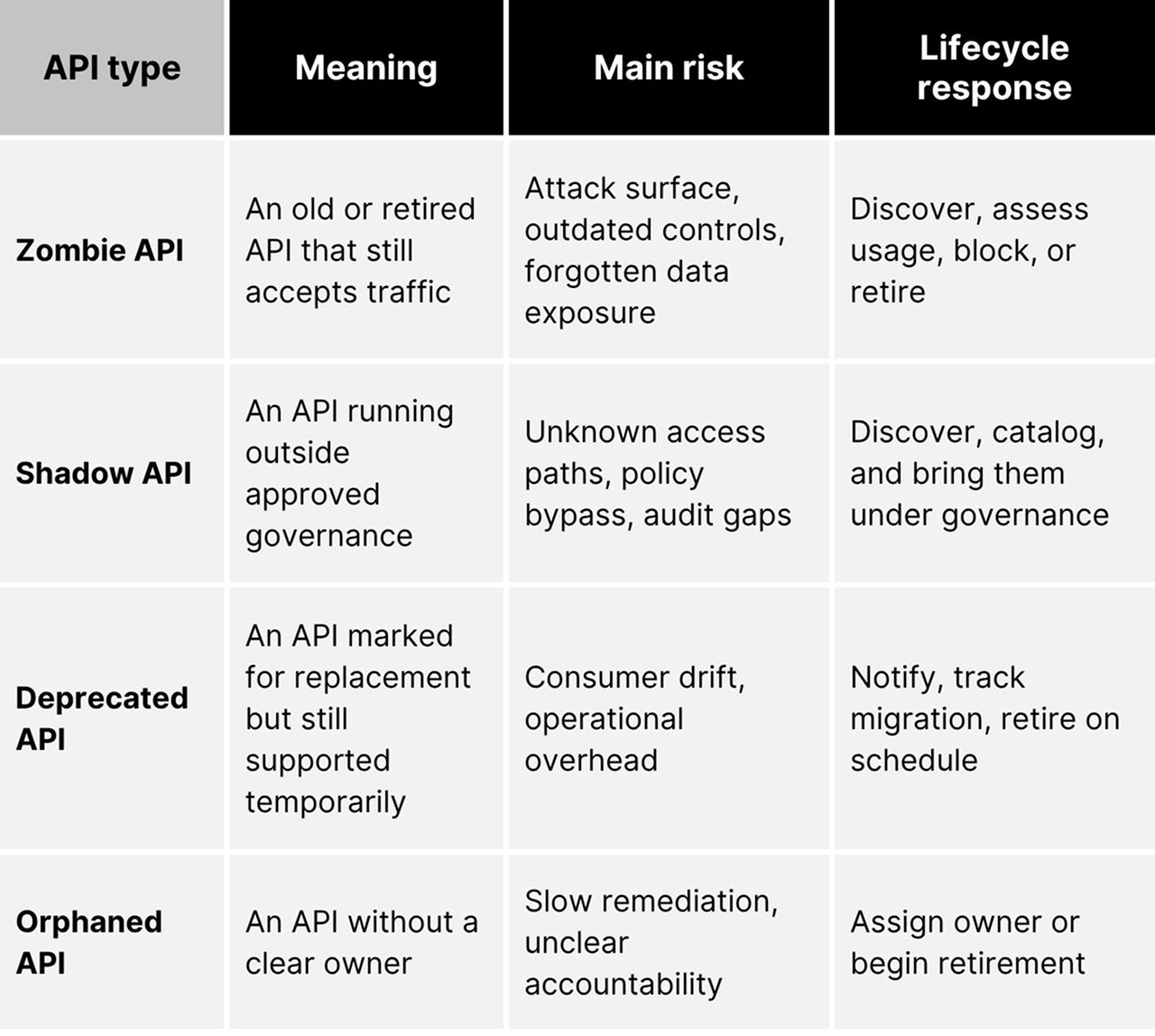
Consider a realistic modernization scenario. A bank migrates customer profile services from an on-prem legacy system to a cloud-native microservices architecture. The new v2 API sits behind the approved API gateway, which provides OAuth, JWT validation, rate limiting, logging, and API observability. But an old v1 endpoint remains active for a partner migration that never finished.
Six months later, that forgotten v1 endpoint still exposes customer profile fields, uses older access rules, and is missing from the current API catalog. Security cannot fully assess it. Compliance cannot easily map the data flow. The product does not know whether any revenue depends on it. Operations sees traffic, but not business context.
That is not an engineering housekeeping issue. It is a problem of security, compliance, customer trust, and modernization. In a 2024 FCC order, T-Mobile's January 2023 API incident was described as a permissions misconfiguration that allowed a threat actor to query an API and obtain customer account data for about 37 million accounts. The point for lifecycle leaders is direct: APIs that expose customer data need current ownership, access controls, monitoring, and retirement discipline.
APIwiz's API security controls and discovery workflows help teams identify unmanaged APIs, bring them into governance, and make retirement decisions with traffic and ownership context.
Mistake 6: Why is technical API usage data not enough?
Technical API usage data is not enough because traffic volume alone does not tell leaders whether APIs are creating value, leaking revenue, duplicating effort, or damaging customer experience.
Most teams can see some runtime metrics:
- Request count
- Error rate
- Latency
- Gateway status codes
- Uptime
- Rate-limit events
Those metrics matter, but executives need commercial and operating signals too:
- API adoption by consumer, partner, app, and business unit
- Reuse across teams
- Revenue by API product or plan
- Support tickets by API and version
- Cost per API, endpoint, consumer, or workflow
- Deprecated API traffic by customer
- Failed onboarding steps in the developer portal
- SLA risk for high-value consumers
An API with low traffic may power a high-value partner workflow. An API with high traffic may be internal duplication that should be consolidated. A deprecated API may look quiet until one enterprise customer is the only remaining user.
API analytics and API observability need business context. APIwiz's API observability layer connects runtime visibility to consumer, product, and lifecycle signals, enabling teams to govern APIs by impact, not just by logs.
Mistake 7: What breaks when governance is disconnected from delivery tools?
Governance breaks when policies live in documents while delivery happens in CI/CD pipelines, API gateways, portals, and observability tools. Manual enforcement cannot keep pace with modern API delivery.
Disconnected governance creates policy drift:
- OpenAPI review happens outside the build process.
- Security exceptions live in email threads.
- Gateway policies differ across Kong, Apigee, cloud, and on-prem runtimes.
- The developer portal content does not match the runtime access.
- API analytics cannot connect usage to ownership.
- Deprecated APIs stay routable because retirement is a spreadsheet task.
The same pattern appears outside API programs too. In its Chegg complaint, the FTC alleged that failures in system monitoring, access controls, and authentication protections meant personal information may have been exposed without the company's knowledge. API programs face the same governance problem when inventory, access control, and observability are disconnected.
The fix is to connect lifecycle controls to the systems teams already use:
- OpenAPI and AsyncAPI linting in CI/CD pipelines
- API contract validation before deployment
- Contract testing for breaking-change prevention
- Gateway policy templates for OAuth, JWT, rate limiting, and logging
- Developer portal workflows for approval, access, and subscription
- API observability alerts tied to owner metadata
- Retirement workflows that remove routes, revoke access, and update catalog status
Governance works best when it becomes the default delivery path. Teams move faster because the approved path is clear, automated, and visible.
How can enterprises reduce API security and compliance risk?
Enterprises reduce API security and compliance risk by combining discovery, ownership, policy enforcement, data classification, observability, and retirement. Security teams cannot protect APIs they cannot see or classify.
Compliance mapping does not replace legal advice, but it helps leaders ask better questions:
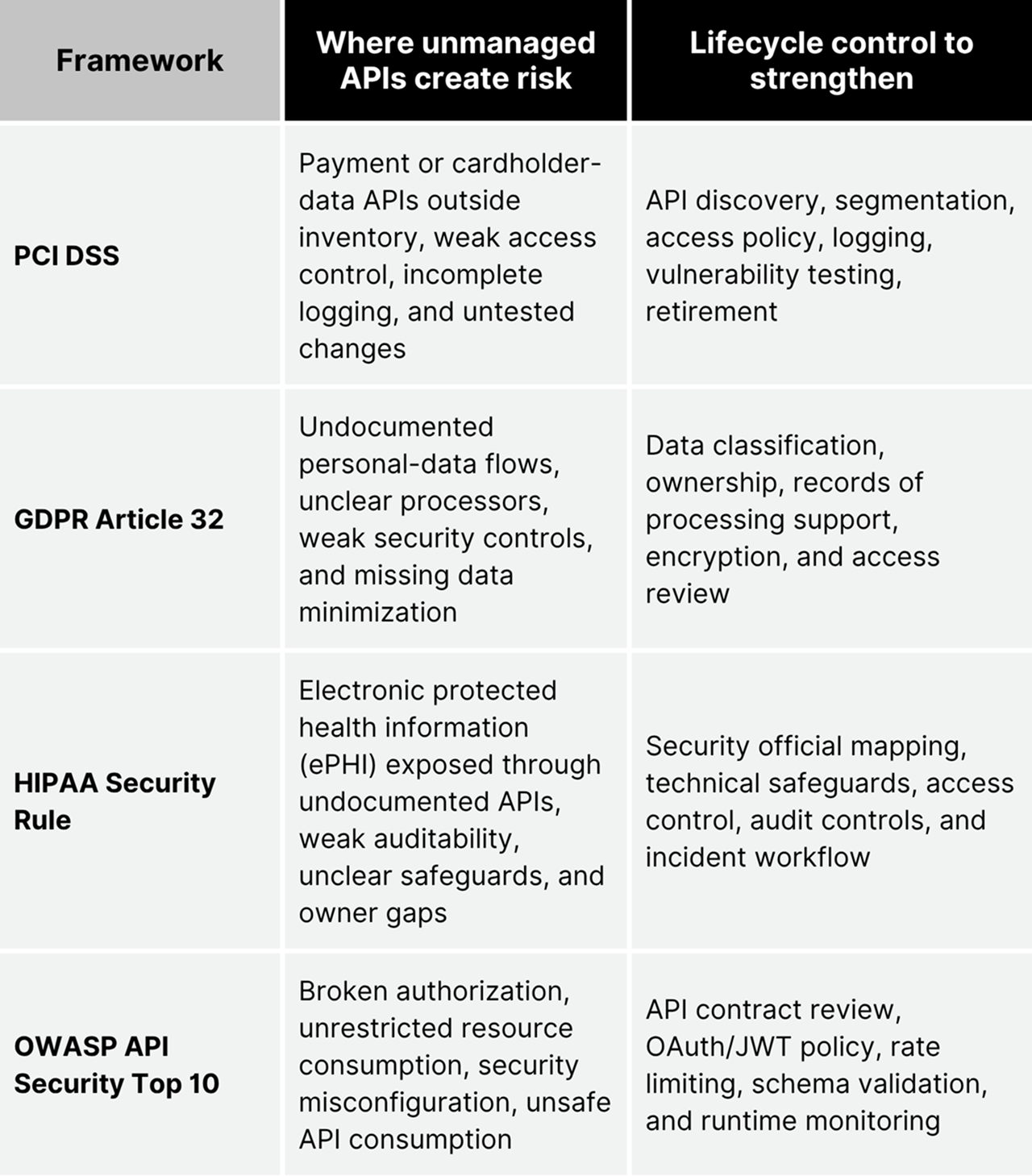
For CXOs, the practical control question is: can the organization produce a current API inventory, including ownership, data classification, access policies, consumers, and lifecycle status, during an audit or incident?
What should CXOs track to measure API lifecycle maturity?
CXOs should track API lifecycle maturity through visibility, ownership, governance, adoption, risk, and retirement metrics. The goal is not more dashboards; it is a short set of indicators that show whether the API estate is under control.
Use this checklist with platform, security, product, and architecture leaders:
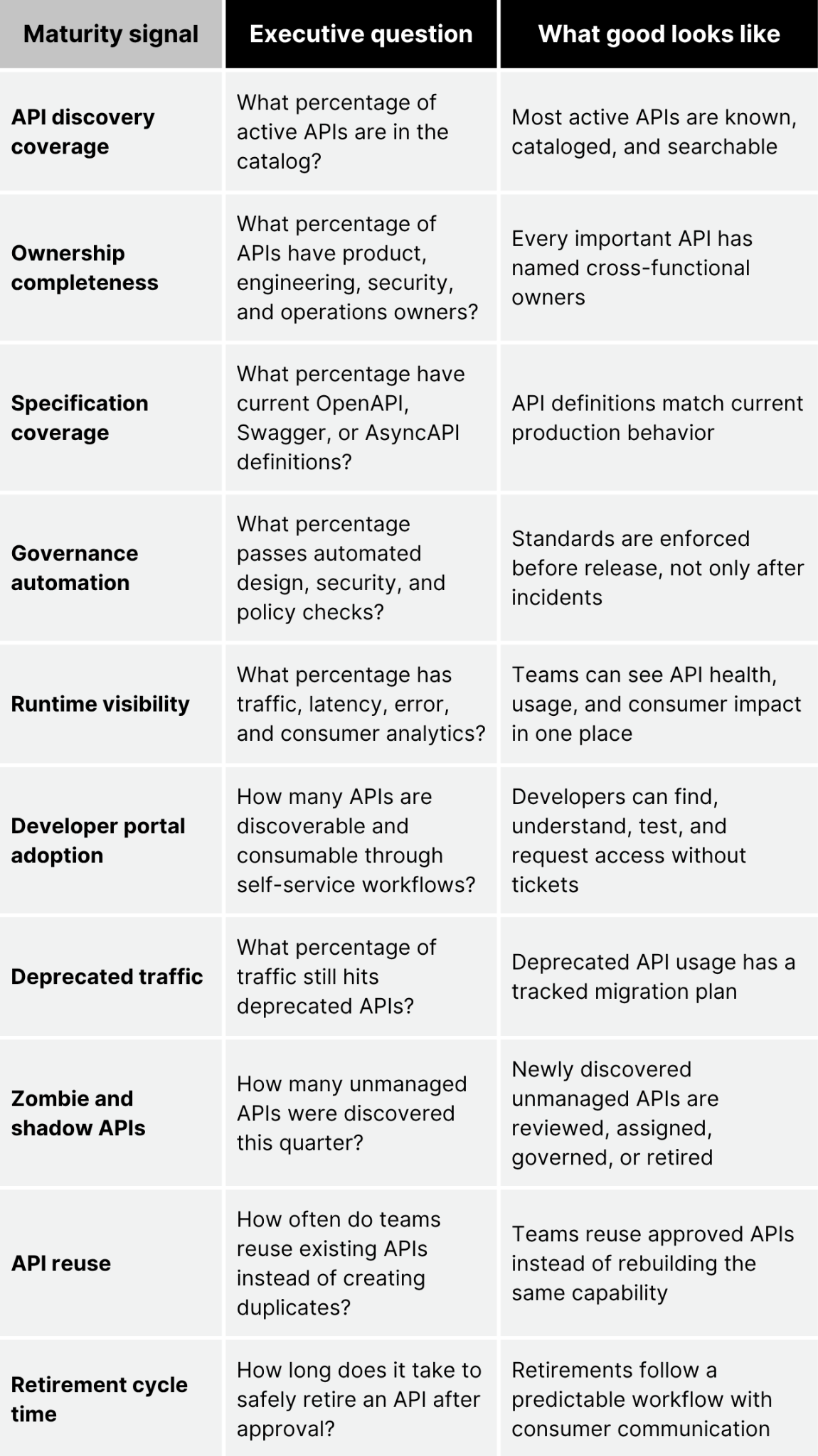
A healthy API lifecycle program makes these metrics reviewable at the executive level and actionable at the team level.
How does APIwiz help reduce API lifecycle risk?
APIwiz serves as a visibility and governance layer throughout the API lifecycle, helping leaders regain control over design, publishing, ownership, monitoring, workflows, and retirement. It is built for enterprises that need governance without forcing every team into a single gateway or a single delivery model.
Where APIwiz helps:
- API discovery: visibility into APIs across environments, including unmanaged endpoints
- Lifecycle governance: design-first standards, review workflows, and policy consistency
- API catalog and registry: ownership metadata, lifecycle status, documentation, and reuse context
- Developer portal workflows: self-service discovery, documentation, access, and subscription paths
- API observability: usage, traffic, latency, errors, consumers, and lifecycle signals
- Security controls: OAuth, JWT, rate limiting, and policy enforcement alignment
- Retirement visibility: deprecated API tracking, consumer migration, and route removal support
APIwiz's API marketplace and monetization workflows also help teams connect API lifecycle management to adoption, packaging, and revenue outcomes, while the CBQ modernization story shows how lifecycle visibility matters during enterprise banking modernization.
Summary
Mature API lifecycle management protects revenue, trust, security, and execution speed. It gives leaders a governed way to know which APIs exist, who owns them, how they are used, whether they meet policy, and when they should be retired.
The organizations that get this right do not treat APIs as scattered technical endpoints. They treat them as managed digital assets with owners, contracts, policies, usage signals, and end-of-life paths.
Book a demo to see how APIwiz helps enterprises discover, govern, observe, publish, and retire APIs across the full API lifecycle.
FAQs
What is API lifecycle management?
API lifecycle management is the governance of APIs from initial design through build, publishing, monitoring, versioning, deprecation, and retirement. It combines API contracts, ownership, documentation, security controls, analytics, and workflow automation. The goal is to make APIs reliable, discoverable, reusable, measurable, and safe to retire.
Why does API lifecycle management matter to business leaders?
API lifecycle management matters to business leaders because APIs carry revenue, customer experience, security, compliance, and modernization risk. Poor lifecycle control can hide abandoned endpoints, delay partner onboarding, increase support costs, and weaken trust. Mature lifecycle management gives leaders a current view of API assets and the controls around them.
What are the biggest risks of poor API lifecycle management?
The biggest risks are revenue leakage, security exposure, compliance gaps, customer disruption, duplicated engineering work, failed migrations, and weak developer experience. These risks grow as API sprawl increases across cloud, on-prem, gateway, and microservices environments. The earlier teams add ownership and governance, the cheaper these risks are to control.
How do zombie APIs relate to API lifecycle management?
Zombie APIs are a symptom of poor API lifecycle management. They are endpoints that remain active after they should have been deprecated or retired. They often lack current ownership, documentation, security review, or business justification, which makes them risky during audits, incidents, and modernization programs.
How can enterprises reduce API security and compliance risk?
Enterprises can reduce API security and compliance risk by discovering all APIs, assigning owners, classifying data, enforcing security policy, monitoring runtime behavior, and retiring endpoints that no longer serve a business purpose. OpenAPI, AsyncAPI, contract testing, OAuth, JWT, rate limiting, and gateway policy automation all help. The control model has to cover the full lifecycle, not only production traffic.
What should CXOs track to measure API lifecycle maturity?
CXOs should track discovery coverage, ownership completeness, specification coverage, governance automation, runtime visibility, developer portal adoption, deprecated API traffic, unmanaged API count, API reuse, and retirement cycle time. These metrics show whether the API estate is becoming more controlled or more fragmented. They also connect technical work to business outcomes such as risk reduction, adoption, revenue protection, and execution speed.
Related reads
- API Management Goes Beyond the API Gateway
- Hidden Cost of API Sprawl
- Your API Gateway Is Lying To You
- How APIwiz Solves API Observability
- API Observability and Compliance
- How Healthy Is Your API Program?
- APIwiz Design
- APIwiz Observe
Effortless API Management at scale.
Support existing investments & retain context across runtimes.
.webp)
Effortless API Management at scale.
Support existing investments & retain context across runtimes.