

API Management Platform Comparison 2026: APIwiz vs Apigee, Kong, Azure, AWS, and More

API management tools are harder to compare in 2026 because the category has split into several sub-categories.
Apigee, Azure API Management, MuleSoft, IBM API Connect, and APIwiz compete for enterprise API programs. Kong and Tyk appeal to gateway-first and Kubernetes-heavy teams. AWS API Gateway is the practical default for AWS-native workloads. Postman and SwaggerHub are strongest as developer workflow platforms for designing, testing, documenting, and collaborating on APIs, while APIwiz also covers design and testing inside a broader governed API lifecycle. Gravitee and WSO2 stand out when organizations care about open architecture, events, and agent-facing API governance.
The right question is not "Which platform has the longest feature list?" It is "Which one matches the way our APIs are built, governed, exposed, secured, and consumed?"
This comparison gives you a practical shortlist.
Quick recommendations
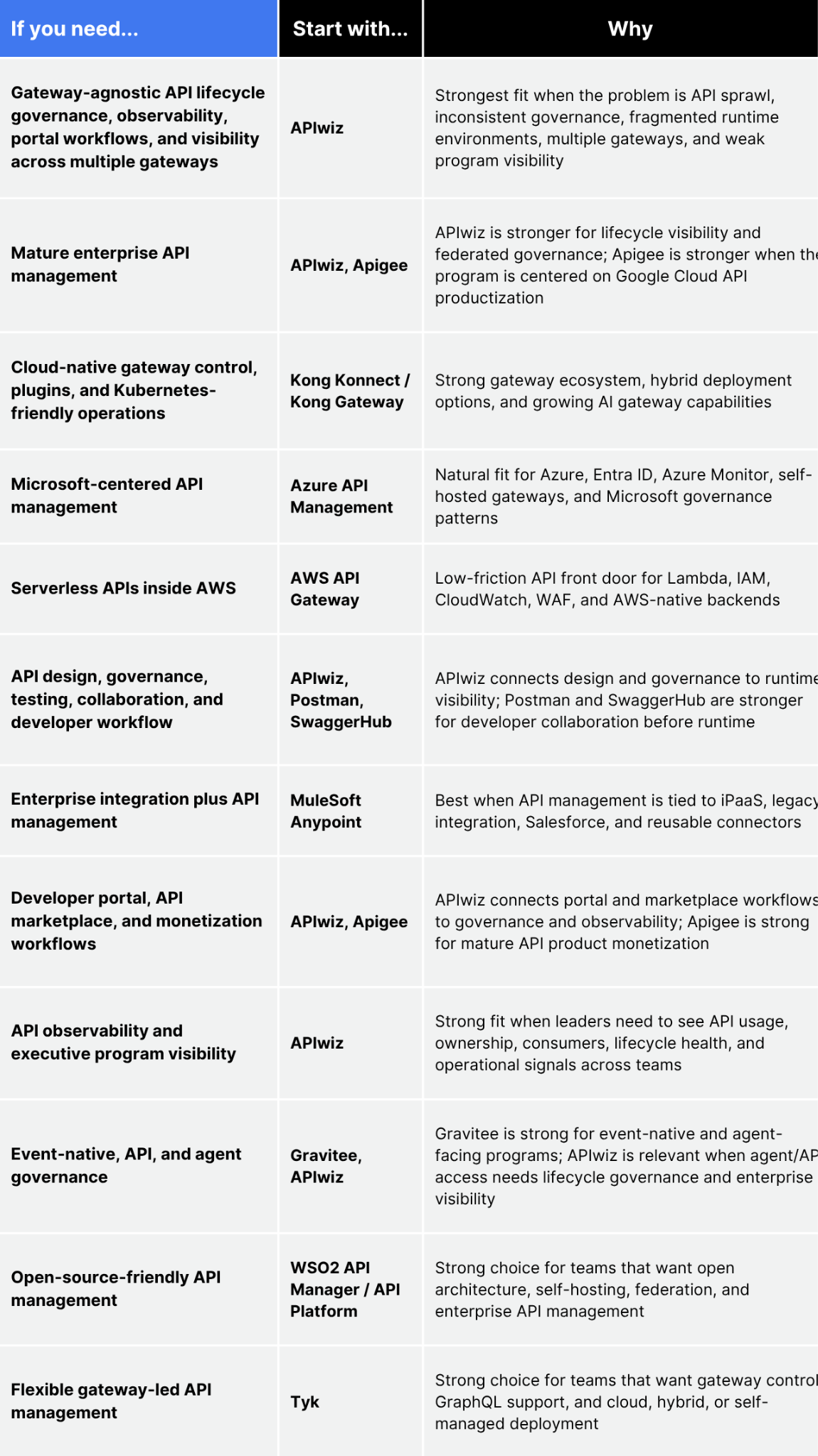
How to compare API management tools in 2026
Use these evaluation criteria before looking at vendor demos.
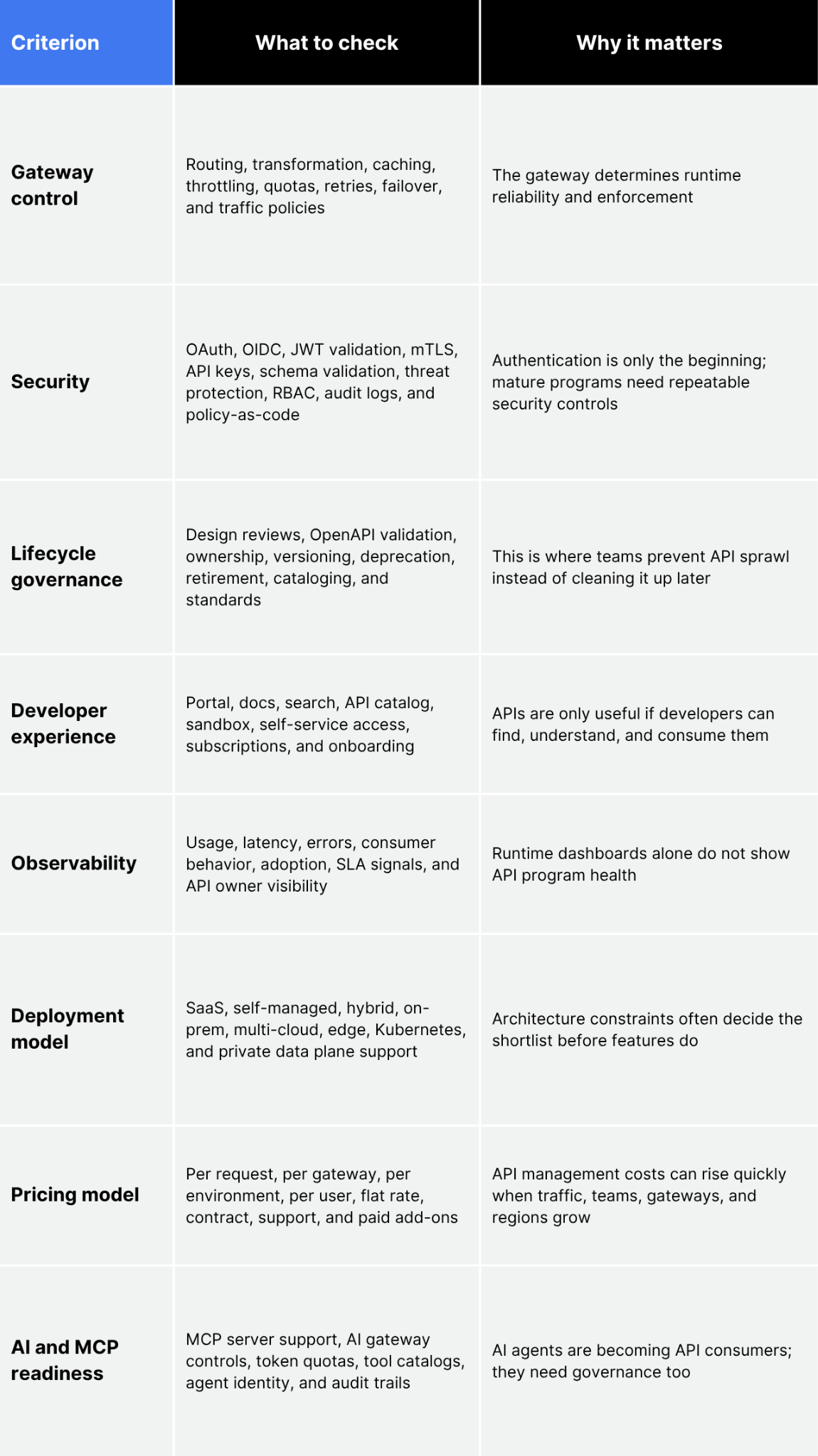
The two most common buying mistakes are choosing an API gateway when the organization actually needs a full API management platform, and choosing a heavyweight enterprise suite when the need is runtime control.
Where APIwiz fits
APIwiz fits best when API management has outgrown runtime traffic control. It serves as a unified control plane for APIs spanning multiple systems, teams, and gateways. Instead of managing API design, governance, discovery, security, observability, developer portal workflows, and API distribution as separate silos, APIwiz brings these workflows into a single API program view.
That makes APIwiz especially relevant for organizations with multiple gateways, multiple teams, unclear ownership, duplicated APIs, inconsistent policies, or limited visibility into API program health.
API management tools comparison matrix
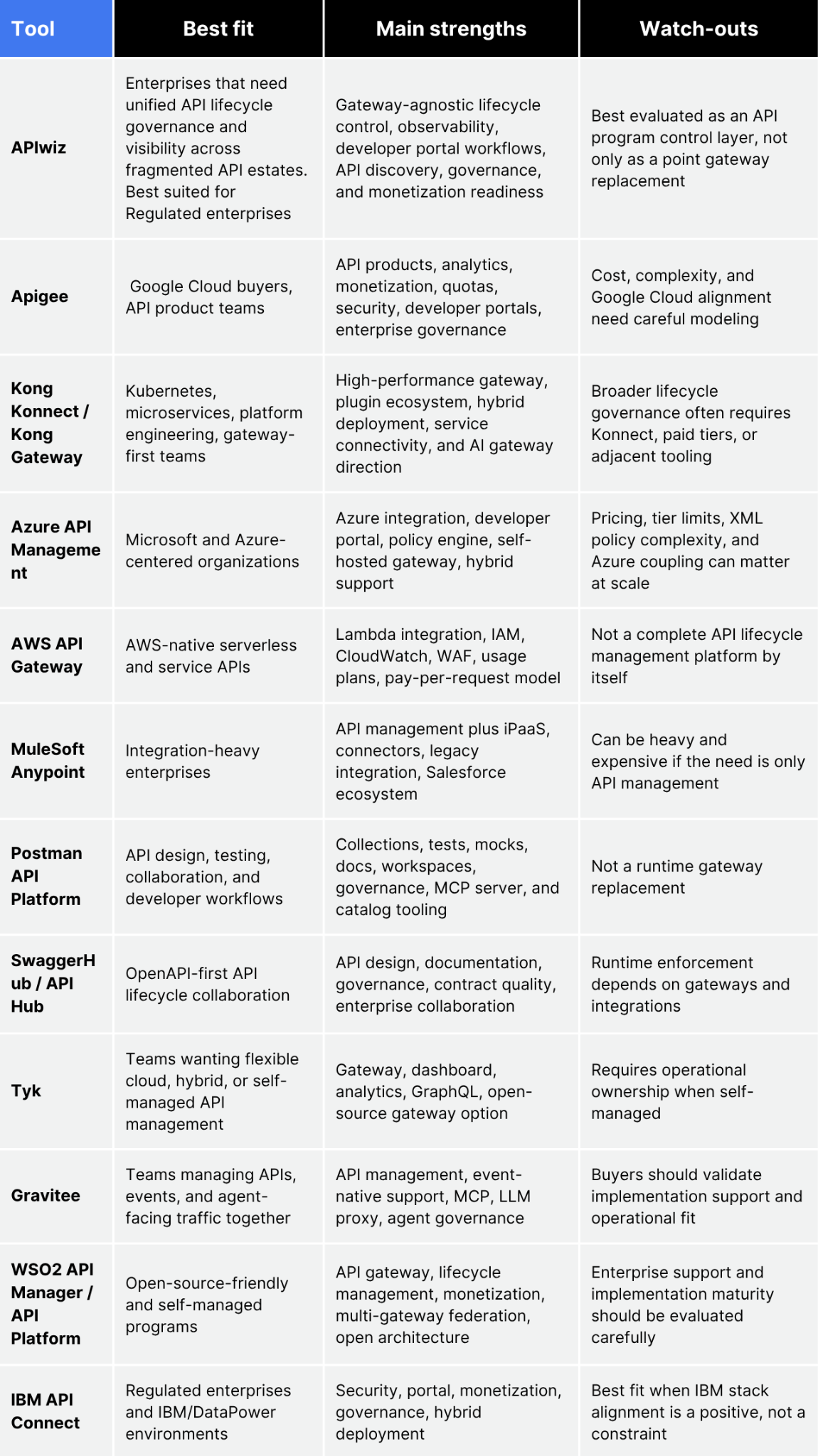
Tool-by-tool comparison
1. APIwiz: best for unified API governance and program visibility
APIwiz is the strongest fit when the problem is not just "we need a gateway." It is better suited to enterprises asking harder questions:
- Can we govern APIs across multiple gateways without forcing a rip-and-replace migration?
- Can we discover shadow, zombie, duplicate, and unmanaged APIs across distributed environments?
- Can API ownership, lifecycle status, policies, documentation, and consumer access all live in a single control plane?
- Can observability connect runtime behavior to API products, consumers, owners, and business outcomes?
- Can portal, marketplace, and monetization workflows remain connected to governance rather than becoming another silo?
- Can leaders see API program health across teams, clouds, and gateways without first standardizing on a single runtime?
APIwiz positions itself as a federated API management platform, with lifecycle workflows spanning design, build, security, observability, distribution, and monetization. Its value is strongest where organizations already have API sprawl, multiple gateways, inconsistent policies, and fragmented developer portal workflows.
Strengths
- API lifecycle governance across design, ownership, publishing, monitoring, and retirement
- API discovery and cataloging for distributed API estates
- Gateway-agnostic visibility rather than a rip-and-replace gateway story
- Developer portal and API marketplace workflows
- Observability tied to API usage, consumer behavior, and program visibility
- Good fit for regulated enterprises that need governance and auditability
Watch-outs
- If the API estate is entirely AWS or Azure and governance needs are light, a cloud-native service may be enough.
2. Apigee: best for mature enterprise API product management
Apigee remains one of the deepest enterprise API management platforms. Google positions Apigee as a platform for building, managing, securing, publishing, and monetizing APIs, offering API products, developer portals, analytics, security, and Google Cloud integration.
Strengths
- Mature API product and developer portal capabilities
- Strong analytics, monetization, quota, and policy controls
- Good fit for large enterprises with centralized API programs
- Strong Google Cloud alignment
- Pay-as-you-go and subscription options
Watch-outs
- Can be complex to learn, configure, and operate.
- Cost needs careful modeling across environments, proxy types, traffic, analytics, security add-ons, and support.
- Best fit when Google Cloud alignment is strategic rather than incidental.
Choose Apigee over APIwiz when: your API program is already centered on Google Cloud, and API product monetization is a core requirement.
Choose APIwiz over Apigee when: your main concern is governance, discovery, ownership, and visibility across multiple gateways or fragmented enterprise teams.
3. Kong: best for gateway-first cloud-native teams
Kong is one of the strong gateway-first options. Kong Gateway and Kong Konnect appeal to teams that care about performance, plugins, Kubernetes, hybrid deployment, service connectivity, and infrastructure control. Kong also documents AI gateway and MCP capabilities, including Konnect MCP support and AI gateway controls.
Strengths
- Mature gateway and plugin ecosystem
- Strong Kubernetes and microservices fit
- Flexible deployment: self-managed gateway, Konnect control plane, hybrid patterns
- Good choice for platform teams that want gateway control close to workloads
- Documented AI gateway and MCP capabilities
Watch-outs
- Broader lifecycle governance, portal workflows, and analytics often depend on Konnect or additional tooling.
- Self-managed deployments require operational maturity.
- Gateway strength does not automatically solve enterprise API discovery or lifecycle ownership.
Choose Kong over APIwiz when: your top priorities are runtime gateway control, Kubernetes ingress, plugins, or service connectivity.
Choose APIwiz over Kong when: your top priority is lifecycle visibility, governance, cataloging, observability, and API program control across teams.
4. Azure API Management: best for Microsoft-centered enterprises
Azure API Management is a strong default for organizations already standardized on Azure. It supports API publishing, gateway policies, developer portals, analytics, Azure integration, and hybrid deployment through self-hosted gateways.
Microsoft documentation describes the self-hosted gateway as a way to manage APIs hosted on-premises and across clouds from a single Azure API Management service. That makes Azure APIM a practical fit for hybrid Microsoft environments.
Strengths
- Strong Azure, Entra ID, Azure Monitor, and Azure networking integration
- Built-in developer portal and subscription workflows
- Self-hosted gateway support for hybrid and multi-cloud exposure
- Broad protocol and policy support
Watch-outs
- Teams outside the Microsoft ecosystem may find it harder to adopt.
- Pricing and tier selection can become complicated at enterprise scale.
- Policy configuration can become hard to maintain if teams rely heavily on XML-based policies.
Choose Azure API Management over APIwiz when: Azure is the center of gravity and the organization wants API management tightly coupled to Microsoft infrastructure.
Choose APIwiz over Azure API Management when: the enterprise needs cross-gateway, cross-cloud API lifecycle visibility that is not centered on one cloud provider.
5. AWS API Gateway: best for AWS-native serverless APIs
AWS API Gateway is the pragmatic choice for teams building APIs on AWS. It integrates naturally with Lambda, IAM, CloudWatch, WAF, Step Functions, DynamoDB, and other AWS services.
Strengths
- Low-friction API front door for AWS-native services
- Pay-per-request pricing model
- REST, HTTP, and WebSocket API support
- Strong integration with AWS identity, monitoring, and security services
- Good fit for serverless architectures
Watch-outs
- It is not a complete API lifecycle management platform.
- Developer portal, catalog, governance, design review, and cross-team ownership workflows usually need separate tooling.
- Multi-cloud or gateway-agnostic API programs will outgrow it as the sole management layer.
Choose AWS API Gateway over APIwiz when: most APIs are AWS-native, and the immediate need is secure routing to AWS services.
Choose APIwiz over AWS API Gateway when: the organization needs visibility, governance, observability, and developer portal workflows across more than AWS runtime traffic.
6. MuleSoft Anypoint: best for integration-heavy enterprises
MuleSoft Anypoint is strongest when API management is part of a broader integration strategy. It combines API management with integration, automation, connectors, legacy integration, and Salesforce ecosystem alignment.
Strengths
- Strong enterprise integration and connector ecosystem
- API management tied to broader integration workflows
- Good fit for legacy modernization and complex system connectivity
- Enterprise governance, monitoring, and deployment options
Watch-outs
- Can be expensive and heavy if the need is mainly for an API gateway or API governance.
- Requires platform expertise and implementation planning.
Choose MuleSoft when: integration, connectors, and legacy system orchestration are as important as API management.
Choose APIwiz when: the primary need is API lifecycle governance, discovery, observability, and program visibility rather than full iPaaS.
7. Postman: best for API development workflows
Postman is not a gateway replacement. It is one of the strongest platforms for API design, testing, mock servers, workspaces, and developer productivity.
APIwiz too documents a collaborative design studio, automated linting, version management, changelog management, automated API documentation, an API Sandbox for mocking and simulation, and an API Test Suite for automated scenario-driven tests. The difference is positioning: Postman is usually adopted as a developer productivity workspace, while APIwiz brings design and testing into a larger governed API management lifecycle.
Strengths
- Familiar developer experience
- Collections, test automation, mocks, documentation, and collaboration
- Useful across design, testing, debugging, and onboarding
- Enterprise governance features for teams and workspaces
- MCP server and catalog tooling
Watch-outs
- It does not replace runtime API management.
- Governance is often workspace-centered rather than enterprise runtime-centered.
Use APIwiz instead of Postman if: you need API design, documentation, mocking, validation, and automated testing inside a broader governed API lifecycle. APIwiz then extends those workflows to governance, observability, portal workflows, API distribution, and multi-gateway visibility within a single lifecycle platform.
8. SwaggerHub / API Hub: best for OpenAPI-first lifecycle collaboration
SwaggerHub and SmartBear's API Hub focus on API design, OpenAPI governance, documentation, collaboration, and API quality. SmartBear's documentation emphasizes OpenAPI and AsyncAPI definition management, versioning, governance rules, and enterprise collaboration.
Strengths
- Strong OpenAPI design and documentation workflows
- Useful for standardization, style guides, versioning, and contract quality
- Good fit when the source of truth for APIs needs to be specification-driven
- Integrates into broader API delivery toolchains
Watch-outs
- Runtime enforcement still needs an API gateway and API management platform.
- It is strongest before deployment, not as the production traffic control layer.
Use APIwiz instead of SwaggerHub if: you need OpenAPI-first design and governance to connect directly with lifecycle ownership, observability, portal workflows, API distribution, and multi-gateway program visibility.
9. Gravitee: best for APIs, events, and agent-facing traffic
Gravitee is worth shortlisting when the API program includes REST APIs, asynchronous APIs, event streams, and AI/agent-facing access patterns. Its positioning around APIs, events, MCP, LLM proxies, and agent governance makes it one of the more interesting options for 2026.
Strengths
- REST, event, and agent governance story
- Developer portal and API management capabilities
- Good fit for hybrid API/event architectures
- Documented AI/MCP positioning for agent-facing API programs
Watch-outs
- Buyers should validate ecosystem maturity, implementation support, and operational fit.
Use APIwiz instead of Gravitee if: the priority is not only governing APIs, events, or agents, but connecting API ownership, lifecycle status, design quality, security, observability, portal workflows, distribution, and multi-gateway visibility in one enterprise control plane. Gravitee is compelling for event-native and agent-facing programs; APIwiz goes further when leaders need end-to-end API program visibility across teams, clouds, and gateways.
10. Tyk: best for flexible gateway-led API management
Tyk is a good fit for teams that want API gateway control with cloud, hybrid, and self-managed deployment options. It is especially relevant when teams want an API gateway, dashboard, developer portal, analytics, GraphQL support, and more infrastructure ownership than a fully managed SaaS platform usually provides.
Strengths
- Flexible cloud, hybrid, and self-managed deployment models
- Gateway, dashboard, developer portal, analytics, and GraphQL support
- Good fit for teams that want infrastructure control
- Open-source gateway option
Watch-outs
- Self-managed flexibility comes with operational responsibility.
- Broader enterprise governance and program visibility need careful evaluation.
Use APIwiz instead of Tyk if: the greater need is not only gateway control but also API lifecycle governance, ownership, design quality, observability, portal workflows, distribution, and visibility across multiple teams or gateways.
11. WSO2: best for open-source-friendly enterprise API management
WSO2 API Manager and WSO2 API Platform are attractive to teams seeking open-source-friendly API management, monetization, multi-gateway federation, and an open architecture.
Strengths
- API gateway, lifecycle management, developer portal, and monetization
- Multi-gateway federation and open architecture
- Strong self-managed and enterprise deployment story
- Good fit for teams with platform engineering capacity and open-source preferences
Watch-outs
- Self-managed flexibility comes with operational responsibility.
- Enterprise support, upgrades, and governance workflows need careful evaluation.
Use APIwiz instead of WSO2 if: the organization wants a more focused API program control plane for design governance, lifecycle ownership, observability, developer portal workflows, distribution, and multi-gateway visibility without taking on a broader open-source enterprise middleware footprint.
12. IBM API Connect: best for regulated IBM-aligned enterprises
IBM API Connect remains relevant for large regulated enterprises, especially those already invested in IBM DataPower, IBM Cloud, or IBM integration patterns.
Strengths
- Strong enterprise security and governance
- Developer portal and monetization capabilities
- Hybrid deployment options
- Good fit for regulated industries
Watch-outs
- Best fit when IBM ecosystem alignment is an advantage.
- May be too heavy for teams that need fast developer-first API delivery.
Use APIwiz instead of IBM API Connect if: the organization needs a more gateway-agnostic API program control plane for lifecycle governance, design quality, observability, portal workflows, distribution, and visibility across teams, clouds, and gateways without anchoring the program to the IBM stack.
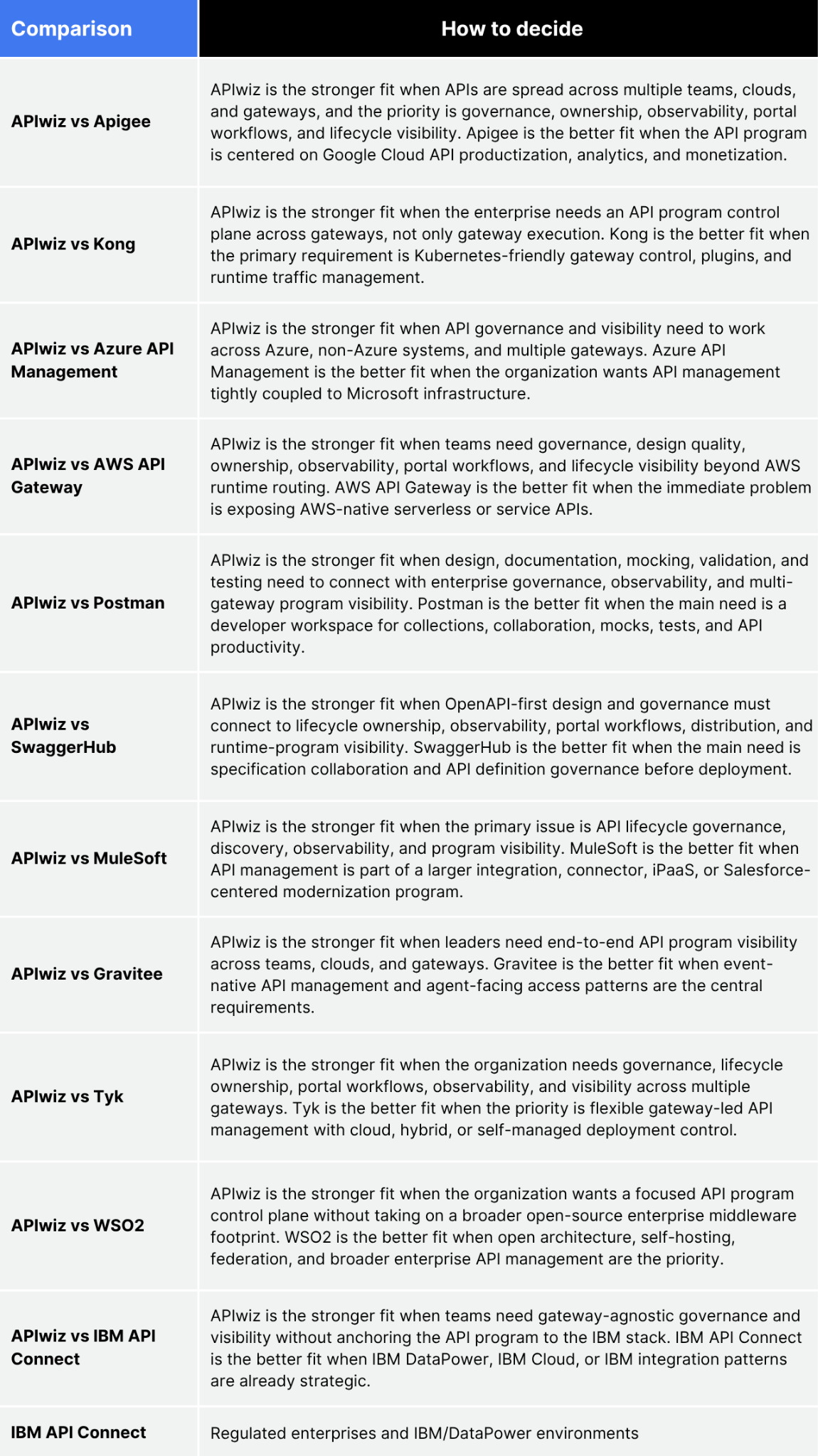
Head-to-head: APIwiz vs the tools buyers compare most
Which API management platform should you choose?
For most enterprises, the API management decision is no longer just about picking a gateway. Gateways, developer tools, cloud-native services, integration platforms, and open-source API managers can all solve important parts of the problem. But enterprise API programs usually need more than one part solved.
The critical requirements are lifecycle governance, design quality, API discovery, ownership, security, observability, developer portal workflows, distribution, monetization readiness, and visibility across teams, systems, clouds, and gateways. Without those capabilities, API management becomes fragmented. Teams may still be able to route traffic or publish documentation, but leaders cannot easily see which APIs exist, who owns them, which versions are active, which APIs are duplicated, which consumers are using them, or where governance gaps are growing.
That is where APIwiz should lead the shortlist. It is strongest when API management needs to function as an enterprise control plane, not just a gateway, developer workspace, or cloud service. If the organization has multiple teams, multiple gateways, inconsistent standards, unclear ownership, disconnected portals, or limited visibility into API programs, APIwiz is the platform that brings those workflows together.
Other tools can still be useful in specific environments. A cloud-native gateway may make sense for one cloud workload. A developer workspace may help teams collaborate on requests and tests. An integration platform may be needed to connect to legacy systems. But in todays environment where AI readiness is also a major critera, APIwiz is the more complete enterprise fit.
FAQs
What is the best API management tool in 2026?
There is no single best tool for every team. APIwiz is a strong fit for enterprises that need governance, lifecycle visibility, observability, and cross-gateway control. Apigee is strong for Google Cloud enterprise API programs. Kong is strong for gateway-first cloud-native teams. Azure API Management is strong for Microsoft-centered enterprises. AWS API Gateway is strong for AWS-native serverless APIs.
What is the difference between an API gateway and API management?
An API gateway controls runtime traffic: routing, authentication, rate limiting, transformation, and policy enforcement. API management includes the gateway but also covers design, governance, cataloging, developer portals, analytics, monetization, versioning, and retirement.
Can I use more than one API management tool?
Yes. Many enterprises use Postman or SwaggerHub for developer-side design and testing, Kong or AWS API Gateway for runtime traffic, and a platform like APIwiz for governance, observability, lifecycle visibility, and API program control. APIwiz can also cover design and testing when teams want those workflows governed inside the same API lifecycle platform.
What cost drivers should I watch?
Watch API calls, gateways, environments, regions, managed APIs, users, premium security features, analytics retention, support tiers, private networking, and implementation services. Pricing can look reasonable in a pilot and become expensive when traffic, consumers, and environments grow.
Which tool is best for AI agents and MCP?
Kong, Gravitee, WSO2, Postman, and Apigee all publish AI or MCP-related capabilities. APIwiz is relevant when agent-facing API access needs to connect back to lifecycle governance, observability, policy, cataloging, and enterprise visibility. Because this category is moving quickly, ask vendors to show working MCP, AI gateway, identity, quota, audit, and tool discovery workflows.
Related reads
- API Management Goes Beyond the API Gateway
- How APIwiz Solves API Observability
- Hidden Cost of API Sprawl
Effortless API Management at scale.
Support existing investments & retain context across runtimes.
.webp)
Effortless API Management at scale.
Support existing investments & retain context across runtimes.