


What Is API Governance? Framework & Best Practices 2026

What is API governance?
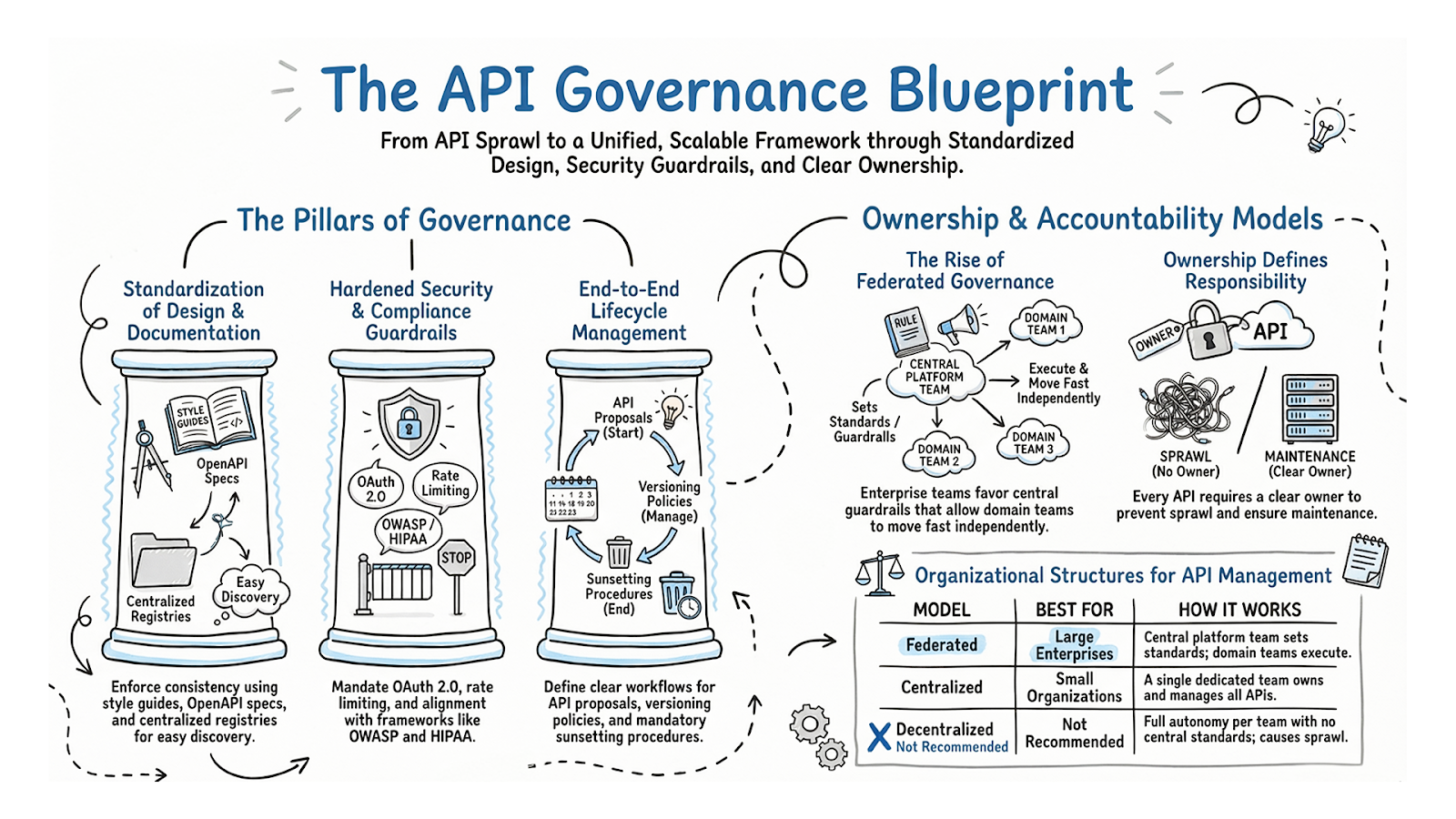
API governance is the framework of standards, policies, and practices an organization uses to ensure its APIs are designed consistently, secured properly, and managed throughout their lifecycle. It defines how APIs are created, documented, versioned, and retired.
Key pillars of API governance:
- Design standards and style guides
- Security and compliance policies
- Lifecycle management and versioning
- Discoverability and documentation
- Organizational ownership and accountability
Why does API governance matter?
API governance matters because without it, organizations end up with inconsistent, insecure, and undiscoverable APIs that create technical debt, security vulnerabilities, and developer frustration at scale.
The numbers make the gap clear. According to the Postman 2025 State of the API Report, 82% of organizations have adopted an API-first approach, and yet most lack a formal API governance strategy. That means the vast majority of enterprise API portfolios are growing without standardized design patterns, consistent security baselines, or lifecycle policies. The result is API sprawl, where thousands of endpoints, many redundant or undocumented, with shadow APIs bypassing review entirely.
43% of organizations plan to implement API governance within the next 12 months. The window between "ungoverned" and "governed" is closing fast, and teams that act now set the standards everyone else will follow.
The business stakes are rising. Gartner predicted that API abuse would become the most frequent attack vector for enterprise web applications, and that ungoverned APIs would be the primary exposure point. Compliance frameworks like PCI DSS 4.0, EU DORA, and SOC 2 now explicitly require API security controls. Governance is no longer optional for regulated industries — it's a prerequisite for doing business.
How is API governance different from API management?
API management is a full-lifecycle discipline. It covers how APIs are designed, built, secured, deployed, monitored, and retired. Gartner's critical capabilities for API management reflect this breadth, spanning API design and development, security policy enforcement, developer portal and onboarding, traffic management, analytics, and monetization. Reducing API management to just runtime gateway operations like rate limiting, traffic routing, and key management is an outdated view that ignores the majority of what it takes to run an API program at scale.
API governance is the standards layer that runs through it all. It defines the rules, policies, and guardrails that ensure every stage of API management is executed consistently: how APIs should be designed, what security baselines they must meet, how they're versioned and deprecated, and who owns them. Without governance, each team makes its own decisions at every stage, resulting in inconsistency, security gaps, and sprawl that no amount of runtime management can fix.
The real question isn't "governance vs. management." It's whether your organization is truly managing APIs or just operating gateways. Governance is what makes the difference, and the sections below break down what a governance framework looks like in practice.
What are the core components of an API governance framework?
A complete API governance framework covers six areas:
1. Design standards and style guides
The foundation of governance. An API style guide codifies naming conventions, output structure, error response formats, versioning schemes, and pagination patterns so every API in the organization feels like one product.
What a style guide typically enforces:
- RESTful resource naming (nouns, not verbs)
- Consistent HTTP status code usage
- Standard error response schema
- Versioning strategy (URI path vs. header vs. query parameter)
- Pagination pattern (cursor-based vs. offset-based)
How it's enforced: Using federated API management platforms and automated API linting tools like APIwiz.
2. Security policies
Security governance defines the minimum requirements every API must meet before deployment.
Common security governance rules:
- Enforcing OAuth 2.0 or API key authentication on all endpoints
- Input validation and rate limiting on all public-facing APIs
- mTLS/TLS 1.2+ enforced for all API traffic
- Vulnerability scanning in the CI/CD pipeline
- Sensitive data handling rules (PII masking, field-level encryption)
3. Lifecycle management and versioning
API governance must cover the full API lifecycle, from proposal through deprecation and sunsetting.
Key lifecycle governance decisions:
- API proposal and approval workflows (who can create a new API?)
- Versioning policies (breaking vs. non-breaking changes)
- Deprecation timeline and consumer notification requirements
- Sunset policy (how long deprecated versions remain available)
4. Documentation and discoverability
Ungoverned documentation means undiscoverable APIs. Governance mandates what must be documented and where it lives.
Documentation governance requirements:
- OpenAPI specification required for every REST API
- AsyncAPI specification for event-driven APIs
- API registry or catalog for centralized discoverability
- Changelog maintained for every version
- Sandbox/test environment available for every published API
5. Organizational ownership and accountability
Every API needs a clear owner. Governance defines who is responsible for what.

Federated governance is the model most enterprise platform engineering teams are adopting. A central team defines the guardrails; domain teams move fast within them.
6. Compliance and regulatory enforcement
For regulated industries, governance must map API controls to compliance frameworks.
Relevant frameworks:
- OWASP API Security Top 10 — baseline for all industries
- PCI DSS 4.0 — financial data handling
- HIPAA — healthcare API data
- EU DORA — financial services operational resilience
- SOC 2 Type II — SaaS and cloud services
What are API governance best practices?
The most effective API governance best practices share five characteristics:
1. Automate enforcement
- Embed linting rules into CI/CD pipelines
- Block deployment if the OpenAPI spec fails validation
- Auto-generate documentation from specs — no separate manual step
2. Adopt a design-first approach
- Write the OpenAPI spec before writing code
- Use the spec to generate mock servers for early consumer feedback
- Contract testing catches breaking changes before deployment
3. Start with one team, then scale
- Pilot governance with a single product team or domain
- Prove value (faster onboarding, fewer integration bugs) before enforcing org-wide
- Document the wins to build internal buy-in
4. Allow exceptions with a clear process
- Some APIs legitimately need non-standard patterns. Such cases require an exception.
- Require a documented exception request with technical justification
- Review exceptions quarterly to identify patterns that should become new rules
5. Measure governance outcomes
%201.png)
If you aren't measuring these metrics, you can't prove governance is working — and you'll lose organizational support.
What are common API governance mistakes?
The most common API governance mistakes are governing too late (after APIs ship), governing too rigidly (blocking velocity), and governing without tooling (relying on manual reviews that don't scale).
Mistakes to avoid:
- Governance as an afterthought: Retroactively applying standards to hundreds of existing APIs is expensive and disruptive. Start governance before the API program scales.
- Overly rigid rules with no exceptions: Teams route around governance that blocks them. Build in a documented exception process.
- Manual review bottlenecks: If a human must approve every API spec change, governance becomes a velocity killer. Automate linting, security scanning, and documentation generation.
- No visibility into the API landscape: You can't govern what you can't see. Auto-discovery of shadow and zombie APIs and a centralized registry are prerequisites.
- Governance without measurement: If you don't track consistency scores, vulnerability counts, and time-to-first-call, you can't prove governance is working.
How is AI changing API governance in 2026?
AI is changing API governance in two ways: One, APIs now need governance designed for AI consumers. Two, AI is being used to automate the enforcement of governance itself.
Governing APIs for AI consumption:
- AI agents using function calling and Model Context Protocol (MCP) need APIs with precise, machine-readable specs
- 51% of developers cite unauthorized or excessive API calls from AI agents as their top security concern — governance must account for machine-to-machine API consumption (Postman 2025 State of the API Report)
- Rate limiting, idempotency, and error handling must be designed for autonomous retry logic, not just human developers
- Gartner predicts more than 80% of enterprises will use generative AI APIs by 2026
Using AI to enforce governance:
- AI-powered API linting that understands intent, not just syntax
- Automated classification of API sensitivity levels for security policy assignment
- Anomaly detection that flags governance violations in runtime API behavior
- Natural language querying of API registries ("show me all payment APIs missing OAuth")
The organizations that build governance frameworks accounting for both directions: governing APIs for AI and governing APIs with AI, will be the ones whose API programs scale without breaking.
How does APIwiz approach API governance?
APIwiz provides federated API governance across any gateway or service mesh, giving platform teams centralized policy control while respective teams retain ownership of their APIs.
Key governance capabilities of APIwiz include:
- Zero-touch API discovery across multi-cloud environments — find every API, including shadow and zombie APIs
- Automated policy enforcement integrated into CI/CD workflows
- Design-first studio with built-in automated linting that catches style and structural errors at the spec level
- Centralized API registry with full lifecycle visibility (proposal → production → deprecation)
- Security scanning with OWASP Top 10 enforcement and compliance reporting
- Role-based access control for API creation, modification, and publishing
Enterprise customers, including RCBC and Commercial Bank Qatar, use APIwiz to manage 25K+ APIs with federated governance across their entire stack.
Key takeaways
API governance is no longer a nice-to-have for mature organizations. It is the foundation that determines whether your API program scales or collapses under its own weight. Effective governance automates enforcement through design-first workflows and CI/CD linting, balances consistency with flexibility through federated ownership models, and measures outcomes rather than just compliance. In 2026, with AI agents consuming APIs autonomously and regulatory requirements tightening, governance is where security, velocity, and trust intersect.
If you’re interested in seeing how APIwiz delivers federated API governance across any gateway, any cloud, book a demo.
FAQs about API governance
What is the difference between API governance and API management?
API management is a full-lifecycle discipline covering how APIs are designed, built, secured, deployed, monitored, and retired. API governance is the standards layer within it, defining the rules and policies that ensure every stage is executed consistently. Without governance, API management reduces to gateway operations. With it, organizations get the consistency and control needed to scale API programs across teams, clouds, and gateways.
Who should own API governance in an organization?
The most effective model is federated ownership. A central platform or architecture team defines organization-wide standards, security policies, and compliance requirements. Individual teams own the APIs for their specific business area and operate within those guardrails.
How do you implement API governance without slowing teams down?
Automation is the key. Embed governance into the developer workflow through automated API linting in CI/CD pipelines rather than adding manual review gates. Auto-generate documentation from OpenAPI specs so there's no separate manual step. Provide clear exception processes for edge cases so teams aren't blocked when legitimate non-standard patterns are needed.
What is an API style guide?
An API style guide codifies your organization's standards for API design — naming conventions, URL structures, error response formats, versioning schemes, pagination patterns, and authentication requirements. It ensures every API in your portfolio follows the same patterns, making them predictable for consumers. Style guides are enforced by automated linting tools like APIwiz, which validate OpenAPI specs against your rules.
How does API governance support compliance?
API governance maps development practices to regulatory requirements. For financial services, this means aligning API security controls with PCI DSS 4.0 and EU DORA. In healthcare, it means enforcing HIPAA data-handling rules at the API layer. Governance ensures APIs are auditable — every design decision, security scan result, and version change is logged and traceable for compliance reporting.
Can you apply API governance to existing APIs retroactively?
Yes, but it's more expensive than governing from the start. Begin by inventorying all existing APIs using automated discovery tools like APIwiz. Run them through your style guide linting to identify gaps. Prioritize remediation by risk and traffic volume. Fix high-traffic, security-critical APIs first, then expand incrementally with clear timelines and tooling support for each team.
Effortless API Management at scale.
Support existing investments & retain context across runtimes.
.webp)
Effortless API Management at scale.
Support existing investments & retain context across runtimes.