

Top API Trends for Developers in 2026

What are the top API trends in 2026?
The most significant API trends in 2026 are AI-native API design, the rise of API-as-a-product, API security hardening, and the emergence of developer experience as a competitive differentiator.
Why each trend matters right now:
- AI-native APIs — AI agents now generate over 30% of new API traffic, and most APIs aren't designed for machine consumption
- API-as-a-product — 65% of organizations are generating revenue from their API programs, turning APIs into business lines
- API security — APIs are one of the key targets for enterprise attacks, with AI agents introducing entirely new threat vectors
- Developer experience — In a crowded API market, the product that's easiest to integrate wins adoption
Now, let’s dive deep and look at each trend in depth and understand how they’re shaping up the market.
Why are APIs trending in 2026?
APIs are trending and have become a hot topic because three forces are converging — the rise of agentic AI systems that consume APIs autonomously, a favorable API management market that hit $16.29 billion in 2026, and a regulatory environment that now treats API security as a compliance requirement.
What's driving the shift:
- AI-generated API traffic — Gartner projects that more than 30% API demand will come from AI and large language models
- Market growth is projected at 34.7% CAGR, from 10 billion in 2025 to an estimated 108 billion by 2033
- API-first adoption — 83% of organizations have adopted an API-first approach at some level, according to the Postman 2025 State of the API Report
- Event-driven architectures (AsyncAPI, WebSockets, gRPC streaming) are displacing synchronous REST-only patterns for real-time use cases
These forces don't operate in isolation. AI agents drive more API calls, amplifying security exposure and demanding better governance, which in turn requires platform-level tooling. Each trend compounds the others.
How is AI changing API design and consumption?
AI is transforming APIs from human-developer tools into machine-consumed interfaces, demanding new design patterns that prioritize machine readability, predictable schemas, and discoverability.
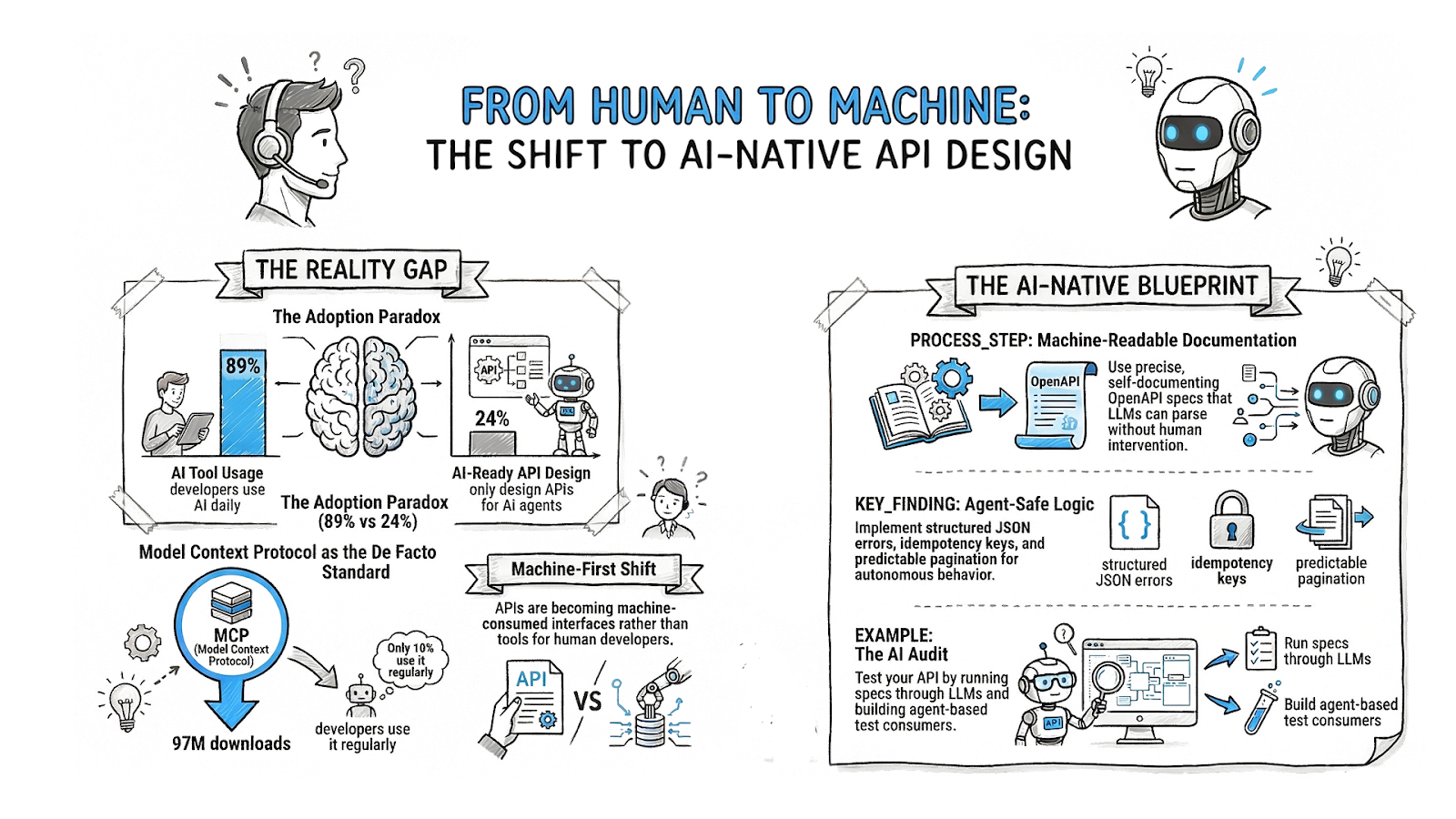
The gap between AI adoption and AI-ready API design is stark. The Postman 2025 State of the API Report found that 89% of developers use AI tools daily, yet only 24% currently design APIs for AI agents.
97 million monthly SDK downloads and backing from Anthropic, OpenAI, Google, and Microsoft have made the Model Context Protocol (MCP) the de facto standard for connecting AI agents to enterprise tools — yet only 10% of developers use it regularly.
What AI-native API design requires:
- Precise, self-documenting OpenAPI specs that LLM function calling and tool-use can parse without human interpretation
- MCP and Agent-to-Agent Protocol (A2A) integration for standardized agent-to-service communication
- Structured JSON error responses that are designed for machine parsing, not human-readable strings
- Idempotency keys and predictable cursor-based pagination for agent-safe consumption
- Rate limiting and retry logic engineered for safe autonomous agent behavior patterns
What developers should do now:
- Audit existing APIs for machine readability — run your OpenAPI spec through an LLM function-calling test to find gaps
- Build an agent-based test consumer alongside your human test suite to catch failure modes that traditional QA misses
- Design authentication flows for machine-to-machine contexts
What is API-as-a-product and why does it matter?
API-as-a-product (AaaP) is the strategy of treating APIs as standalone business products — with their own roadmaps, pricing models, developer documentation, and go-to-market strategies — rather than treating them as internal integration utilities.
The economics make the case clearly. The Postman 2025 report found that 65% of organizations are now generating revenue from their API programs, up from 62% in 2024.
API monetization revenue is expected to double from 3.97 billion in 2023 to 8.56 billion by 2027. Developer portals and API marketplaces are becoming the primary distribution channel for digital services.
Traditional API vs. API-as-a-product:
.png)
Teams building API-as-a-product need three capabilities that most internal APIs lack: a developer portal that makes onboarding frictionless, dynamic metering that tracks usage at the endpoint level, and a governance layer that enforces consistency across the entire portfolio.
Why is API security a top priority in 2026?
API security is a top priority because APIs are now the primary attack surface for enterprise applications — Gartner, OWASP, and NIST all flag API-specific vulnerabilities as a critical and growing risk category.
The OWASP API Security Top 10 (2023 edition) lists Broken Object Level Authorization (BOLA) as one of the major API vulnerabilities. The Postman 2025 report adds a new dimension: 51% of developers now cite unauthorized agent access as a top security concern, reflecting the reality that AI agents introduce attack vectors that traditional perimeter defenses weren't built for.
High-profile API breaches underscore the stakes. T-Mobile's 2023 breach exposed 37 million customer records through a misconfigured API endpoint. Optus's 2022 breach leaked 10 million customer accounts due to an API deployed without proper authorization controls.
What modern API security requires:
- Shift-left security scanning in CI/CD pipelines (SAST/DAST for APIs)
- Runtime API threat detection and anomaly monitoring
- Zero-trust architecture at the API layer (mTLS, OAuth 2.0, token-bound credentials)
- Automated API discovery to find shadow and zombie APIs before attackers do
How is developer experience becoming a competitive advantage for APIs?
Developer experience is becoming a competitive advantage because, in a market with multiple API options for every function, developers choose the API that's easiest to understand, integrate with, and debug.
The data backs this up. Poor developer onboarding is the #1 reason APIs fail to gain traction. For API-as-a-product models, developer experience directly correlates with revenue. Every friction point in the integration journey is a potential churn event.
What good API developer experience looks like:
- Interactive API documentation
- Sandbox environments for testing the APIs
- Clear, consistent error messages with actionable remediation steps
- Time-to-first-successful-call under 5 minutes
AI is also reshaping the developer experience. Teams that provide AI-generated documentation, code examples, and interactive tryout consoles gain adoption faster. Natural language API exploration, where developers describe what they need, and AI suggests the right endpoint, is moving from experimental to expected.
How does APIwiz help teams stay ahead of API trends?
APIwiz is a federated API management platform that gives engineering teams a single control plane for designing, building, securing, observing, and distributing APIs across any gateway, team, or cloud.
Key capabilities of APIwiz include:
- Zero-touch API discovery: Automatically discovers and catalogs all APIs, including shadow and unmanaged endpoints, with zero manual intervention, giving teams a consolidated inventory across environments.
- Design-first API studio: A low-code environment for visually defining and collaborating on API specifications, with automated linting to catch style and structural errors early, plus built-in changelogs and versioning.
- Security pipeline and compliance: Enforces security policies to detect and mitigate threats in real time, with continuous compliance monitoring and instant alerts for risk deviations.
- Federated gateway management: Centrally manage API deployments across multiple cloud gateways from a single control plane, enforcing unified governance policies across all of them.
- Developer portal and API marketplace: Customizable portals with tailored documentation, API tryouts, sandbox environments for testing integrations, and built-in community forums for developer engagement.
- Dynamic metering and monetization: Tracks usage at the endpoint level with adaptable pricing models, such as graduated, flat-rate, or usage-based, to transform APIs from a cost center into a revenue stream.
- eBPF-powered observability: Logging and tracing powered by eBPF, with centralized insights that let teams monitor API performance, security, and governance from a single view.
- Visual API builder: A low-code workflow builder that lets teams visually design, orchestrate, and deploy API logic, reducing complex coding and accelerating feature releases without sacrificing control.
APIwiz reduces API lifecycle processes by up to 50% and manages 25K+ APIs and 10B+ API volume for enterprise customers, including RCBC, Tonik, and Commercial Bank Qatar.
Key takeaways
The API trends that exist today is result of evolution across various areas of technology, market forces, and the changing behavior of developers and development workflows.
AI agents drive more API calls, amplifying security exposure and demanding platform-level governance, which in turn raises the bar for developer experience. Teams that treat these trends as interconnected, not as separate line items on a roadmap, will build APIs that get adopted, trusted, and monetized.
If you’re looking to streamline your APIs or control API sprawl, book a Demo to see how APIwiz gives you full-lifecycle API management across any gateway, any cloud.
Effortless API Management at scale.
Support existing investments & retain context across runtimes.
.webp)
Effortless API Management at scale.
Support existing investments & retain context across runtimes.