


API Monetization: A Complete Practitioner's Guide

What is API monetization?
API monetization is the practice of turning API access, usage, or ecosystem value into measurable revenue through pricing, packaging, metering, billing, and partner distribution.
Key aspects of API monetization:
- Pricing models
- Usage metering
- Billing integration
- Access enforcement
- Developer adoption
Below, we explore how API monetization works in practice: models, pricing math, technical architecture, platform choices, launch risks, and the new pricing problem created by AI APIs.
Why does API monetization matter?
API monetization matters because APIs increasingly operate as products, distribution channels, and revenue infrastructure rather than back-office integration plumbing. Postman's 2025 State of the API Report says 65% of organizations now generate revenue from APIs, and 74% of those that generate API revenue generate at least 10% of total revenue from APIs.
That revenue can come from several paths:
- Direct API access fees
- Usage-based consumption
- Premium data products and
- Partner ecosystem revenue
The strategic point is not "charge for every endpoint." The point is to identify where an API creates economic value, package that value clearly, and establish sufficient operational control to bill for it without undermining adoption.
When should you monetize an API?
You should monetize an API when it delivers repeatable business value to an identifiable consumer, and your team can measure, secure, support, and enforce usage reliably. If the API is unstable, undocumented, or difficult to onboard, pricing will expose those weaknesses faster than it creates revenue.
Good API monetization candidates usually have:
- Clear external or partner demand
- Differentiated data, workflow, or transaction value
- Predictable usage patterns
- Documented integration paths, reusable API design patterns, and API documentation workflows
- Strong API key or OAuth access control, supported by API security controls
- Reliable metering and analytics through an API observability layer
- Support and SLA commitments
Weak API monetization candidates usually have:
- Experimental endpoints
- Internal-only dependencies
- Incomplete documentation
- Unclear ownership
- High support burden
- Unmeasured infrastructure cost
- No plan for abuse prevention
Monetization should come after product readiness, not before it.
What are the main API monetization models?
The main API monetization models are pay-per-use, subscription, tiered pricing, freemium, revenue share, marketplace distribution, and hybrid pricing. The best model depends on the API's value metric, customer maturity, usage predictability, and cost structure.
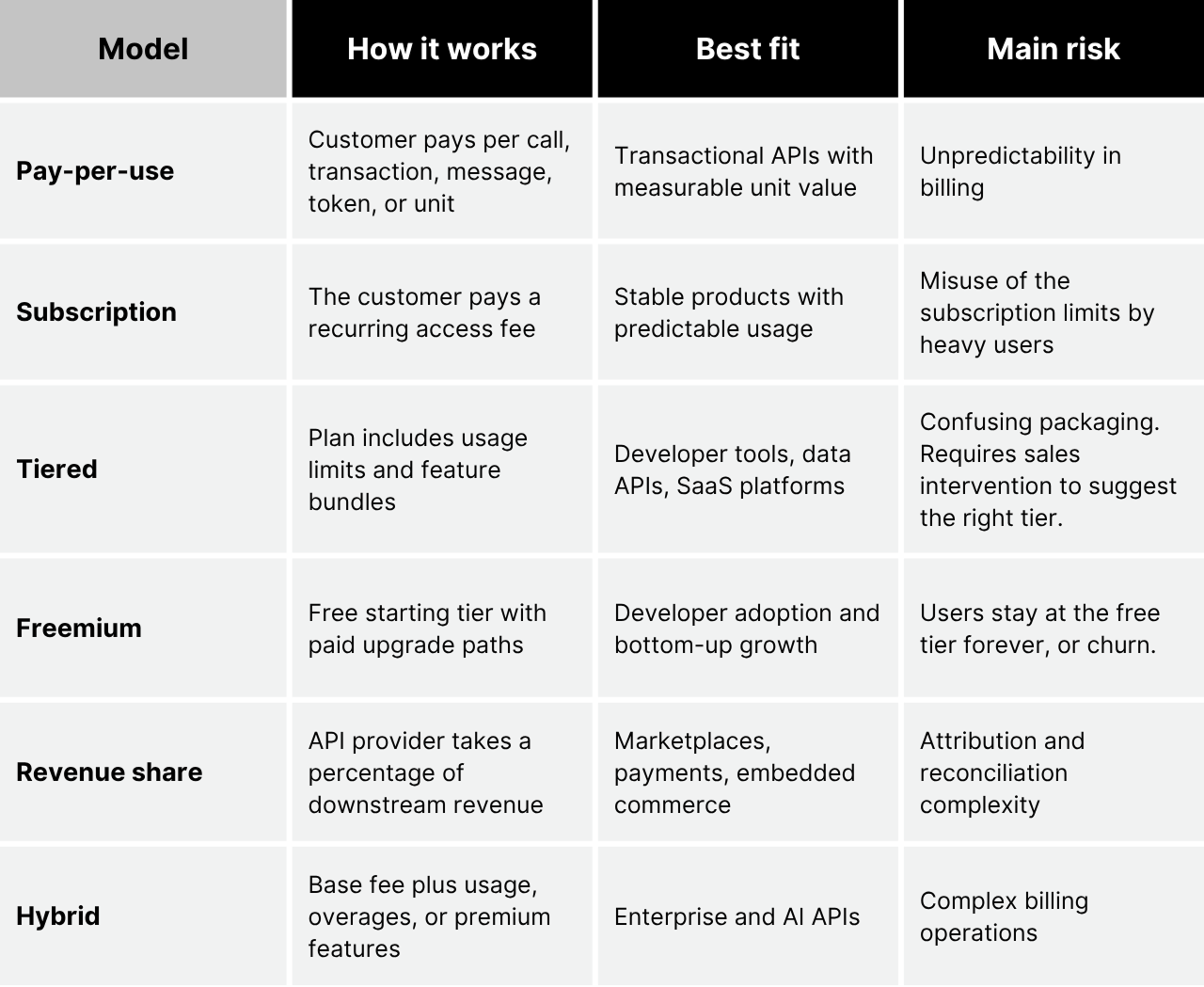
A practical API program often starts with freemium or tiered access, then adds metered overages once usage patterns are visible.
How do you price an API?
You price an API by combining cost floor, customer value, competitive context, packaging strategy, and price testing. A usable price is not just a number; it is a plan structure that tells developers what they can build, what happens when they scale, and how costs change with usage.
Start with four inputs:
- Unit of value: API call, transaction, record, storage (GB), message, token, task, or outcome
- Operating cost: Infrastructure, third-party fees, model inference, storage, support, fraud, and compliance
- Willingness to pay: Business value created or cost avoided
- Adoption path: Free trial, sandbox, starter plan, production plan, enterprise contract
A simple pricing formula is:
Target unit price = unit cost + support cost allocation + risk buffer + target margin
For value-based pricing, reverse the math:
API price ceiling = customer economic value x acceptable vendor share (in %)
If an API saves a partner $50,000 per month in manual operations, a $2,000 monthly platform fee plus usage overages may be easier to justify than a tiny per-call fee. If an API powers SMS, verification, maps, payments, AI inference, or data enrichment, a usage metric usually maps better to real customer value.
What does API pricing look like in practice?
API pricing usually works best when the plan structure is simple enough for developers and controlled enough for finance. A common structure combines a free test tier, a predictable production tier, and enterprise terms for high-volume customers.
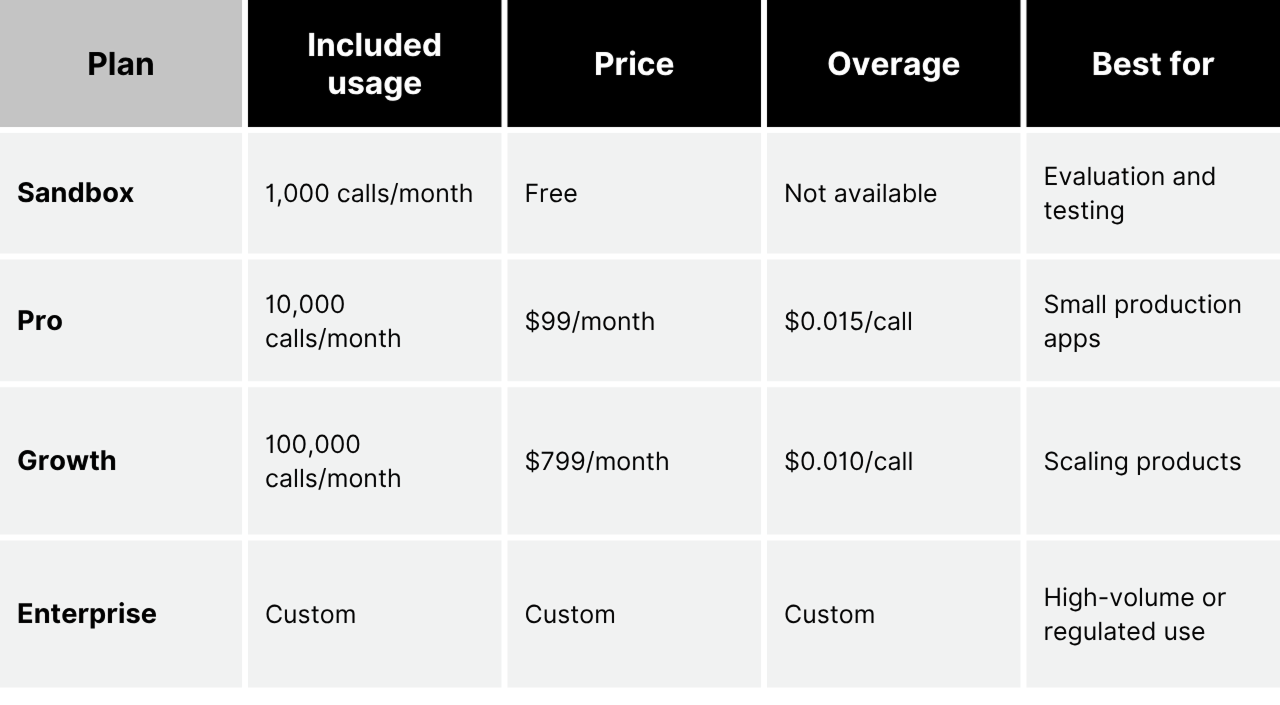
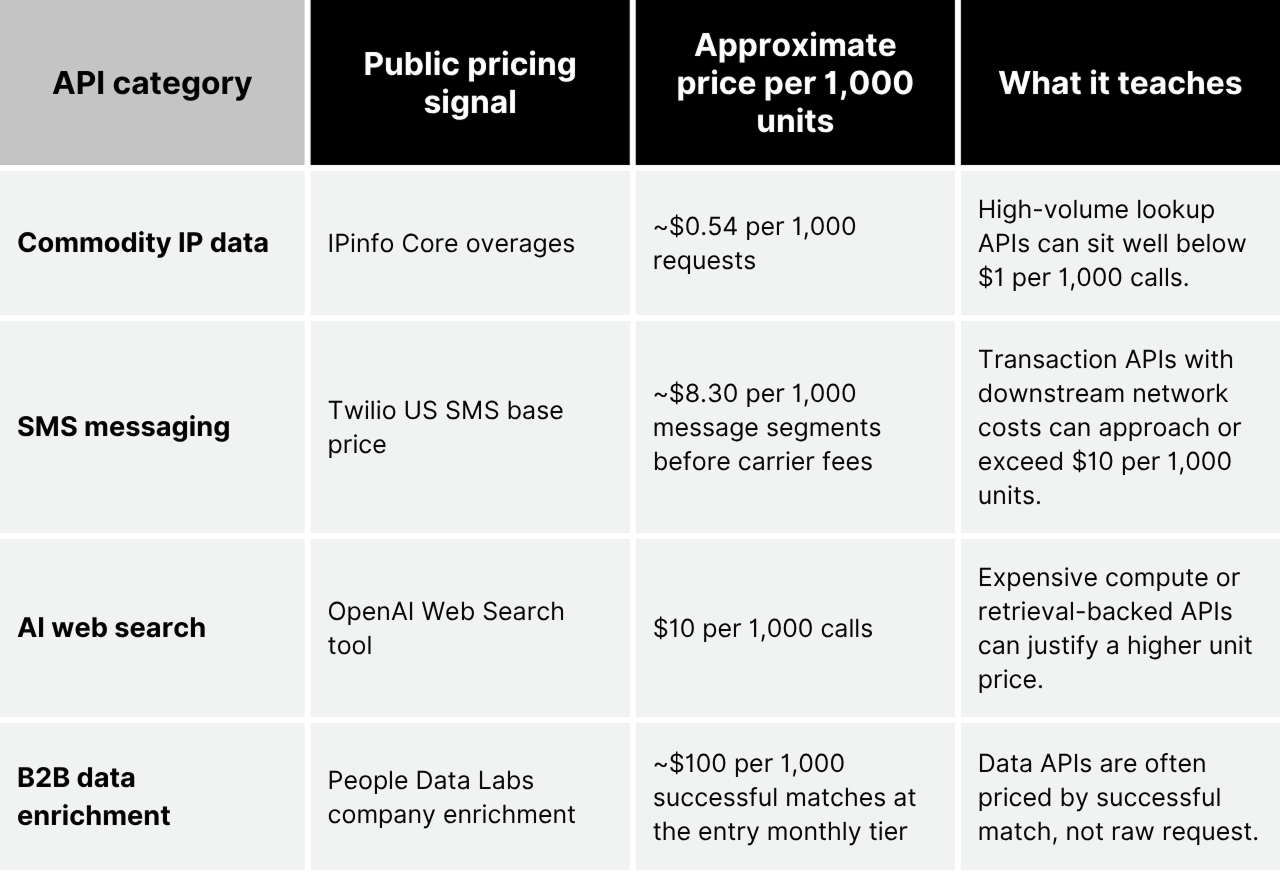
Pricing benchmark:
A more conservative worked example for a standard business API might look like this:
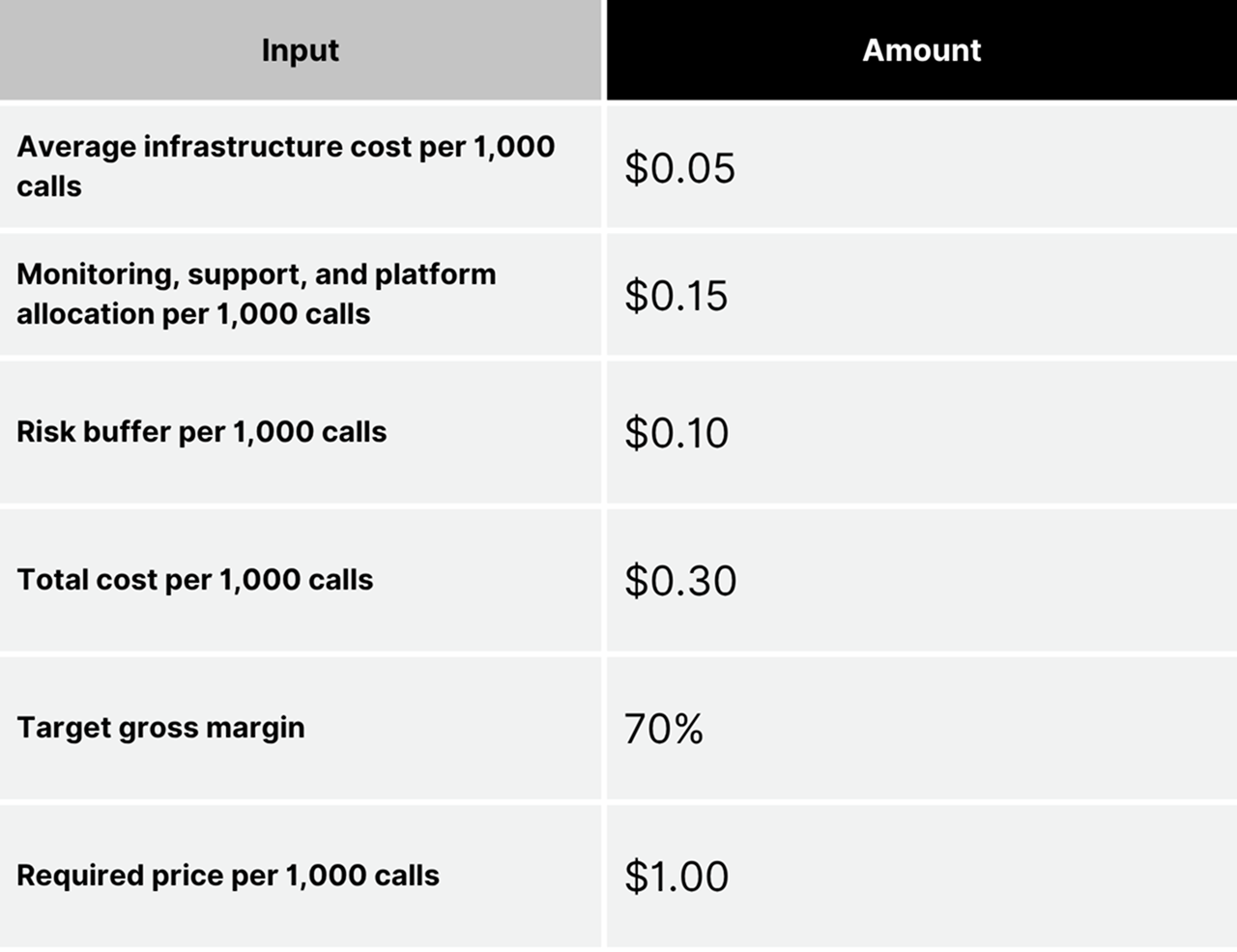
At $1 per 1,000 calls, a customer using 100,000 calls per month produces $100 in gross revenue against roughly $30 in allocated cost. For higher-value APIs, such as messaging, maps, AI retrieval, fraud scoring, or data enrichment, the unit price may move from cents to several dollars or more per 1,000 units because the API includes pass-through cost, proprietary data, expensive compute, or measurable business value.
What technical capabilities are required before charging for an API?
A monetized API needs metering, identity, access control, quota enforcement, billing integration, documentation, analytics, and support operations before launch. Pricing strategy fails quickly when the platform cannot prove who used what, when, and under which contract.
Minimum viable technical stack for API monetization:
- API identity: API key, OAuth 2.0 client, JWT claims, or application registration
- Usage metering: Request count, transaction type, response status, latency, payload size, token count, or business event
- Quota enforcement: Rate limiting, monthly limits, overage rules, burst controls, and abuse thresholds
- Billing integration: Stripe usage-based billing, Stripe Connect, Chargebee usage-based billing, Revenera, ERP, or internal billing system
- Developer portal: API catalog, docs, SDKs, credentials, plan visibility, and self-service onboarding
- Observability: Usage analytics, error rate, latency, SLA tracking, and anomaly detection
- Governance: Product ownership, change policy, terms, security review, and deprecation process
The non-negotiable requirement is auditability. If a customer disputes an invoice, your team needs a clear usage trail that connects application identity, API product, plan, timestamp, unit, and charge.
How do you implement API monetization?
You implement API monetization in three phases: strategy, technical implementation, and launch optimization. Each phase should produce a concrete artifact, not just a discussion.
Phase 1: Strategy
Strategy defines the commercial logic behind the API before the team touches implementation. In this phase, the goal is to decide what is being sold, who is buying it, what usage metric reflects value, and what limits protect both the provider and the customer.
The strategy phase should define:
- API product definition
- Target customer segments
- Unit of value
- Pricing model
- Free-tier policy
- Abuse and overage rules
- Legal terms and SLA commitments
- Success metrics
Phase 2: Technical implementation
Technical implementation turns the pricing strategy into enforceable platform behavior. This phase connects plans, identities, metering events, quotas, billing systems, and customer-visible dashboards to ensure usage is tracked and billed accurately.
The technical implementation phase should have the following things in place:
- API products and plans
- API key or OAuth enrollment, backed by secure access policies
- Metering events and consumer usage analytics
- Rate limits and quotas
- Billing-system integration
- Invoice reconciliation
- Usage dashboards
- Alerting for abnormal usage
Phase 3: Launch and optimization
Launch is where monetization becomes an operating motion, not just a pricing page. The team should publish the API, onboard a controlled cohort of customers, monitor usage and support patterns, and refine plans based on real adoption data.
The launch and optimization phase should cover:
- Sandbox onboarding
- Developer portal publishing
- Pricing-page messaging
- Sales enablement
- Customer support playbooks
- Usage review cadence
- Pricing experiments
- Churn and expansion analysis
Teams often rush from strategy to launch, skipping implementation details. That is where revenue leakage, billing disputes, and customer frustration appear.
What does a monetization-ready API checklist include?
A monetization-ready API checklist includes product, technical, legal, operational, and customer-experience requirements. The checklist should be completed before public pricing goes live.
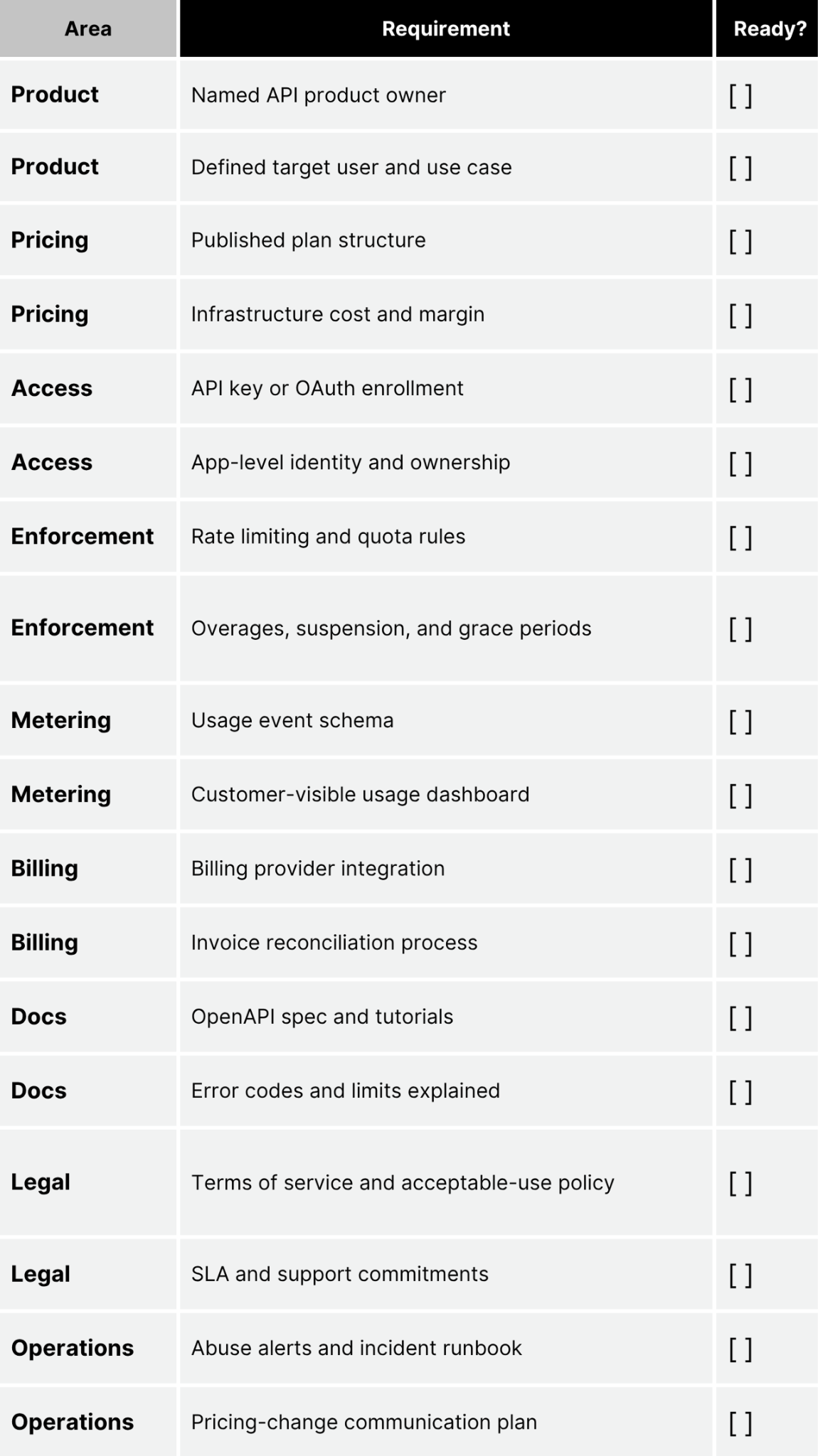
This checklist is also a useful internal gate. If the API cannot pass the checklist, keep it in beta or private preview.
How do major API management platforms support monetization?
Major API management platforms support monetization through various combinations of API products, developer portals, plans, subscriptions, quotas, analytics, billing hooks, and payment provider integrations. The biggest distinction is whether billing is built into the platform or assembled through external systems.
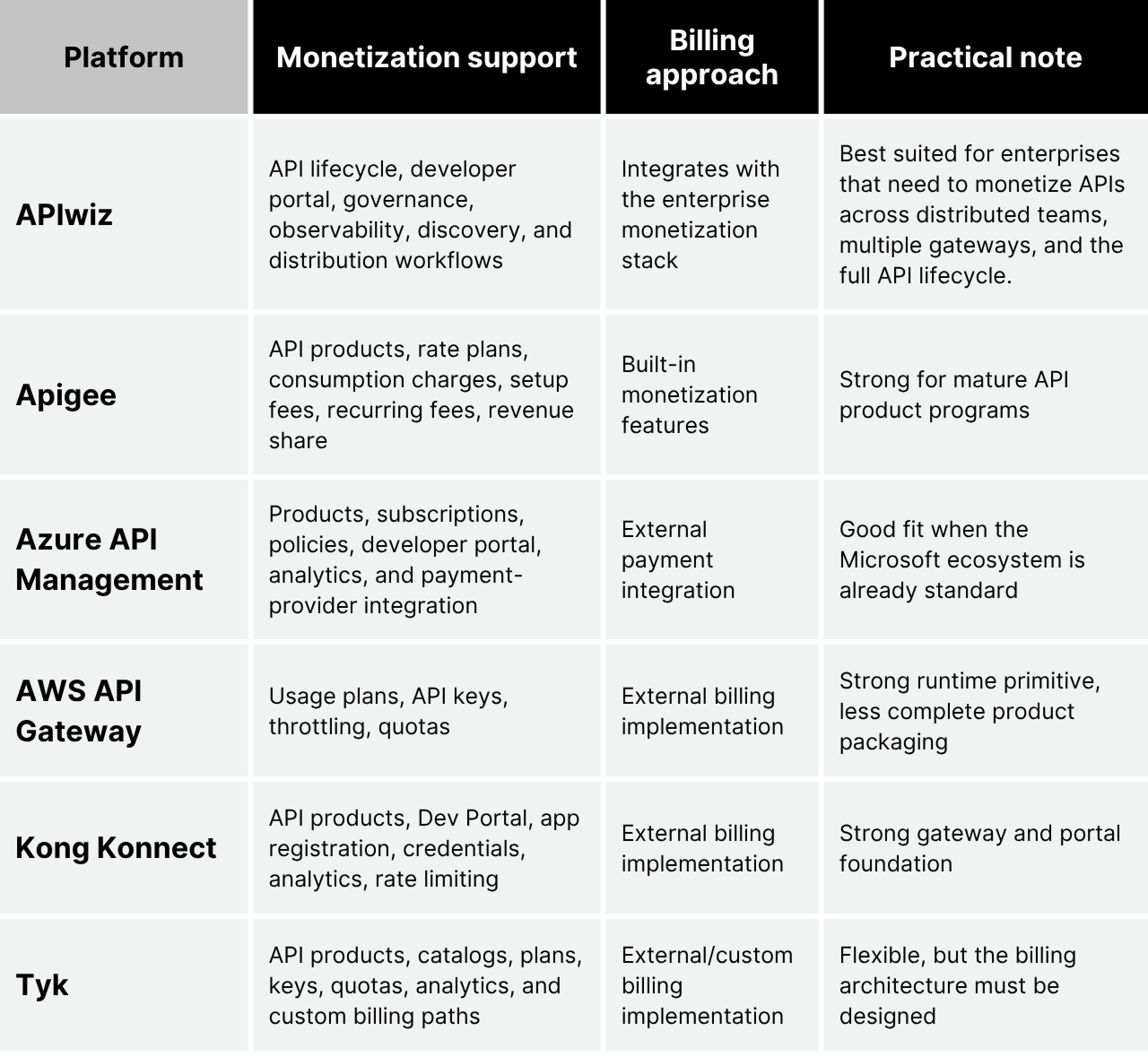
The platform question is not "which tool has a monetization checkbox?" It is "which tool can connect product packaging, runtime control, usage visibility, governance, and billing without creating manual work for every API team?"
What are common API monetization mistakes?
Common API monetization mistakes include pricing too early, metering the wrong unit, hiding limits, underestimating support cost, and changing pricing without a migration path. These mistakes usually stem from treating monetization as a financial exercise rather than an API product discipline.
Avoid these failure modes:
- Charging before product readiness: Weak docs, unstable endpoints, and unclear limits reduce conversion; design-first API documentation reduces that friction before launch.
- Metering vanity units: API calls may not reflect value if customers care about transactions, records, tasks, or outcomes.
- No free-tier controls: Free access without quotas, abuse detection, or card verification invites misuse; API security pipelines help enforce policy before abuse turns into cost.
- Invoice disputes: Incomplete logs and unclear event definitions make billing hard to defend; API logging and tracing create the usage trail customers and finance teams need.
- Hidden overages: Surprise charges damage trust and increase support load.
- No pricing-change plan: Existing users need notice, grandfathering, or migration paths.
- Manual reconciliation: Spreadsheet-based billing does not scale past early pilots.
- Ignoring indirect value: Some APIs monetize through retention, partner growth, or ecosystem lock-in rather than direct fees.
The safest pattern is to launch with conservative plans, instrument everything, review usage monthly, then raise sophistication as the product matures.
How do you monetize an AI API?
You monetize an AI API by pricing it using a variable-cost model, setting guardrails to prevent runaway usage, and choosing a unit that better reflects customer value than raw requests. AI APIs are harder to price because inference costs can vary with prompt length, model choice, retrieval usage, latency tier, caching, and output size.
Common AI API pricing units:
- Tokens
- Requests
- Tasks
- Documents processed
- Minutes of audio or video
- Agent actions
- Successful outcomes
- Enterprise capacity blocks
AI API pricing needs additional controls:
- Model-specific cost tracking
- Input and output token limits
- Per-customer spend caps
- Rate limits by model tier
- Prompt and response size monitoring
- Caching and batching strategies
- Abuse and prompt-injection detection
- Cost anomaly alerts
For thin-margin AI APIs, avoid a simple flat subscription unless usage is tightly bounded. A safer model is base platform access plus metered usage, volume discounts, and hard caps for preview customers.
How should API teams handle pricing changes?
API teams should handle pricing changes with advance notice, customer segmentation, migration windows, usage simulations, and explicit grandfathering rules. Pricing changes are product changes; they affect architecture, budgets, contracts, and customer trust.
A pricing-change process should include:
- Current usage analysis by customer cohort
- Revenue and margin simulation
- Customer impact bands
- Legal and contract review
- Notice timeline
- Migration guide
- Usage dashboard updates
- Support scripts
- Exception policy
Google Maps Platform's March 1, 2025 pricing update is a useful reminder that API pricing models evolve. Even when a change is commercially reasonable, customers need time and tooling to understand the impact.
How does APIwiz approach API monetization?
APIwiz approaches API monetization as part of the full API lifecycle and optimizes APIs across federated environments. That matters because monetization depends on more than billing; it depends on knowing which APIs exist, who owns them, who consumes them, how they perform, and whether they are ready for external adoption.
Relevant APIwiz capabilities:
- Federated API discovery across gateways and environments: Monetization starts with knowing which APIs exist, who owns them, and which consumers already depend on them. APIwiz helps teams build that inventory across distributed gateways, so high-value APIs can be selected for packaging rather than guessed from tribal knowledge.
- API marketplace and developer portal workflows: A paid API requires more than an endpoint; it needs a product page, guides, credentials, rate card visibility, and a clear path from discovery to production use. APIwiz Distribute gives teams the portal and marketplace layer needed to present monetized APIs as products.
- API product governance and lifecycle visibility: Monetized APIs need clear ownership, change control, release readiness, and deprecation rules because pricing turns API changes into customer-impacting events. APIwiz keeps lifecycle status visible so teams can tell whether an API is ready for external, partner, or paid consumption.
- Usage analytics and observability context: Usage-based pricing depends on trustworthy usage data, not rough estimates. APIwiz Observe gives teams visibility into traffic, consumers, errors, latency, and usage patterns so pricing, quota, and support decisions are based on actual behavior.
- Security and policy enforcement support: Free tiers, trials, and paid plans all need guardrails for keys, tokens, quotas, abuse, and access scope. APIwiz helps teams connect monetization with security policies so commercial access does not create uncontrolled technical risk.
- Documentation and onboarding consistency: Developers are less likely to pay for an API they cannot understand quickly. APIwiz supports consistent specs, documentation, and onboarding flows, enabling customers to evaluate, test, and adopt APIs with less hand-holding from internal teams.
- Internal-link and API inventory foundations for distribution: Monetization depends on discoverability inside and outside the organization. A maintained API inventory and approved link targets make it easier to connect related API products, docs, case studies, and blog content into a coherent distribution path.
For teams with API sprawl, monetization starts with visibility. You cannot package, price, and support APIs that remain hidden across teams, gateways, and legacy systems. In the Commercial Bank of Qatar modernization story, APIwiz helped create centralized inventory, governance, security enforcement, and observability across 15+ domain teams before scale became manageable.
What metrics should API monetization teams track?
API monetization teams should track adoption, activation, usage, revenue, margin, reliability, support, and expansion metrics. Revenue alone is too slow and too blunt to diagnose whether the API product is healthy.
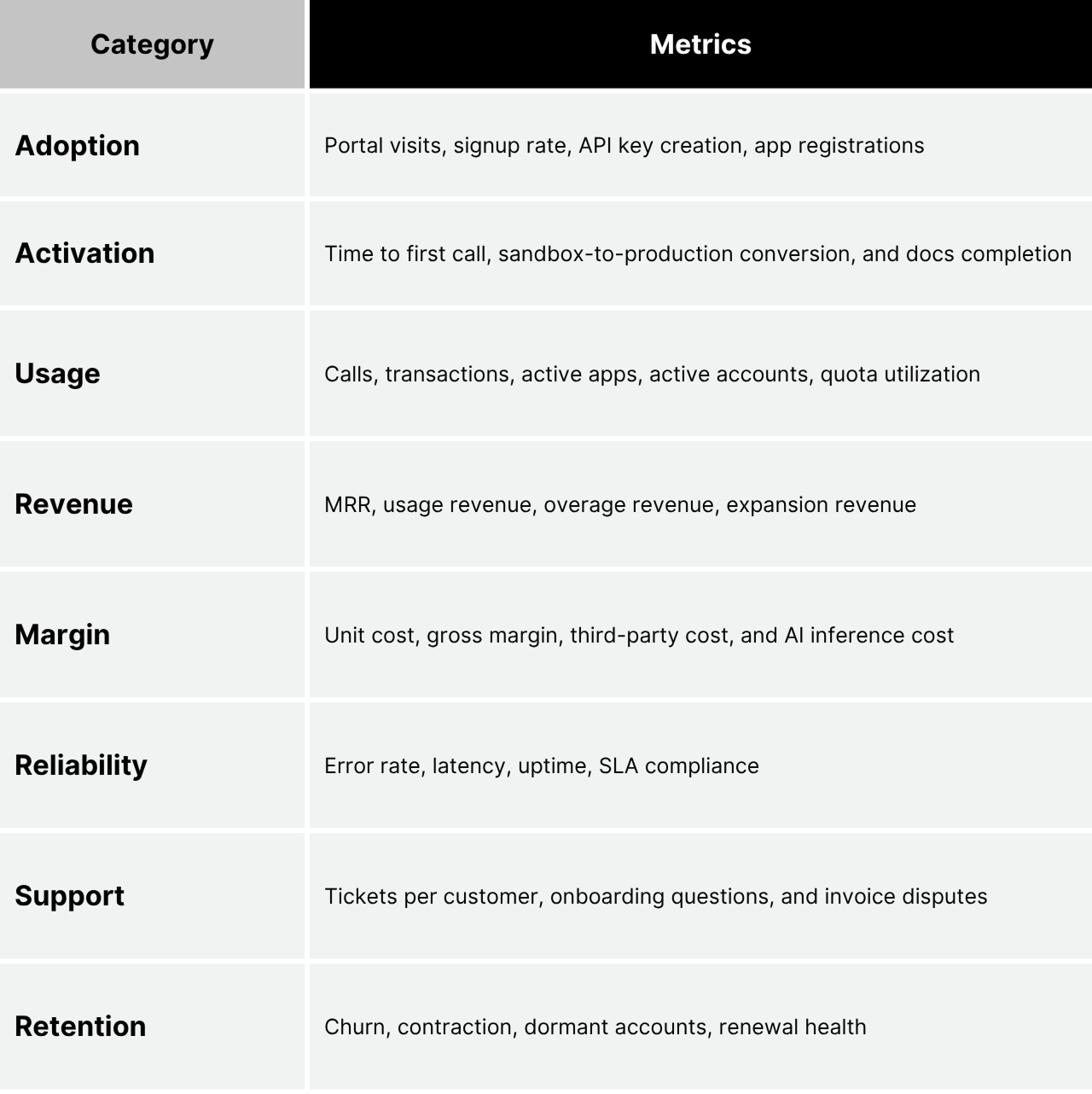
The best monetization dashboards connect product usage and financial outcomes. If usage grows but the margin shrinks, the pricing model needs attention.
What are the first steps to launch API monetization?
The first steps are to pick one high-value API product, define the value metric, create a simple plan structure, instrument usage, and test pricing with a small customer segment. A narrow launch is easier to measure and safer to fix.
A practical first 30 days:
- Select one API with clear customer demand.
- Assign a product owner and technical owner.
- Define the API product, audience, and value metric.
- Build the cost model, calculate the operating infrastructure costs, and compute costs using real usage data.
- Create drafts for the sandbox, production, and enterprise plans.
- Instrument metering and usage exports.
- Connect billing or create a manual pilot process.
- Publish documentation and limits in the developer portal.
- Invite a controlled customer cohort.
- Review usage, margin, support, and conversion weekly.
Do not start with every API. Start where value, ownership, and operational readiness already exist. The Tonik Bank case study is a useful example: fragmented gateways, testing tools, and documentation silos limited the bank's ability to prepare APIs for partner monetization until governance, visibility, and lifecycle automation were consolidated.
Key takeaways
API monetization works when pricing, product packaging, metering, billing, enforcement, and developer experience reinforce each other. The strongest programs start with a clear value metric, validate the cost floor, keep plan structures understandable, and build operational controls before launch. If your API program is still fragmented across teams and gateways, begin with discovery and governance before public pricing.
Ready to evaluate which APIs are monetization-ready? Check out APIwiz to discover, govern, and distribute APIs across your enterprise API ecosystem. Talk to us to know more.
FAQs about API monetization
How do you monetize an API?
You monetize an API by packaging access into a product, choosing a pricing model, measuring usage, enforcing limits, and billing customers for the value they consume. The most common models are subscription, pay-per-use, tiered pricing, freemium, revenue share, and hybrid plans. A monetized API also needs documentation, support, legal terms, and customer-visible usage data.
Can you make money with an API?
Yes, you can make money with an API when the API provides valuable data, workflow automation, transactions, infrastructure access, or partner capabilities that customers are willing to pay for. Revenue can be direct, such as usage fees, or indirect, such as partner growth and customer retention. The API must be reliable, secure, discoverable, and measurable before monetization will scale.
What is the best API monetization model?
The best API monetization model is the one that matches the customer's value metric and the provider's cost structure. Pay-per-use works well for transactional APIs, subscriptions work well for predictable access, and hybrid pricing works well when customers need a base plan plus scalable usage. AI APIs often use metered pricing because costs vary with token volume, model tier, and output size.
How do you price an API?
You price an API by calculating the infrastructure and compute cost, estimating customer value, comparing alternatives, and testing plan structures with real users. Cost-plus pricing protects margin, while value-based pricing captures more upside when the API creates measurable business value. Most teams should publish simple tiers first, then tune limits and overages as usage data grows.
How much does it cost to monetize an API?
The cost to monetize an API depends on the maturity of your API platform, billing stack, developer portal, and support model. Teams with existing API management, metering, and billing integrations may only need packaging and launch work. Teams without reliable identity, quotas, analytics, documentation, and invoice reconciliation must invest in platform foundations first.
What are the risks of API monetization?
The main risks are inaccurate metering, pricing confusion, free-tier abuse, invoice disputes, unexpected infrastructure costs, customer churn after pricing changes, and legal exposure from unclear terms. These risks are manageable with audit-grade usage data, transparent limits, clear pricing communication, and strong operational controls. The most damaging risk is charging for an API before it is ready for production customers.
What tools are needed for API monetization?
API monetization needs an API gateway or management layer, a developer portal, an identity system, usage metering, rate limiting, analytics, a billing system, and a support workflow. Common billing tools include Stripe, Chargebee, Revenera, and enterprise ERP systems. The exact stack depends on whether the API is public, partner-only, internal chargeback, or enterprise-contracted.
How do you monetize an AI API?
You monetize an AI API by tracking variable cost drivers such as tokens, model tier, retrieval, latency, and output size, then pricing against a unit that customers understand. Common models include per-token, per-request, per-task, capacity-based, and hybrid plans. AI APIs also need spend caps, token limits, model-specific margins, and anomaly alerts to prevent runaway cost.
Effortless API Management at scale.
Support existing investments & retain context across runtimes.
.webp)
Effortless API Management at scale.
Support existing investments & retain context across runtimes.